Convergent vs divergent thinking: When to use each at work

85 % das empresas da Fortune 100 escolhem a Asana¹






Summary
Have you ever taken a personality test like the Myers-Briggs Type Indicator? If so, you've likely answered a bunch of questions for an algorithm to tell you how you interact with the world around you. One thing this test will tell you is whether you make decisions more objectively (thinkers) or more subjectively (feelers).
Convergent and divergent thinking resemble that aspect of the Myers-Briggs test. While you may naturally be more analytical or creative, you can learn to think in both ways. In this piece, we'll explain the differences between convergent and divergent thinking and discuss how using both types improves your decision-making skills.
Learn how enterprises can improve processes and productivity, no matter how complex your organization is. With fewer redundancies, leaders and their teams can hit goals faster.
What is the difference between convergent and divergent thinking?
Convergent thinking focuses on finding one well-defined solution to a problem, while divergent thinking generates multiple possible solutions through creative exploration. Here's how they differ:
Convergent thinking: Narrows options down to a single, logical answer. Best for tasks with clear right answers, like multiple-choice tests or problems with defined solutions.
Divergent thinking: Expands possibilities by exploring many potential ideas. Best for brainstorming, innovation, and open-ended challenges.
Psychologist J. P. Guilford coined these terms in 1956 to describe two distinct cognitive approaches to problem-solving.
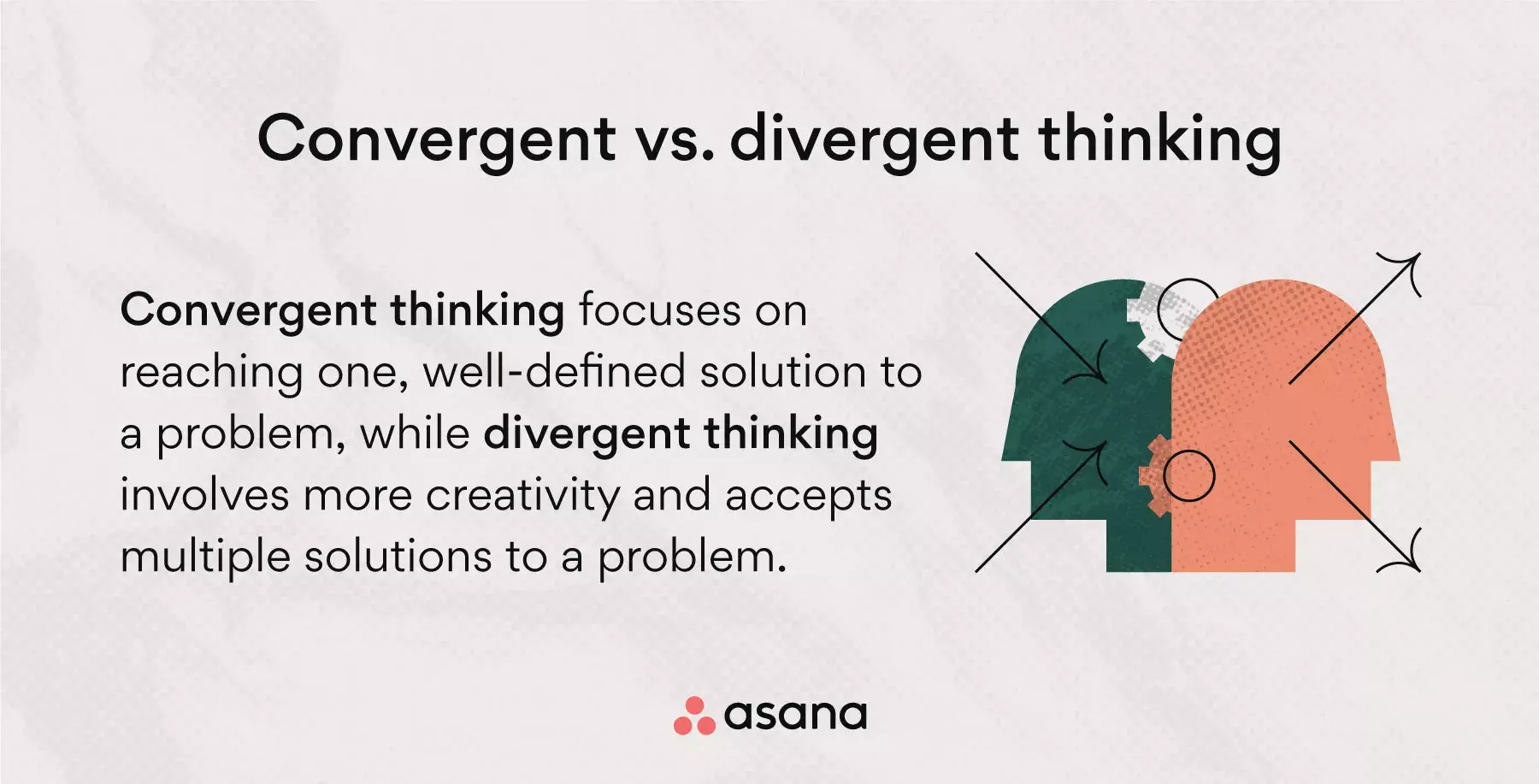
In practice, here's what these different types of thinking might look like:
Convergent thinking: If the copy machine breaks at work, a convergent thinker would call a technician right away to fix the copy machine.
Divergent thinking: If the copy machine breaks at work, a divergent thinker would try to determine the cause of the malfunction and assess various ways to fix it. One option may be to call a technician, while other options may include looking up a DIY video on YouTube or sending a company-wide email to see if any team members have experience with fixing copy machines. They would then determine which solution is most suitable.
Convergent vs. divergent thinking: pros and cons
Convergent thinking | Divergent thinking | |
Pros | - Reaches decisions quickly - Provides clarity and direction - Keeps teams focused on outcomes - Reduces complexity | - Encourages creativity and innovation - Allows teams to adapt and pivot - Explores multiple angles - Invites diverse perspectives |
Cons | - May overlook creative solutions - Can miss better alternatives - Risk of groupthink - Less adaptable to change | - Takes more time - Can lead to analysis paralysis - May lose focus without boundaries - Harder to transition to action |
Convergent thinking in project management
You may use convergent thinking in project management without being aware of it. Because convergent thinking embraces structure and clear solutions, it's natural for project managers to lean toward this approach. The benefits of convergent thinking include:
A quicker way to arrive at a solution
Leaves no room for ambiguity
Encourages organization and linear processes
There's nothing wrong with using convergent thinking to align teams, create workflows, and plan projects. There are many instances in project management when you must reach solutions quickly. However, if you completely avoid divergent thinking, you'll have trouble developing innovative solutions to problems.
Leia: Use estas estratégias de solução de problemas para transformar a sua equipe em uma habilidosa fonte de soluçõesThe benefits of divergent thinking
It can be difficult for busy project managers to slow down and think divergently. When deadlines loom, the pressure to decide quickly can feel like the only option.
However, working too quickly can cause you to make decisions within your comfort zone instead of taking risks. Divergent thinking helps you adopt a learning mindset and can also help you:
Identify new opportunities
Find creative ways to solve problems
Assess ideas from multiple perspectives
Understand and learn from others
Fast results and predictability may work some of the time, but this way of thinking won't help you stand out from competitors. You'll need divergent thinking to impress clients or customers and set yourself apart from others.
Learn how enterprises can improve processes and productivity, no matter how complex your organization is. With fewer redundancies, leaders and their teams can hit goals faster.
When to use convergent vs divergent thinking
The most effective teams don't choose one thinking mode over the other; they know when to apply each. Match your approach to the stage of your project or problem.
Use divergent thinking when
Divergent thinking works best during early project phases and when facing complex challenges. Consider using divergent thinking when:
You're starting a new project and need to explore possibilities
Your team is stuck and needs fresh perspectives
You're looking for breakthrough solutions rather than incremental improvements
Cross-functional collaboration could spark new ideas
The problem is ambiguous or undefined
Use convergent thinking when
Convergent thinking is most effective when you need to move from ideas to action. Apply convergent thinking when:
You have a clear set of options to evaluate
Deadlines require swift decision-making
Resources are limited, and you need to prioritize
You're in the implementation phase of a project
The problem has a defined scope with measurable criteria
How to be a more divergent thinker
Becoming a more divergent thinker will help you exercise both sides of your brain and ensure you see problems from every angle. The following strategies can stimulate divergent thinking:
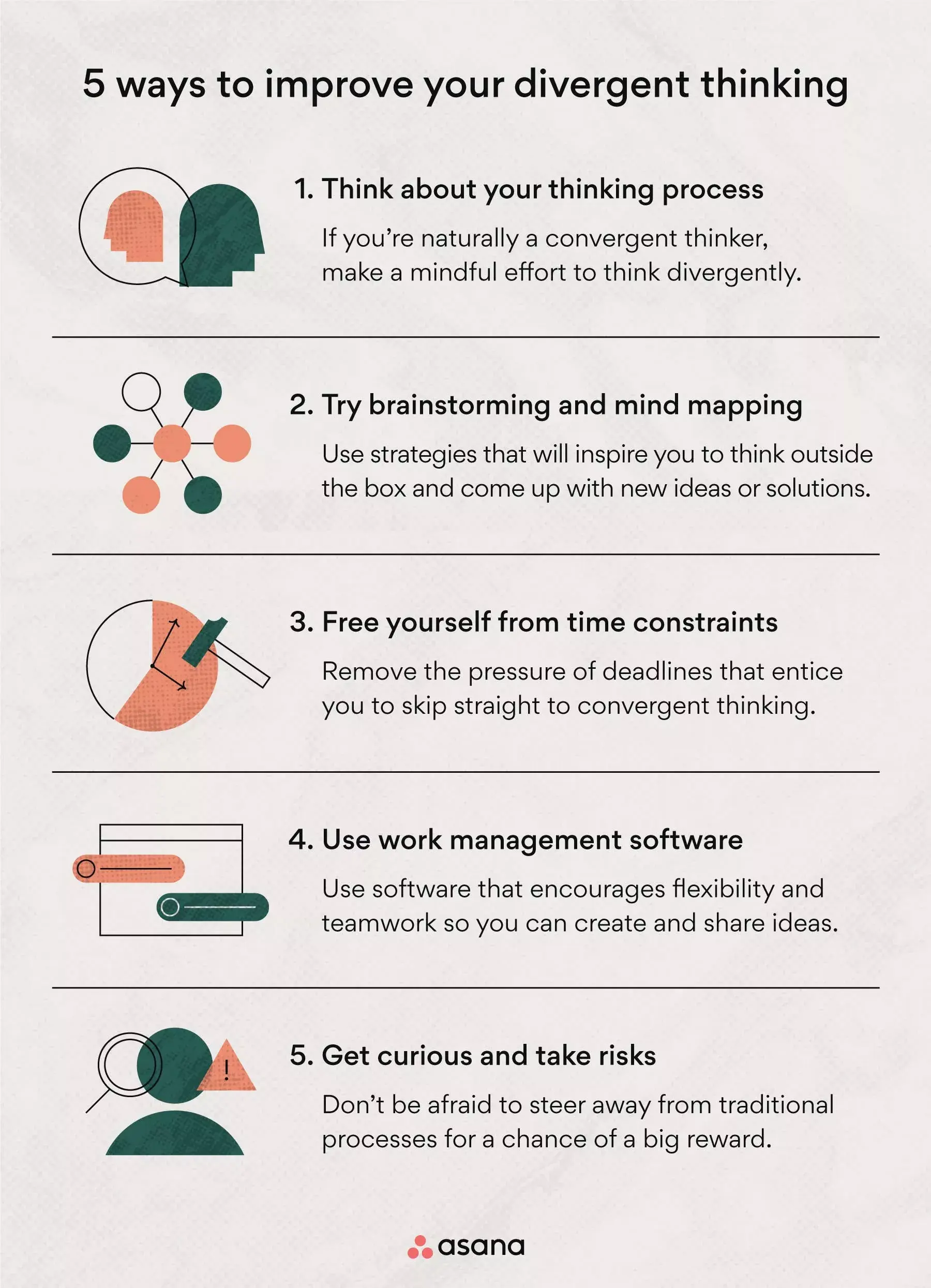
1. Think about your thinking process
Sometimes the best strategy is the simplest one. When you're mindful of thinking divergently, it becomes easier. Try putting up notes in your office or adding steps to your processes that encourage divergent thinking.
Steps that encourage divergent thinking may include:
Require at least a one-hour break before sending emails regarding big decisions
Before making a big decision, put yourself in the shoes of other team members and consider their perspectives
Don't make big decisions without vetting your decision with at least two people
By taking active steps to think about your thinking, you may realize that divergent thinking comes more naturally.
2. Try brainstorming and mind mapping
Brainstorming and mind mapping inspire divergent thinking by helping you generate new ideas without constraints.
Mind mapping: Diagram tasks, words, or concepts that link to a central idea. This visual approach helps you explore thoughts without worrying about structure.
Other divergent thinking techniques include:
Starbursting: Starbursting is a visual brainstorming technique where you put an idea in the middle of a whiteboard and draw a six-point star around it. Each point will represent the questions: who, what, when, where, why, and how?
SWOT analysis: SWOT analysis can be used for strategic planning and brainstorming. You can use it to vet the strengths, weaknesses, opportunities, and threats of an idea.
Lightning decision jam: Known as LDJ, this brainstorming technique begins by writing down positives about a topic or what's working, then writing down negatives and identifying what needs to be addressed most urgently.
Try group brainstorming sessions to get fresh ideas and solutions. If you perform these sessions regularly, you may find them enjoyable and crucial for creative problem-solving.
Leia: Diagrama de afinidade: como organizar as informações3. Free yourself from time constraints
Everyone has deadlines they must meet. But if you're making an important decision or trying to solve a crucial problem, try to remove those strict time constraints so you don't feel pressured to skip straight to a convergent thinking approach.
Some techniques you can use to relieve pressure caused by deadlines include:
Request a meeting agenda in advance so you have time to prepare.
Use timeboxing to generate multiple ideas in 5-10-minute intervals.
Set personal deadlines before official deadlines to give yourself some wiggle room.
It's understandable to feel rushed to find the correct answer in a high-pressure work environment. But you won't know your answer is correct without taking the time to consider all possible solutions.
4. Use work management software
Work management software like Asana supports both thinking modes. It provides the flexibility for divergent brainstorming and the structure for convergent execution.
If you're having trouble with divergent thinking in particular, there are certain features of the software you may find most useful. Work management software can stimulate divergent thinking by allowing you to:
Collaborate with others on projects
Share ideas and feedback quickly
Make changes at the click of a button
Keeping your projects online is also important because your team can work together regardless of whether they work remotely or in the office.
5. Get curious and take risks
Sometimes team members settle into convergent thinking habits because they're afraid of taking risks. While it's important to prevent project risks when possible, you shouldn't be afraid to steer away from traditional processes and think outside of the box.
The best project managers can switch between convergent and divergent thinking depending on whether a situation requires a quick and structured solution or an open mind. Not every situation requires subjectivity, but you'll often need to use a mix of convergent and divergent thinking to be a successful leader.
Use convergent and divergent thinking for creative problem-solving
You can use a mix of convergent and divergent thinking to solve problems in your processes or projects, an approach formalized in the design thinking process. Without using both types of thinking, you'll have a harder time getting from point A to point B.
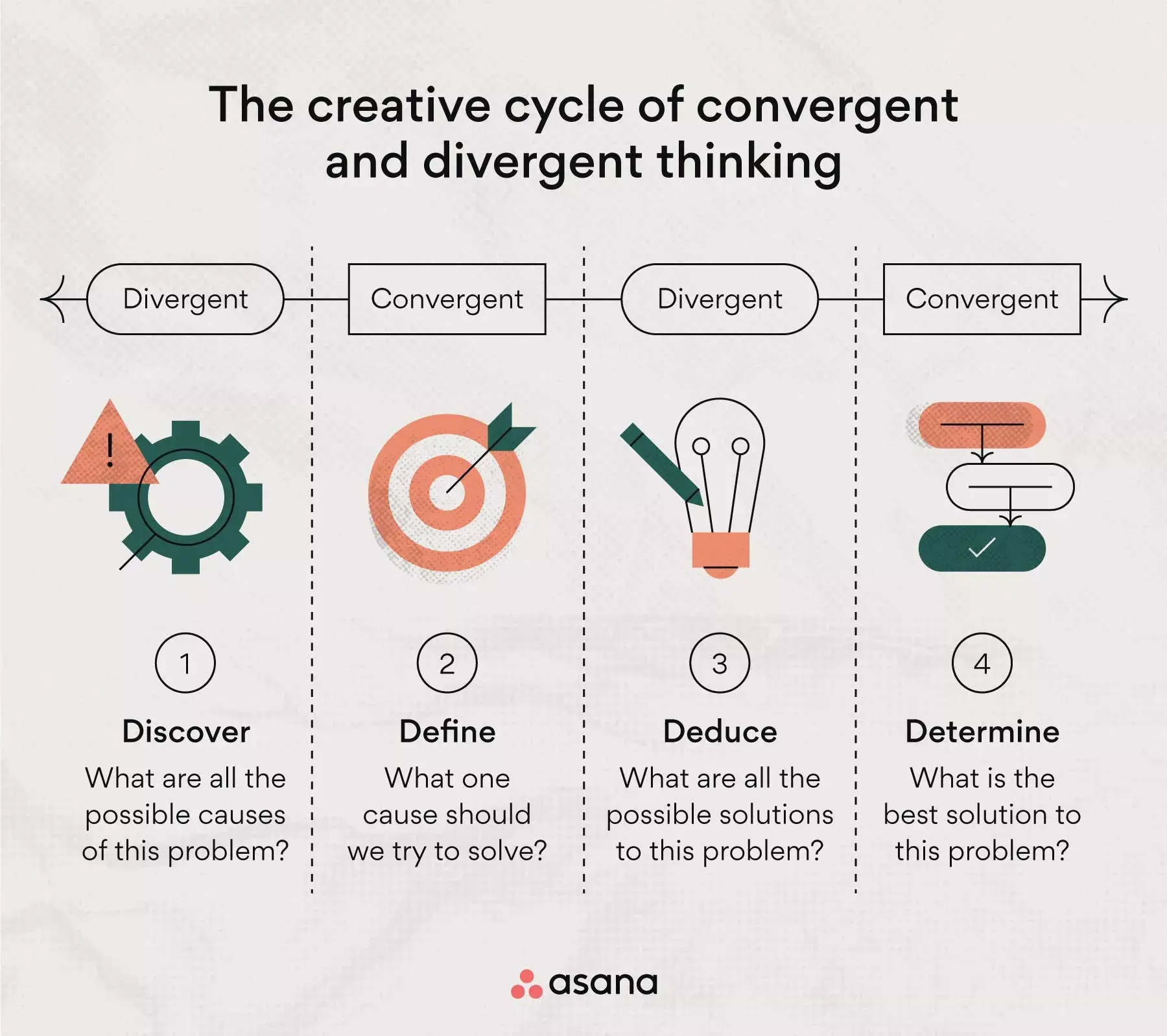
1. Discover: Divergent thinking
The first stage of creative problem-solving is discovery, and in this stage, you'll need to use divergent thinking. When you have a problem at work, the first step is to discover the cause of the problem by considering all of the possibilities.
For example, if multiple projects run over budget, convergent thinking might jump straight to one conclusion. Divergent thinking, however, considers all possible causes before narrowing down.
Possible causes of budget overruns may include:
Lack of communication between team members
Improper allocation of resources
Poor project planning
Projects are taking longer than expected
Now that you have all the possible causes of your problem, you can move on to the next stage of creative problem solving, which is to define your cause.
2. Define: Convergent thinking
Use convergent thinking when narrowing down the potential causes of your problem. While it's possible that more than one cause led to your budget overruns, convergent thinking requires a focused approach, so you'll need to choose the cause you think is most problematic.
Lack of communication may have contributed to your budget overruns, but if poor project planning played a bigger role, then it's the cause you should go with. When you create a solution for your project planning procedure, it can lead to better budgeting. Most causes are also inter-linked, so better planning will improve workplace communication even if it wasn't the primary goal.
3. Deduce: Divergent thinking
In stage three, you'll switch back to divergent thinking as you work to find a solution to your problem. If the cause of your budget overruns is poor project planning, then possible solutions may include:
Use a project plan template
Better communication with stakeholders
More thorough research of project requirements
Implement cost control methods
You must consider all possible solutions to your problem before you can land on the best solution.
4. Determine: Convergent thinking
In the final stage, use convergent thinking to select the solution that will most effectively solve your problem. Start with one action item. If you tackle more than one, make sure they're related.
For example, after discussing possible solutions with your team, you decide that adding cost-control methods to your cost management plan should prevent budget overruns and may even help you save money.
Balance both thinking modes for better results
We all have a natural cognitive approach to creative problem solving, and there's nothing wrong with sticking to your guns. But if you want to inspire idea generation and solve problems in the best way possible, then you must use both convergent and divergent thinking.
The most effective teams know how to move fluidly between divergent exploration and convergent decision-making. By building both capabilities, you create a problem-solving approach that's both creative and actionable. Ready to put both thinking styles into practice? Get started with Asana to organize your brainstorming sessions, track decisions, and keep your team aligned throughout the creative problem-solving process.
Learn how enterprises can improve processes and productivity, no matter how complex your organization is. With fewer redundancies, leaders and their teams can hit goals faster.
Relatório especial Anatomia do trabalho: a relação inexplorada entre a síndrome do impostor e o burnout
O burnout e a síndrome do impostor têm sido historicamente estudados como dois fenômenos distintos. Neste relatório, conectamos os pontos para ajudar os líderes a reduzir o burnout e aumentar a retenção de funcionários.


Frequently asked questions about convergent and divergent thinking
Yes. While you may naturally lean toward one style, both are skills you can develop with practice, and the best problem solvers learn to switch between modes as needed.
Neither mode is universally better; effective problem-solving requires both. Use divergent thinking to explore possibilities, then convergent thinking to choose the best path forward.
Create dedicated time for brainstorming without judgment (divergent) and establish clear decision-making processes (convergent). Building diverse teams also ensures both perspectives are represented.
Transition when you've generated enough ideas, when resources require narrowing focus, or when moving from discovery to implementation. Clear milestones and deadlines signal when it's time to shift.