What are OKRs? Examples of how Gojek, Asana, and other teams connect objectives to results


85% of Fortune 100 companies choose Asana¹






Summary
Agreeing on a goal does not mean everyone knows what success looks like or how to measure it. Asana research found that only 16% of employees said their company set and communicated goals effectively. OKRs make those expectations more specific. They pair an objective with measurable results, so your team can track progress and adjust if results fall short. You can use OKRs to set business objectives or plan your team’s next quarter.
How to align goals and OKRs across teams
Learn how to transform your team’s goals into measurable outcomes with powerful OKRs. When teams can understand how their work ladders up to the organization’s overall goals, better results follow.
OKR meaning and definition
OKR stands for objectives and key results. It is a goal-setting framework that pairs a desired outcome with measurable results. The objective describes what you want to achieve; the key results tell you whether you are getting there. Teams use OKRs to prioritize work and assess progress against specific objectives.
What is an objective?
In the OKR framework, objectives describe qualitative goals that define what a team wants to achieve. Teams usually set objectives for a fixed period, such as a quarter or a year, to push performance beyond current results.
Objectives show what different teams might want to achieve:
Marketing: Get more people to attend our webinars.
Sales: Help more qualified prospects become customers.
IT: Resolve employee technology problems faster.
People team: Help new hires understand their priorities sooner.
Operations: Deliver incoming requests more reliably.
Objectives should reflect your company’s strategy, mission, and long-term goals. Some are commitments your team expects to meet; others are ambitious stretch goals.
What are key results?
A key result is a specific, measurable, time-bound, and verifiable outcome that shows progress toward an objective. The objective explains what you want to achieve, while key results define how you track success. Give each key result a starting value, a target, and a deadline so your team can compare the result with its original plan.
Team | Objective | Example key result |
Marketing | Increase webinar attendance. | Increase live attendance from 40% to 60% of sign-ups across the three-webinar series by December 31. |
Sales | Help more qualified prospects become customers. | Increase the share of qualified leads that become customers from 20% to 27% by December 31. |
IT | Resolve employee technology problems faster. | Reduce the median time to resolve employee help tickets from three business days to one by December 31. |
People team | Help new hires understand their priorities sooner. | Increase the share of new hires who say they understand their priorities after 30 days from 65% to 85% by December 31. |
Operations | Deliver incoming requests more reliably. | Increase the share of requests completed by their agreed due date from 70% to 90% by December 31. |
How do OKRs work?
OKRs help teams agree on a priority, decide how to measure progress, and choose work that can influence the result. The OKR framework follows a simple formula:
I will [objective] as measured by [key result].
Here’s how three teams could use that OKR formula and determine tasks that might help them reach each result.
Team | Objective | Key result | Work needed to reach the goal |
Customer support | Help customers get answers without being transferred. | Increase the share of cases resolved on first contact from 58% to 75% by December 31. | Improve the request form and give agents access to relevant customer history. |
Product | Help new users complete their first project. | Increase the share of new users who complete a project within 14 days from 42% to 60% by December 31. | Test shorter setup instructions and a guided first-project flow. |
Finance | Make monthly reports available sooner. | Reduce the median time between month-end and delivery of the report from eight business days to four by December 31. | Standardize data requests and set earlier review deadlines. |
The objective names the change each team wants to make, and the key result sets a measurable target for that change. Together, they form the OKR. The final column shows the work each team plans to do to help meet its target.
Weak OKRs and how to improve them
You can spot a bad OKR when the objective is vague, the key results lack measurable targets, or the key results describe tasks rather than outcomes. Here are three weaker versions of the examples above:
Weak OKR | What’s missing | Stronger version |
Objective: Make support better. Key result: Improve customer experience. | The objective is broad, and the key result has no measure or target. | Objective: Help customers get answers without being transferred. Key result: Increase first-contact resolution from 58% to 75% by December 31. |
Objective: Help new users complete their first project. Key result: Launch a guided setup flow. | Launching the flow is work the product team can do. It does not measure whether more users complete a project. | Key result: Increase the share of new users who complete a project within 14 days from 42% to 60% by December 31. Keep the setup flow in the work plan. |
Objective: Make monthly reports available sooner. Key result: Deliver reports faster. | The direction is useful, but the team has no starting value, target, or deadline. | Key result: Reduce the median time from month-end to report delivery from eight business days to four by December 31. |
How Asana helps teams make OKRs more consistent
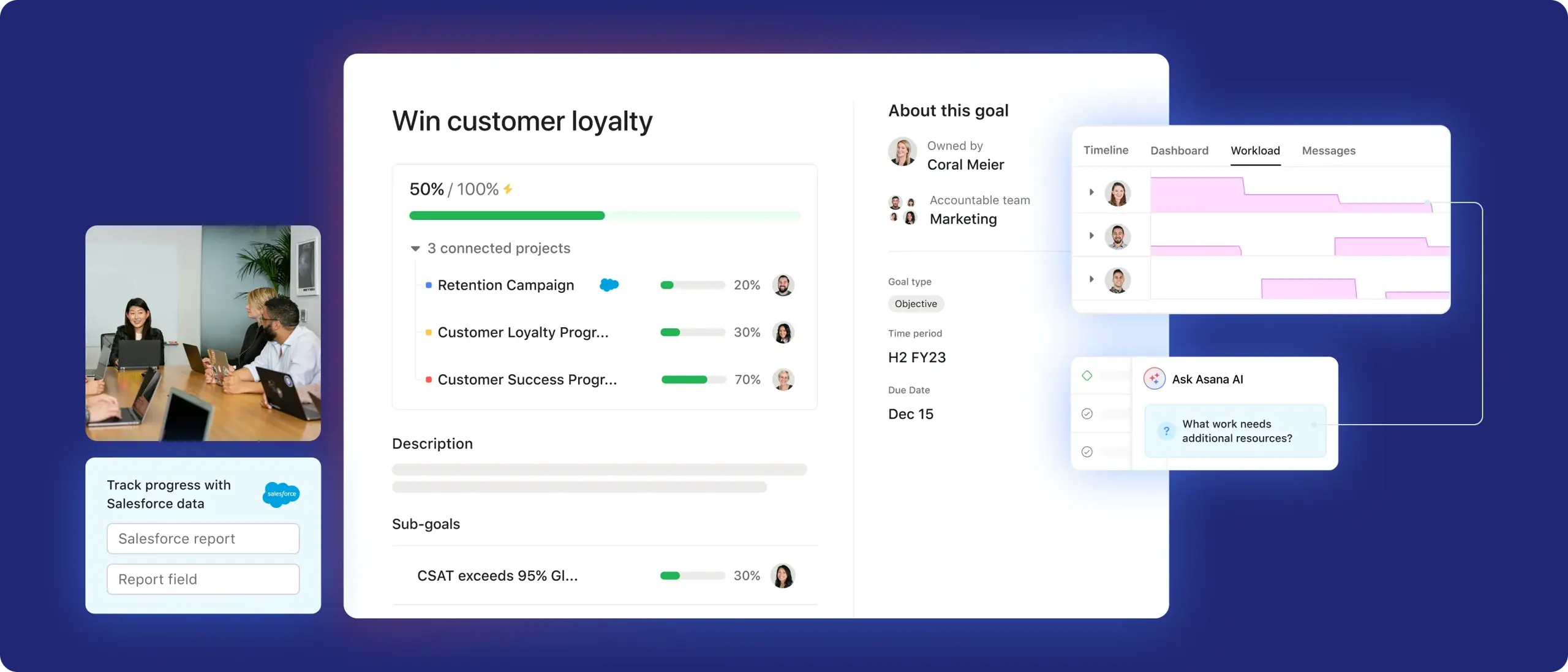
Asana uses OKRs to connect company priorities with team goals and key results. Employees can see company, team, and individual goals in Asana, along with the projects and tasks assigned to them. Goal owners share progress updates so teams can follow the work after the initial planning session.
However, teams can agree on an objective and still describe success differently. One team might list deliverables, while another sets a target without explaining how they'll measure it.
Asana describes using templates to show teams what information to include in their objectives and key results. By setting the format and required details in advance, Asana gives teams a consistent starting point without having one person design every goal.
Consistency matters after you write a goal, too. Asana’s Work Innovation Lab found that executives were 2.5 times as likely as non-executives to update goal status in Asana. Give each key result an owner and agree on when to review its current value, so everyone knows how to report progress.
“Your goal management needs to help you make good decisions, fast. You need to have built-in flexibility to pivot quickly when circumstances change, or when you run into roadblocks,” says Lotte Vester, Asana’s former Head of Organizational Strategy.
You can apply the same approach with your OKRs: agree on the information every goal needs before teams start writing them. The simple template later in this article offers a starting point you can adapt.
Watch how Asana uses work management to set and design goals.
Read: Asana tips: 3 ways to set achievable goalsHow to create and track OKRs in Asana
Let’s follow a marketing team planning three webinars in Q4 2026. The team wants more people to sign up and attend, while making sure the sessions are useful. The team will review the first webinar, adjust the next two, and assess the full series by December 31. All names and figures in this example are illustrative.
1. Set up the objective and key results

Maya Chen owns the objective “Get more people to attend our webinars.” The team uses its previous three comparable webinars as the baseline and agrees on these targets for the new series:
Key result and owner | Baseline | Target by December 31 |
Average sign-ups per webinar: Maya Chen | 200 | 300 |
Live attendance as a share of sign-ups: Jon Bell | 40% | 60% |
Average usefulness rating: Priya Shah | 3.5 out of 5 | 4.5 out of 5 |
The owners agree on how to measure each result before launching the series:
Maya uses the registration report to calculate average sign-ups across the three webinars, counting each person once per webinar.
Jon divides total live attendances by total sign-ups across the series. He counts each person once per webinar and excludes recording views.
Priya asks attendees “How useful was this webinar?” on the same 1–5 scale after every session. Each survey closes seven days after its webinar, with the final session held by December 24. She records the response count and rate alongside the average rating.
In Asana Goals, create the objective as a parent goal and add the three key results as subgoals, each with its owner and December 31 deadline. Add Marketing webinar series under Related work so the team can find the promotional tasks and session plans.
Each owner updates their key result in Asana using the latest registration, attendance, or survey report.
2. Review progress and decide what to change

After the first webinar, 300 people have signed up, and 135 have attended live. That is a 45% attendance rate, below the 60% target.
Jon enters 45% from the attendance report and marks the key result as At risk in Asana. In his OKR status update, he records the sign-up and attendance counts, explains the shortfall, and links the next action to the webinar project.
The team reviews the reminder schedule and session timeline. Jon takes responsibility for testing a reminder before webinar 2, with the task due before that session. The team keeps the original target and checks attendance again after each remaining webinar.
3. Review final results and plan the next cycle
At quarter-end, Maya reviews the full series with Jon and Priya. They use the same counting rules and seven-day survey windows they agreed on at the start.
Measure | Baseline | Target | Final result |
Average sign-ups per webinar | 200 | 300 | 320: met |
Live attendance | 40% | 60% | 55%: missed |
Average usefulness rating | 3.5 out of 5 | 4.5 out of 5 | 4.6 out of 5: met |
The series attracted 960 sign-ups and 528 live attendees. Priya received 330 survey responses, a 62.5% response rate among live attendees. The 4.6 rating reflects feedback from respondents, not everyone who registered.
Sign-ups and usefulness met their targets, but attendance fell short by 5 percentage points. Jon records the final attendance value and the missed target; Maya closes the overall objective as Partial and summarizes the results in Asana.
For the next series, Jon will ask registrants who missed the live sessions what prevented them from joining. The attendance rate improved, but the team cannot yet tell whether the reminder made the difference. They’ll use the feedback to choose their next test.
That’s how teams use Asana for OKRs: record the key result, document what they learned, and connect the next action to the objective.
A simple OKR template
Copy this table into a document or spreadsheet and adapt it for your team. These fields are a starting point for recording the goal, the work behind it, and what happens at each review.
Field | Fill in |
Objective | What do you want to change, and why does it matter? |
Owner and deadline | Who owns the objective, and when will you assess it? |
Key result (repeat as needed) | Change [measure] from [baseline] to [target] by [date]. |
Supporting work | Which projects or tasks will help achieve the result? |
Progress check-in | Record the current value, any blockers, and the next action. |
Final result | Compare the outcome with the target and note what you learned. |
Ready to put this into practice? Start with Asana’s OKR project template. Use the template to draft your team’s OKRs, or use Asana Goals to connect goals across teams as shown above.
Create an OKR templateHow Gojek, Joyn, and Interactive use Asana for OKRs
Customer teams use Asana to connect goals with their work in different ways. Gojek shows an established OKR workflow, Joyn shows how it adapted its goal-setting process with Asana, and Interactive shows how faster reporting supports its plans to introduce OKRs.
Gojek: Public OKRs, projects, and milestones
At Gojek, leaders track company OKRs on a board visible to everyone. Teams use those priorities to set their own OKRs, then use a template to turn each key result into a project with milestones and tasks.
That connection helps teams translate a company priority into the work they need to do. Leaders use portfolios to follow the key results and projects that matter to them, while project owners share regular status updates explaining progress and risks. Gojek reports that keeping OKRs visible also helped teams stay aligned during an internal restructuring.
By using Asana to coordinate work, Gojek estimates it saves 3,486 workdays a year. That is a companywide coordination saving, not a measure of how many OKRs it achieved.
Read Gojek's success storyJoyn: Reduced goal management by 60%
Joyn found that its traditional OKR format produced vague objectives and required teams to spend too much time searching for three to five suitable results. They moved to a more flexible process in Asana, connecting company goals with team goals and using relevant KPIs, milestones, or deliverables to measure progress.
Joyn reports that this approach reduced goal-management time for team leads by 60%. This experience is why they choose metrics that help a team make decisions, rather than forcing every goal into the same format.
Read Joyn's success storyInteractive: Saving time on weekly reporting
Interactive’s cloud business operations team brought project information into Asana so colleagues could see progress without relying on spreadsheets with a single owner. Its customer story illustrates how Asana’s AI reporting features save project managers one to two hours each week on reporting.
The story describes using Asana Goals for OKRs as a planned next step. The reported saving comes from the reporting workflow already in place.
Read Interactive's success storyWhat types of OKRs do teams use?
Three common types of OKRs are committed, aspirational, and learning OKRs. Choose a type based on what you expect to achieve and how much uncertainty the work involves.
Committed OKRs are business goals your team expects to achieve in full. Use them when you can commit resources and agree on a realistic target, such as moving all customers to a new domain by year-end without losing access.
Aspirational OKRs set ambitious moonshot goals that push teams beyond current performance and allow room for partial achievement. For example, a team might aim to double the reach of a successful webinar series while testing new ways to attract attendees.
Learning OKRs support exploration when you need evidence before choosing a larger target. For example, a marketing team could test three webinar topics with its intended audience and identify which one receives the highest usefulness rating. Use the findings to decide what to invest in next.
Company and team OKRs describe whose priorities the goals represent. Either level can use any of these types, and teams can help shape goals through a mix of top-down and bottom-up planning.
What are the best practices for setting OKRs?
Our marketing team’s OKR example and customer stories show why writing the objective is only part of the process. Keep these practices in place throughout the cycle:
Limit the number of objectives. Choose the priorities your team has the time and resources to pursue.
Make key results measurable. Agree on the starting value, target, deadline, and source before tracking progress.
Assign key result owners. Assign each result to one person responsible for updating it and explaining changes.
Check in regularly. Review results while you still have time to adjust.
Connect OKRs to daily work. Keep the supporting projects and tasks visible alongside the goals they serve.
Bring your OKR to life
Start with one objective your team cares about. Add measurable key results, name the owners, and schedule the first review. Asana’s OKR project template gives you a place to organize that work and keep the next steps visible.
Create an OKR templateFAQs about OKRs
Start with the outcome you want, then choose results that will show whether you achieved it.
Write the objective. Describe the change in plain language and connect it to a team priority. For example: “Get more people to attend our webinars.”
Set key results. Give each result a baseline, target, and deadline. One might be to increase live attendance from 40% to 60% by December 31.
Name owners and sources. Assign someone to update each result and record where the numbers will come from.
Review and adjust. Check progress against the targets, identify what is at risk, and decide what to change.
Start with a small set of objectives linked to your team’s priorities. For each objective, define measurable key results, assign owners, and identify the tasks that will help you achieve your OKR. Schedule check-ins to review progress and decide what to change. At the end of the cycle, assess the results and use what you learned to plan the next one. See Asana’s guide to setting OKRs for more detail.
Set only as many objectives as your team can actively support and review. Three to five objectives, each with three to five key results, can be a starting point, but a smaller team or narrower project may need fewer. Objectives are the outcomes you want; key results are the measures that show you're getting there.
An OKR pairs a time-bound objective with measurable results. A key performance indicator (KPI) tracks ongoing performance, such as customer retention or webinar attendance. They can work together: a KPI becomes part of a key result when you give it a target and deadline. For example, attendance rate is a KPI; increasing it from 40% to 60% by December 31 is a key result.
OKRs help teams agree on priorities, see how their work supports company goals, and make progress visible. Shared objectives can also foster cross-department collaboration, with each team owning relevant results. Gojek’s public OKRs show how this works in practice: teams can see company priorities and plan their work around them. Regular reviews help turn that alignment into decisions about what to do next.
These illustrative examples show how different teams can pair objectives with results. Adapt the targets, add your baseline and deadline, and define how you'll calculate each measure.
Marketing: Increase brand awareness, measured by reaching 1 million website visitors and growing the community to 1,000 members.
Product: Help customers adopt a new feature, measured by 40% of monthly active users using it and increasing the sign-up-to-conversion rate from 15% to 25%.
HR: Improve employee engagement, measured by a 20% increase in employee satisfaction and 90% participation in performance reviews.
Sales: Increase recurring revenue, measured by reaching $2 million in monthly recurring revenue, increasing annual renewals by 25%, and reducing churn by 10%.
Yes, for an objective such as “Have more quality family time,” one key result could be getting home for dinner by 6 p.m. on 20 nights each month. Turning off the router during dinner would support that goal. Track the results over the month and adjust your routine if the action isn't helping you make that time.
Andy Grove developed the OKR methodology at Intel in the 1970s, building on Peter Drucker’s management by objectives (MBO). John Doerr later brought the approach to Google, introducing it to founders Larry Page and Sergey Brin in 1999. Doerr helped popularize OKRs and described the framework in his book Measure What Matters.
OKR software helps teams record objectives, key results, owners, and progress in one place. In Asana, Goals connects objectives and subgoals with related work and status updates. It is available on Advanced, Enterprise, and Enterprise+ plans, as well as eligible legacy plans. The OKR project template is a separate way to organize goals within an Asana project.