10 best goal management software platforms for teams

85% of Fortune 100 companies choose Asana¹


Summary
Goal management provides teams with a solid foundation for both business growth and personal productivity. While spreadsheets can be a helpful starting point for goal tracking, they’re less effective as goals, owners, deadlines, and progress updates increase.
Goal management software offers a dynamic way to set goals, track progress, and connect individual work with company strategy. The right productivity tool helps each team member see how their tasks contribute to long-term objectives and measurable outcomes.
Transform Your Marketing Operations
See how leading marketing teams use Asana to streamline planning, automate processes, and accelerate campaign delivery. Watch our demo to learn proven strategies for standardizing workflows and scaling your marketing impact across teams and agencies.
What is goal management software, and who should use it?
Goal management software is a specialized digital platform designed to define, track, and manage both individual and team goals. Unlike regular task managers, these tools focus on the "why" and "when" of business activities, providing a framework for Objectives and Key Results (OKRs), Key Performance Indicators (KPIs), and SMART goals (Specific, Measurable, Achievable, Relevant, and Time-bound).
Goal tracking software can support everyone from leadership teams to individual contributors. Executives use these tools to prioritize and communicate business priorities, and to monitor progress toward annual or quarterly goals, while managers use them to connect team activities with department objectives and to bring more useful context into performance reviews.
Individual contributors can use goal-achievement software to understand how their daily work supports the wider organization and to track their own professional development. HR teams can also integrate goal data into performance cycles, employee development plans, and engagement programs.
Goal management software features to look for
To pick the right goal-setting tool, look for certain key features. Good goal management software should offer the following:
Goal hierarchy and cascading: The ability to link sub-goals to parent objectives, forming a visible line of sight from the bottom to the top of the organization.
Progress measurement and visualization: Real-time dashboards, progress bars, and automatic updates that give a quick view of how things are going.
Collaboration tools: Built-in comments, feedback options, and notifications that help teams communicate about specific goals.
Integration features: Connects with other apps such as Slack, Microsoft Teams, Salesforce, and Notion to automatically pull in data.
Reporting and analytics: Let's you export data and use visual tools to spot trends, bottlenecks, and areas that need improvement.
Customizable frameworks: Flexible enough to support different goal-setting methods, like OKRs, KPIs, and Balanced Scorecards.
Top goal management software solutions comparison table
Software | Best For | Key Feature |
Asana | Overall goal management | Goal-to-project linking |
ClickUp | Customization | High-granularity targets |
Betterworks | Enterprise OKRs | Strategy mapping |
Lattice | Performance goals | Integrated reviews |
Monday.com | Visual tracking | Customizable dashboards |
Profit.co | OKR management | Guided OKR authoring |
Weekdone | Weekly check-ins | PPP reporting |
Cascade | Strategic planning | Strategy map visualization |
Strides | Personal goals | Habit tracking and streaks |
WorkBoard | Enterprise strategy execution | Scorecards and AI agents |
Read: 10 best strategic planning software for teams
How we selected the best goal management tools
To create this list, we carefully reviewed dozens of platforms. We used five main criteria to pick the best ones:
Functionality: Does the tool support complex goal hierarchy and multiple methodologies?
Scalability: Can the software meet the needs of a small business as well as a global enterprise?
User experience (UX): Is the interface easy to use so that even nontechnical teams can adopt it quickly?
Integration ecosystem: How well does the tool connect with popular workplace apps?
Value for investment: Are the features worth the price compared to other options?
1. Asana: Best all-in-one goal management software
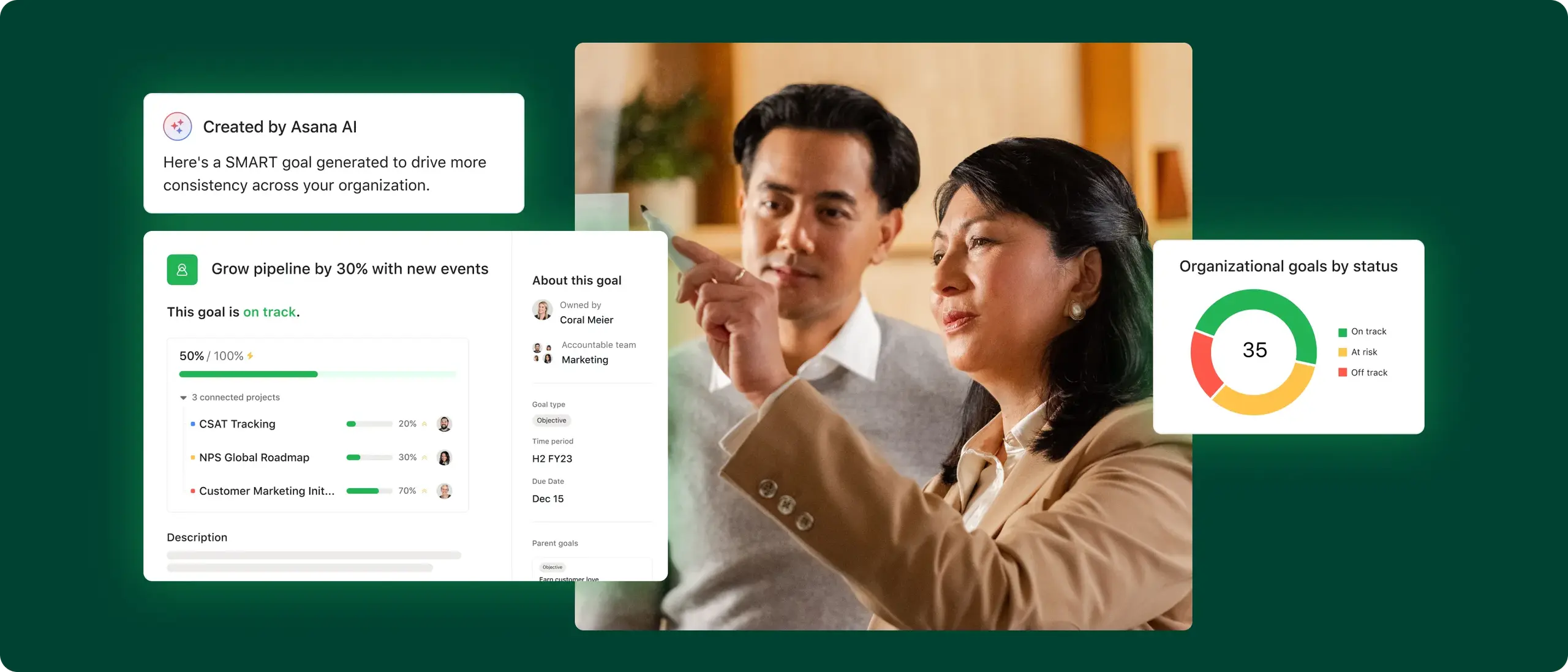
Asana lets teams connect goals, projects, tasks, and updates all in one place. Rather than using separate tools for strategy and day-to-day work, teams can set company goals in Asana and link them directly to the projects that support them.
We selected Asana as the best overall choice because it bridges the gap between strategy and execution better than most goal management platforms. When teams track work in Asana, leaders can see how projects contribute to larger goals. Asana AI and AI Teammates add another layer of support by summarizing work, flagging risks, automating workflows, and handling routine tasks. Asana also offers a generous free plan that helps smaller teams start managing work before upgrading to more advanced goal-tracker features.
Pros and cons
Pros: Connects tasks, projects, and goals; Asana AI and AI Teammates automate summaries and workflows; milestones show visual progress for larger objectives; generous free plan, competitive pricing for individuals and small teams.
Cons: Goals require a higher-tier plan, so some teams may need to upgrade to manage goals comprehensively; there can be a learning curve.
2. ClickUp: Best for custom goal tracking
ClickUp works well for teams that want more control over how they structure and measure goals. Its goal folders help organize objectives by department, quarter, or initiative, while custom target types let teams track metrics such as revenue, completed tasks, support tickets, or yes-or-no outcomes. That flexibility can suit teams with detailed tracking needs, but new users may need time to sort through the platform’s many features.
Pros and cons
Pros: Customizable target types for numbers, money, tasks, and binary outcomes; goal folders help organize objectives by team, department, or quarter.
Cons: The large feature set creates a learning curve for new users; the mobile app may feel slower than the desktop version.
3. Betterworks: Best for enterprise OKRs
Betterworks excels with OKR and performance management for larger organizations. It helps companies connect individual, team, and department goals to broader business priorities, making it useful for enterprise teams that need a more structured approach to strategy and reporting. Its analytics and HRIS integrations add value for people and operations teams, though the platform may require more setup than smaller teams want to manage.
Pros and cons
Pros: Focus on OKR methodology and best practices; analytics help teams identify at-risk objectives; HRIS integrations support enterprise performance management workflows.
Cons: Pricing may be higher and less transparent than SMB-focused tools; setup can require significant admin time.
Explore Asana's goal management features and capabilities
Asana is the leading software for project management, according to G2. See all your work in one place so you can prioritize what matters most.
4. Lattice: Best for performance goals
Lattice works well for companies that want to connect goals to performance reviews, employee development, and manager feedback. Teams can manage OKRs, 1-on-1s, reviews, and engagement workflows on a single platform, giving managers greater context during performance conversations. Lattice makes the most sense for HR-led goal management, but project-heavy teams may need a separate tool for daily work tracking.
Pros and cons
Pros: Integration between goal tracking and performance management; a simple interface that supports employee adoption; 1-on-1 meeting templates help managers discuss current goals.
Cons: Project management features are not as robust as those in Asana, Trello, or ClickUp; HR-focused workflows may not suit teams that primarily need a project-based goal tracking app.
5. Monday.com: Best for visual goal tracking
Monday.com works well for teams that prefer visual dashboards, boards, and status updates. Teams can track goals with custom boards, progress columns, charts, graphs, timelines, and automation rules that reduce manual updates. Its visual format helps stakeholders quickly review progress, though teams may need additional configuration for complex goal dependencies or OKR workflows.
Pros and cons
Pros: Visual dashboards and tracking tools make progress easy to review; template library includes options for goal tracking and strategic planning.
Cons: Seat-based pricing can add extra costs for smaller teams; complex goal dependencies may require more manual setup than specialized OKR tools do.
6. Profit.co: Best for OKR management
Profit.co works well for teams who want dedicated OKR software rather than a work management platform. It supports the entire OKR cycle, from planning and implementation to reflection and reset, with guided setup, KPI libraries, dashboards, and graphs for reviewing goal progress. The platform's OKR features enable teams to create measurable goals, but it may feel too specialized for teams that only need lighter tracking tools.
Pros and cons
Pros: KPI library helps teams define measurable results; guided OKR setup supports stronger goal creation; reflection and reset features support the full OKR cycle.
Cons: The interface can feel crowded due to its large feature set; teams that do not follow the OKR framework may find it too specialized.
7. Weekdone: Best for weekly goal check-ins
Weekdone works well for teams that want a simple weekly rhythm for goal updates. Its PPP method covers progress, plans, and problems, which helps managers see what teams have finished, what comes next, and where blockers need attention. The platform also supports weekly checklists and updates, but teams that need task management or time tracking may need an additional tool.
Pros and cons
Pros: Weekly reporting cadence helps teams revisit goals often; PPP format gives managers a simple way to review progress, plans, and blockers; short-term updates help teams connect weekly work to longer-term goals.
Cons: Project management capabilities are limited compared with broader work management tools; pricing may feel high for smaller teams.
8. Cascade: Best for strategic planning
Cascade works well for leadership teams that need to turn strategic plans into goals, initiatives, and measurable progress. The platform focuses on strategy maps, business unit planning, risk management, and high-level reporting, making it a better fit for executives and strategy teams than for individual goal tracking. Teams that need everyday project management may still need a separate work management tool.
Pros and cons
Pros: Strategy maps help teams show relationships between goals and business priorities; planning features support business units and leadership teams; built-in risk management helps teams monitor strategic initiatives.
Cons: The platform may feel too high-level for individual task or habit tracking, and enterprise strategy features can come at a higher price point.
9. Strides: Best for personal goals
Strides works well for individuals who want to track personal goals, habits, and professional development outside a team setting. Users can track habits, targets, averages, and projects on iOS and Android, which makes the app useful for goals such as daily routines, certifications, or long-term personal milestones. The app favors simple personal tracking over collaboration, so it will not suit teams that need shared goals or company-wide reporting.
Pros and cons
Pros: Simple mobile-first experience; flexible tracker types support habits, targets, averages, and projects; useful for personal routines and long-term habit goals.
Cons: Collaboration and team management features are limited; iOS users get the strongest experience.
10. WorkBoard: Best for enterprise strategy execution
WorkBoard works well for large organizations that want to connect OKRs to strategy execution. The platform links goals to business priorities, supports recurring check-ins and scorecard-style reviews, and uses AI agents to help leaders track progress and adapt plans. WorkBoard acquired Quantive in May 2025, so teams that previously considered Quantive can now find that OKR offering on the WorkBoard platform. It suits companies with mature OKR programs, but smaller teams or users who prefer simpler tools may find it too complex.
Pros and cons
Pros: Scorecards and check-ins keep goal progress visible to leadership; AI agents help summarize progress and surface risks; a scalable structure suits large organizations and complex OKR programs.
Cons: Setup and administration may require dedicated ownership; the interface may feel overwhelming for users who prefer simpler goal tracking.
How to choose the best goal management software
To choose the best goal management software, start by looking at how your team sets goals, tracks progress, and reports results. Use these steps to compare tools based on your workflow, budget, and team needs.
Read: The 10 best workflow management software tools1. Define your goal-setting method
First, figure out which goal-setting method your team uses or wants to use. Some teams use OKRs, others use KPIs, SMART goals, scorecards, or their own process. Pick software that supports your method and fits your team’s workflow.
2. Review your integration needs
List the tools your team uses daily, like Jira, Salesforce, Slack, Google Workspace, Microsoft Teams, or your project management app. Good integrations save time by pulling in goal data from these systems. Choose software that works well with your current tools, especially if you track revenue, support tickets, product work, or campaigns.
3. Consider your team’s technical comfort level
Your team should be able to use the software easily, without always needing admin help. If you want a simple tool, Asana or Trello may be better than specialized OKR platforms. Teams that work with large volumes of data might prefer WorkBoard or Betterworks, but these tools can take longer to learn.
Read: The best project management software4. Compare pricing and total cost
Look beyond the starting price and calculate the full cost of using the platform. Some tools charge per user, while others require higher-tier plans for features such as SSO, advanced reporting, automations, goal permissions, or enterprise support. A cheaper plan may end up costing more over time if your team needs to upgrade right away to manage core goals.
5. Run a short pilot before you commit
Try the software with one team or department before using it across the organization. A 30-day trial can show if people update goals, track progress, and use the tool without extra reminders. Ask users if the software makes goal tracking easier or just adds more admin work, and use their feedback before deciding.
Set, track, and manage goals with Asana
For teams that want powerful goal management without unnecessary complexity, Asana offers a practical way to connect strategy with day-to-day work. Teams can create company goals, build supporting team goals, and link related projects so progress updates come from the work already underway.
Asana helps reduce manual status updates and provides leaders with a more reliable way to monitor progress, spot risks, and identify where teams may need support. With goals, projects, tasks, reporting, Asana AI, and AI Teammates in one platform, teams can manage goals and the work behind them in one place.
Get started with Asana today.
Try Asana now


FAQs about goal management software
Project management software helps teams plan, assign, and complete work. Goal management software helps teams define the outcomes they want and the work that supports them.
For example, a project management tool may track a campaign launch, while a goal management tool may track whether the campaign increased qualified leads or revenue. The best goal management software connects both pieces, so teams can see the work in progress and the business goal behind it.
Goal management software should help teams set goals, assign owners, track progress, and report on results. Useful features often include OKR tracking, dashboards, automated status updates, integrations, permissions, templates, and reporting.
The right feature set depends on how your team manages goals. A small team may need simple progress tracking, while an enterprise team may need advanced reporting, HR integrations, SSO, and analytics.
The best goal management software depends on your team size, workflow, and goal-setting method. Asana is a strong overall choice because it integrates goals with projects, tasks, reporting, AI features, and team workflows on a single platform.
Teams with strict OKR requirements may also compare tools such as Profit.co or Betterworks. Teams that want more visual tracking may consider Monday.com, while HR teams may prefer Lattice for performance-related goals.
Yes, some goal management tools offer free plans, but advanced goal features often require a paid plan. Asana, ClickUp, and Monday.com offer free versions that can help individuals or small teams manage work and basic planning. Free plans work best when teams need simple task and project tracking. Teams that need advanced goal reporting, OKRs, automation, permissions, or executive dashboards should expect to review paid tiers.
Start with a simple rollout. Choose a small number of goals, assign owners, and ask teams to update progress during existing meetings rather than adding another standalone process. Leaders should use the software during team meetings, planning sessions, and performance conversations. When teams see that goal updates shape real decisions, they have a stronger reason to maintain accurate progress updates.