What are OKRs? A guide to objectives and key results


85% of Fortune 100 companies choose Asana¹





Summary
If you regularly set team or company goals, you’ve likely heard the term OKRs thrown around. OKRs, or “objectives and key results,” are a goal-setting methodology that can help teams set measurable goals. While most companies set goals, only 16% of knowledge workers say their company is effective at setting and communicating company goals. To increase employee engagement in goal setting and help your teams set and achieve ambitious goals, try setting OKRs.
How to align goals and OKRs across teams
Learn how to transform your team’s goals into measurable outcomes with powerful OKRs. When teams can understand how their work ladders up to the organization’s overall goals, better results follow.
OKR meaning and definition
OKR stands for objectives and key results. They are a widely used goal-setting framework that teams use to define ambitious goals and measure progress. An OKR pairs an aspirational goal with measurable key results so teams can track whether their work drives desired outcomes. Teams use OKRs to prioritize tasks and assess progress against specific objectives.
What is an objective?
In the OKR framework, objectives describe qualitative goals that define what a team wants to achieve. Teams usually assign objectives to a fixed time period, such as a quarter or a year, and write them to push performance beyond current results while staying achievable.
Objectives function as stretch goals or “moonshots” that drive your team.
Objectives reflect your company’s strategy, mission, and long-term goals.
What are key results?
A key result is a specific, measurable, time-bound, and verifiable outcome that demonstrates you’ve achieved a larger, qualitative objective. The objective explains what you want to achieve, while key results define how you track success. For example, an objective might be “optimize the onboarding experience for new customers,” with key results such as “increase onboarding completion rate to 85%,” and “lower first-month churn by 15%.”
How do OKRs work?
OKRs are designed to help organizations focus on what matters most and align their teams around common goals. By setting challenging yet achievable objectives and defining clear, quantifiable key results, organizations can track their progress, hold themselves accountable, and make data-driven decisions about where to invest their time and resources.
OKRs adhere to a straightforward yet incredibly adaptable framework that adapts to suit almost any objective.
I will [objective] as measured by [key result].
OKRs are typically set and reviewed quarterly, with regular check-ins to ensure teams stay on track and can adjust their OKRs as needed.
What are the best practices for setting OKRs?
Because of how flexible the OKR framework is, you can set and phrase OKRs in a variety of ways. Like any goal, OKRs should be falsifiable and measurable. You should think of OKRs as the pillar of your strategy for the next period. However, to set good OKRs, you also need to connect them to your day-to-day work. Here are some OKR best practices to keep in mind:
Limit the number of objectives. Aim for 3-5 objectives per level (company, team, individual) so you can focus on what matters most when implementing OKRs across the organization.
Make key results measurable. Key results should have clear metrics to track progress, allowing you to measure what matters and achieve measurable outcomes. Use a mix of quantitative and qualitative KRs to ensure a balanced approach to performance management.
Assign key result owners. For each key result, designate a single owner responsible for tracking and updating progress. This aspirational approach to individual OKRs promotes accountability and ownership at all levels of the organization.
Check in regularly. Schedule frequent (weekly or biweekly) check-ins to track progress, address obstacles, and keep milestones and objectives top of mind. Regular check-ins are key to the successful rollout and adoption of an OKR management framework.
Connect OKRs to daily work. Use OKR software that integrates with your team's daily workflow, so goals stay visible and actionable. Companies like Microsoft, LinkedIn, and Spotify have successfully implemented OKRs to track progress, align teams, and drive measurable results. By connecting OKRs to daily work, you can ensure that your strategic planning efforts translate into tangible milestones and achievements.
Even though most companies set goals, research shows that only 26% of employees have a clear understanding of how their individual work contributes to company goals. That’s because most teams set goals at the beginning of a year or quarter and never revisit them. But when employees have clarity on the relationship between their work and their company-level objectives, their motivation doubles. By connecting individual OKRs to your entire organization’s goals, your employees have a context for why their work matters.
Create an OKR templateHow to write an OKR
Now that you understand the key principles of setting effective OKRs, let's dive into the specifics of how to write good OKRs. Whether you're writing OKRs at the company level, team level, or individual level, follow these steps to avoid common mistakes.
Step 1: Start with your objectives
To write an OKR, start by defining your objectives. Start with the word "objective," then state your goal in a clear, succinct manner. Use action-oriented, aspirational language that inspires and motivates, and focus on the measurable outcomes you want to achieve rather than the activities or tasks involved. Aim for 3-5 objectives per level (company, team, individual).
Example:
"Objective: Become the market leader in cloud-based project management software."
Step 2: Define 3-5 key results for each objective
Underneath each objective, list your key results with the phrase "key results." Key results should be specific, measurable, and time-bound, and they should use a mix of quantitative and qualitative metrics. To ensure accountability, assign each key result to a single owner with a clear target for measuring success.
Example:
Key Result 1: Increase market share from 15% to 30% by the end of the fiscal year.
Key Result 2: Achieve a Net Promoter Score of 60+ by the end of Q3.
Key Result 3: Launch three new product features per quarter based on user feedback and usage data.
Key Result 4: Increase the free-to-paid conversion rate from 5% to 15% by the end of Q4.
Step 3: Review and refine your OKR
Once you've drafted your OKRs, review and refine them to ensure they're ambitious but achievable. Pressure test your key results to make sure they are truly measurable and have clear targets. Get feedback from key stakeholders and team members, and revise your OKRs based on their input and changing priorities.
Step 4: Communicate and track progress
Finally, communicate your OKRs to all relevant teams and individuals, and ensure everyone understands how their work contributes to the objectives. Use an OKR tool or spreadsheet to track progress and maintain visibility, and schedule regular check-ins to review progress, address obstacles, and update targets as needed. Celebrate successes and learn from failures along the way.
Read: Asana tips: 3 ways to set achievable goalsWhat types of OKRs do teams use?
Teams use various types of OKRs to assist in planning, execution, and performance monitoring. You select the most suitable OKR type based on who owns the goal and its timeframe.
Committed OKRs are core business goals that require resources, full commitment, and 100% completion, like migrating to a new domain by the end of the year.
Aspirational OKRs set ambitious moonshot goals that push teams beyond current performance and allow room for partial achievement.
Learning OKRs support exploration and experimentation when teams need to test assumptions or gather insight before committing to outcomes.
Strategic OKRs define high-level, long-term priorities that guide company strategy and inform major decisions.
Tactical OKRs translate strategic priorities into shorter-term goals for teams or departments.
Top-down OKRs originate from leadership and establish direction across the organization.
Bottom-up OKRs originate from teams or individuals and reflect on-the-ground goals and opportunities.
Personal OKRs help individuals track goals that contribute to team or organizational outcomes.
What are some real-world examples of OKRs?
Now that you understand the key principles of setting OKRs and how to write them, let's explore some real-world case studies. The following OKR examples demonstrate the application of the framework at various organizational levels, ranging from company-wide objectives to team-specific goals.
Company OKR examples
OKRs are effective at guiding large, long-term goals. Check out a couple of company-wide OKR examples.
Allbirds Objective: Create the lowest carbon footprint in our industry.
Key Result: Supply chain and shipping infrastructure are 100% zero-waste.
Key Result: Pay 100% carbon offset for calculated carbon dioxide emissions.
Key Result: 25% of material is compostable.
Key Result: 75% of material is biodegradable.
Zume Pizza Objective: Delight customers.
Key Result: Net Promoter Score (NPS) of 42 or better.
Key Result: Order Rating of 4.6/5.0 or better.
Key Result: 75% of customers prefer Zume to the competitor in a blind taste test.
Team OKR examples
When you step down a level, from the C-suite to functional teams, OKRs are equally effective. Just as they can direct our strategic thinking, they can also guide our functional work. Here are a few team OKR examples.
Marketing team objective: Increase brand awareness
Key Result: Drive 1M web visitors
Key Result: Increase social media following by 10x
Key Result: Recruit and onboard 1,000 community members
Product team objective: Rollout major product initiative by end of quarter
Key Result: Recommendation score of 8 or above
Key Result: 40% of MAU users use new feature
Key Result: Increase sign-up-to-conversion rate from 15% to 25%
HR team objective: Drive employee impact and engagement
Key Result: Increase employee satisfaction by 20%
Key Result: Achieve 90% employee participation in performance reviews
Key Result: Double positive manager feedback
Sales team objective: Increase recurring revenue
Key Result: Reach $2M in MRR
Key Result: Increase annual renewals by 25%
Key Result: Reduce churn by 10%
Personal OKRs
OKRs aren't just for the workplace, either. When asked about how he improved his personal life, John Doerr revealed he used his trusty system to maximize the time he spent with his family.
Personal objective: Have more quality family time, as measured by:
Key Result: Getting home for dinner by 6 pm, 20 nights a month.
Key Result: Being present by turning off the internet router to eliminate distractions.
What are the main benefits of OKRs?
While there are various goal-management frameworks your team will find helpful, OKRs help you align on flexible goals that are falsifiable, time-bound, and easily measurable. One of the most significant benefits of OKRs is that you can map multiple KRs to each objective. That helps teams:
Set actionable goals faster. OKRs give teams a simple structure for setting goals without lengthy debates over wording. Teams define an objective and pair it with measurable key results, which speeds up planning and implementation.
Support stretch goals. OKRs allow teams to include challenging key results that push performance beyond current levels. Teams use stretch goals or “BHAGs” to test limits without expecting perfect completion.
Improve cross-functional collaboration. OKRs often span multiple teams or departments. A shared objective improves team collaboration by giving everyone a common target, while separate key results define each team’s contribution.
Increase employee engagement. Many organizations set objectives at the leadership level and let teams or individuals define key results. This hybrid top-down/bottom-up approach gives employees ownership over their contributions.
Connect daily work to company goals. OKRs link objectives to measurable results, which helps teams tie daily tasks to broader organizational priorities.
Bring your OKR to life
Thomas Edison once quipped that “vision without execution is hallucination.” It’s an idea that deeply inspired Doerr and the OKR methodology: good ideas with poor execution will forever remain just that, ideas.
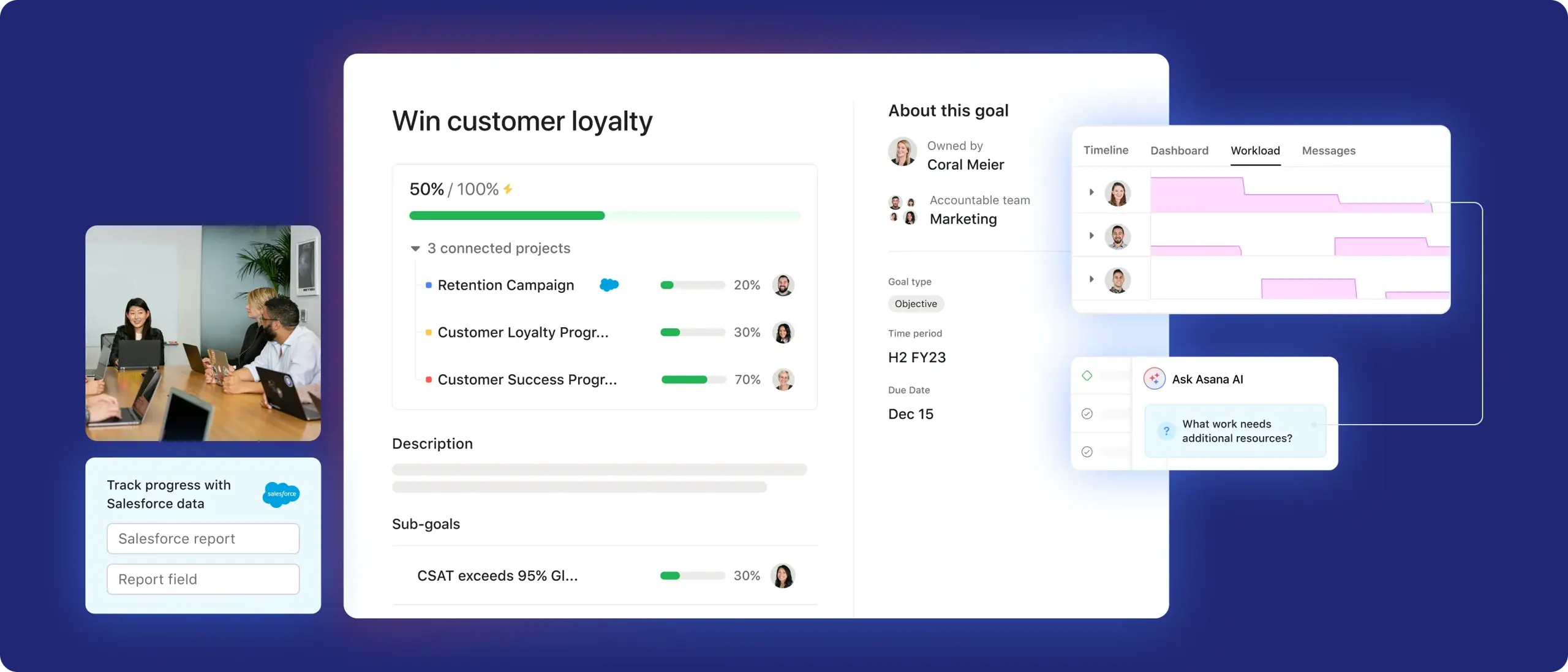
That’s why we’ve developed Goals in Asana. Instead of locking your goals away in a spreadsheet or PowerPoint, Goals in Asana make it simple to set goals and measure progress in the same place you track everyday work.
Create an OKR templateFAQs about OKRs
Still have questions about setting an OKR? We've got answers!