Creative strategy: Build yours in 6 steps + examples


85% of Fortune 100 companies choose Asana¹






Summary
In business, a creative strategy is a detailed plan for achieving your goals. You'll use this strategy to connect with your target audience and communicate your brand in ways that resonate and drive action.
In this piece, we'll explain what a creative strategy is and why you need one for business growth. We'll also cover how creative strategy differs from brand strategy, the key questions to ask when building yours, and the steps you can take to create an effective strategy for your team.
Scale creative and content production
Enhance your creative and content production processes with expert strategies. Learn how to streamline workflows, foster collaboration, and deliver high-quality content efficiently.
What is a creative strategy?
A creative strategy is a plan that guides how your company communicates its message to achieve specific goals. It connects your brand identity, marketing campaigns, and business objectives into one cohesive approach. An effective creative strategy combines strategic goals with innovative methods to reach your target audience.
Your creative strategy should include:
Define your target audience
Identify the actions you want your audience to take
Explain the strategies you'll use to make those actions happen
A creative strategy ensures your end product aligns with your expectations. It also gives the creative team a clear idea of how to move forward and who they should have in mind when creating deliverables.
Why creative strategy matters for your business
Without a clear creative strategy, marketing teams often produce content that looks good but doesn't deliver results. Campaigns launch without a unified direction, and creative assets fail to connect with your audience.
A well-defined creative strategy provides a shared roadmap for everyone involved. When your team understands the goals, audience, and core message, they make faster decisions and produce work that moves the needle.
Here's what a strong creative strategy helps you achieve:
Consistent messaging: Maintain a unified brand voice across all channels and campaigns.
Clearer communication: Align creative teams, stakeholders, and leadership around shared goals.
Efficient budget use: Spend resources on creative work that supports business objectives.
Faster turnaround: Reduce revisions and misaligned work with clear direction from the start.
Think of your creative strategy as the foundation that keeps everyone building in the same direction. Without it, you risk wasting time and resources on work that doesn't support your broader business goals.
Creative strategy vs. brand strategy
While creative strategy and brand strategy are closely related, they serve different purposes. Understanding the distinction helps you build both effectively.
Brand strategy | Creative strategy | |
Definition | Defines who you are as a company | Defines how you communicate your brand |
Focus | Mission, values, positioning, emotional connection | Campaigns, content, creative assets |
Key question | "What do we stand for?" | "How will we bring our brand to life?" |
Scope | Long-term company identity | Project or campaign-specific |
For example, your brand strategy might establish that your company values innovation and simplicity. Your creative strategy would then outline how to communicate those values through a product launch campaign, including the messaging approach, visual style, and target audience.
Both strategies work together. Your brand strategy provides the guardrails, while your creative strategy brings your brand to life in ways that resonate with your audience.
10 questions to ask when building your creative strategy
It's important for your creative strategy to be unique so you can outperform competitors, but the best way to begin the strategic process is with a list of simple questions. Any marketing team can use these questions to get the ideas flowing when writing their creative strategy.
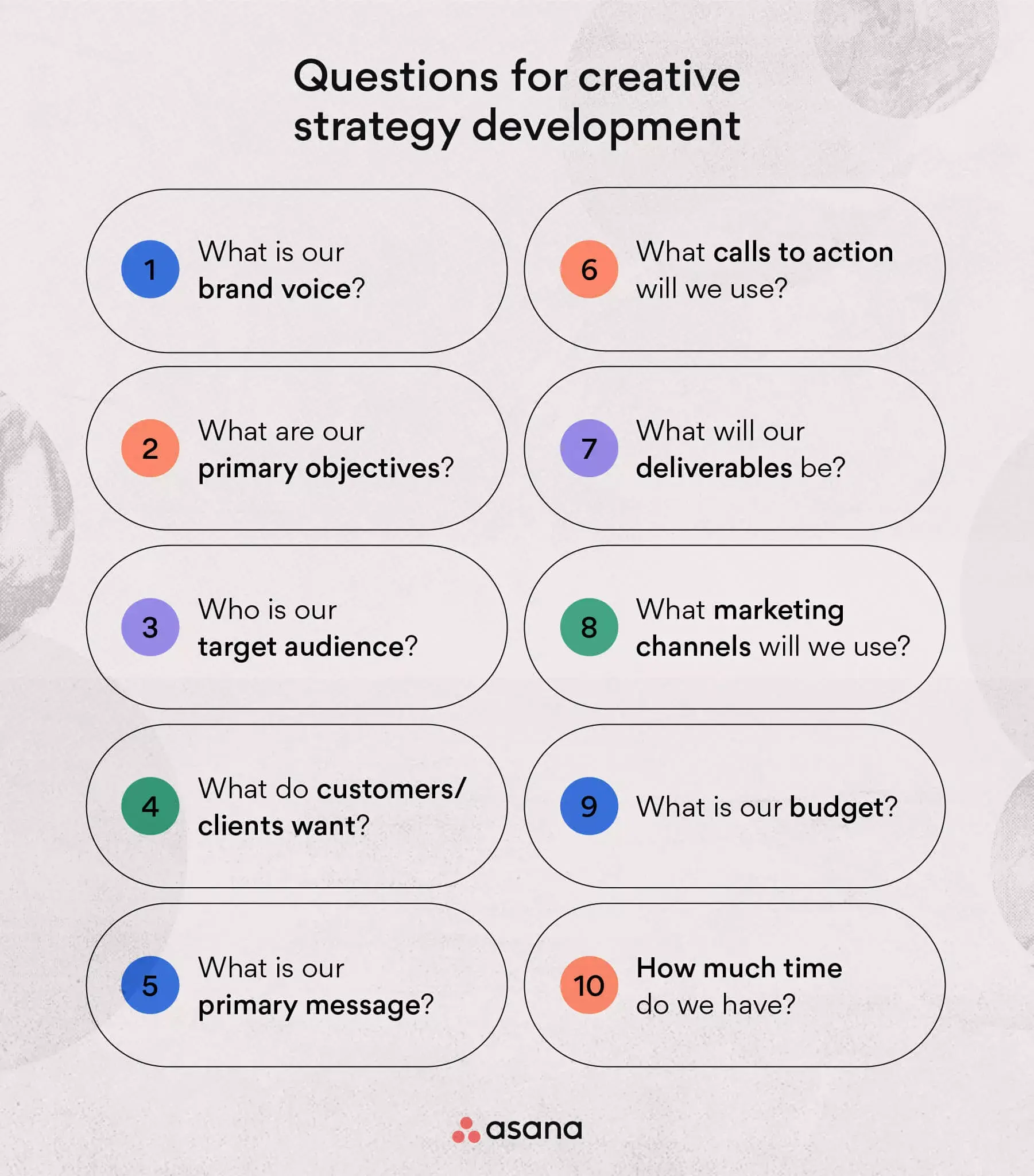
What is our brand voice? Your brand voice is your company's personality. Your voice encompasses not only what you say, but also how you say it. It's important to stick to your brand voice because this voice will build awareness and trust.
What are our primary objectives? Your primary objectives are the end goals you want to achieve through your marketing campaigns. When you define your goals, you gain clarity in your strategic approach.
Who is our target audience? Knowing who you're trying to reach with your marketing message is crucial to your creative strategy. Without a specific target audience, you'll spend unnecessary time and money spreading your message to people who aren't interested in your brand.
What do our customers or clients want? Once you know your target audience, use market research to determine what they want from you. The best way to ensure your marketing plan succeeds is to speak to your end user's needs.
What is our primary message? Your marketing message should have a primary focus and align with your brand voice. If you're creating deliverables for a client, your message may focus on solving their problem.
What call to action will we use? Customer-focused products and services require a call to action to get users to act. Depending on your target market, your call to action may be bold or more subtle.
What will our deliverables be? After identifying what your customers or clients want, you can make creative assets that fit that need. Assess the resources you'll need and determine whether your team members have bandwidth.
What marketing channels will we use? Your target audience likely uses specific marketing channels depending on their demographics. Younger audiences may use Instagram, while older audiences may use Google more frequently.
What is our budget? Your project budget determines how you plan and carry out your creative ideas. If you don't have the money to put a strategy into action, fleshing it out isn't worth it.
How much time do we have to develop the creative strategy? Building a creative strategy takes time because if you're not thorough during the planning stage, the execution stage will go awry. Knowing your project timeline is important so you can plan accordingly.
Scale creative and content production
Enhance your creative and content production processes with expert strategies. Learn how to streamline workflows, foster collaboration, and deliver high-quality content efficiently.
6 steps for writing a creative strategy
Use the questions above to set goals when writing your creative strategy. You'll see that many of those questions go hand in hand with the step-by-step process outlined below.
1. Define your goals
Use the goals of your creative marketing strategy to build it piece by piece. Everything in your strategy should relate to those goals to make it feel cohesive.
Tip: Make your goals SMART goals so that they're easy to measure and monitor during strategy execution. For example, one of your goals may be to increase your customer base by 10% year-over-year.
2. Write a creative strategy statement
Your creative strategy statement is like a mission statement, with the focus being, "Why are we writing this creative strategy? Who are we writing it for, and what value will it bring?" Aim to answer this question succinctly without missing any of the major points.
Tip: The goal of your creative strategy is to communicate your game plan to everyone within your organization. Be sure to include how you plan to stand out from your competitors. An example of a creative strategy statement may be:
"We want top B2B and B2C executives using social media platforms like LinkedIn and Facebook to be so impressed with the joyful and humorous marketing campaigns that they reach out to us for help with their own marketing."
Read: 7 steps to complete a social media audit (with template)3. Choose your success metrics
Success metrics, also known as key performance indicators (KPIs), will help you track how well your strategy is performing against your primary objectives. Knowing your metrics from day one can give you time to determine how best to track them.
Tip: Once you choose success metrics for your creative strategy, set project milestones for when to monitor these metrics. During these checkpoints, determine whether your strategy is progressing as expected or if you need to change direction.
4. Determine your message and target audience
Your message and your target audience comprise a significant portion of your creative strategy. This is where creativity comes in, and you'll want to consider everything from the length and tone to the way you deliver your message.
Tip: The most effective way to know whether your message fits your target audience is to create personas and an ideal customer profile. Detailed personas make it easier to put yourself in your target audience's mind and deliver a message they want to hear.
5. Set a budget
You can set an accurate budget for your creative strategy by outlining everything you think you'll spend money on in a marketing budget. Items you should include in your budget may include:
Project deliverables
Paid advertising
Marketing software or creative programs
External vendors
Service fees
If you don't start with an itemized budget, you can easily go over budget without realizing it.
Tip: Estimating costs in the planning phase lets you adjust your budget before you spend. If your expected spending is too robust, you'll have time to search for cheaper vendors or plan a more cost-effective strategy.
6. Create a timeline
Sticking to a timeline can keep your project within budget and ensure that your end user is satisfied. To ensure everyone stays on track, add milestones to your timeline for team members to follow.
Tip: Use project management software to create timelines and track team member progress against project milestones. Then, create Gantt charts to visualize contingencies between project tasks.
Read: Strategy vs. tactics: What's the difference?Creative strategy example: Content marketing company
A content marketing company may use a creative strategy to achieve various goals that drive long-term business growth. See the creative strategy example below for how this agency plans to increase social media engagement.
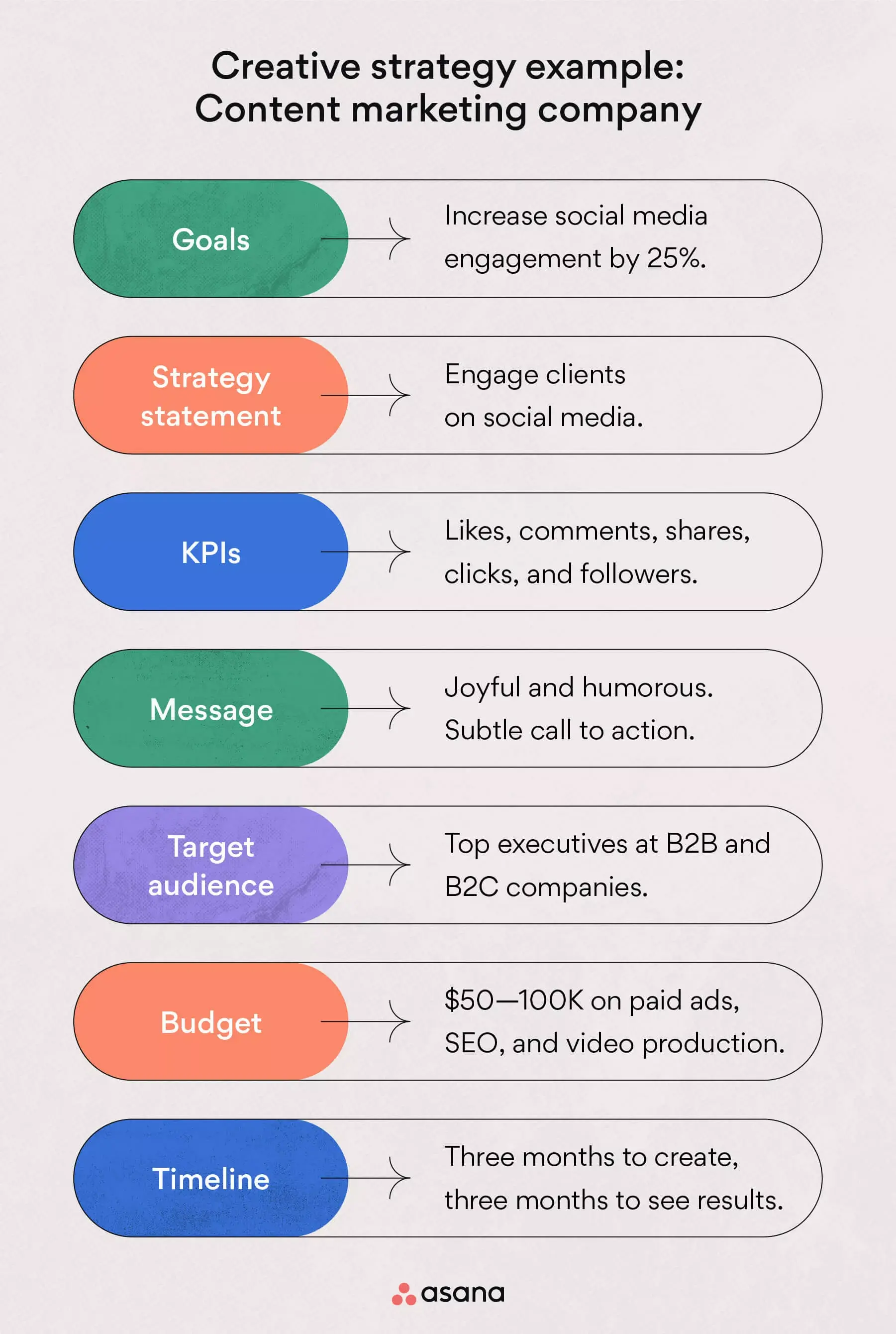
Goals: To increase social media engagement by 25% next quarter, with 10% of that engagement being on Instagram and 15% being on Facebook.
Creative strategy statement: To engage and entertain potential clients who find themselves on social media during their workday. Our goal is to spark joy with excellent content and impress clients with our skills, without making them feel pressured to use our services.
KPIs: We'll measure likes, comments, shares, clicks, and followers through Facebook and Instagram analytics pages.
Message: Our message will be joyful and humorous, and our skills should speak for themselves. When clients see our work, we hope they'll say, "I want to use something like this for my company."
Target audience: Top executives at B2B and B2C companies.
Budget: $50,000–$100,000 spent on paid advertising, organic SEO post creation, and video production.
Timeline: Three months of creation, three additional months to evaluate performance.
How to analyze and iterate on your creative strategy
Creating a creative strategy isn't a one-time task. To get the best results, regularly evaluate what's working and refine your approach through data-driven decision-making.
Here's how to build analysis and iteration into your creative process:
Review performance against your success metrics: Return to your KPIs, compare actual performance to your targets, and identify which creative elements are driving results.
Gather feedback from your team: Your sales team and customer-facing colleagues often have valuable insights about how your messaging lands. Create regular check-ins to collect qualitative feedback.
Test and learn: Use A/B testing to experiment with different creative approaches. Small experiments in messaging, visuals, and calls to action can reveal big opportunities.
Document what you learn: Keep a record of what worked, what didn't, and why. This documentation becomes a valuable resource for future campaigns.
The most effective creative strategies evolve over time. By building regular analysis into your workflow, you support continuous improvement and stay responsive to market changes.
Connect your creative strategy with project management software
You'll need a dedicated team to build and execute a creative strategy. To keep everything organized, use project management software to build timelines, set budgets, and monitor KPIs in one place.
Ready to bring your creative strategy to life? Get started with Asana to plan, track, and manage your creative projects from start to finish.
Scale creative and content production
Enhance your creative and content production processes with expert strategies. Learn how to streamline workflows, foster collaboration, and deliver high-quality content efficiently.
Frequently asked questions about creative strategy
A software company launching a product might create a strategy targeting marketing managers with humorous video ads on LinkedIn, focused on the message "save time on repetitive tasks," and measured by demo sign-ups.
Creative strategy typically falls to creative directors, marketing managers, or dedicated creative strategists. The key is ensuring one person has clear accountability while involving stakeholders who understand business goals and customer needs.
Review your creative strategy at least quarterly and revisit it when launching new products, entering new markets, or responding to major competitive changes.
The most common mistakes include starting without clear goals, skipping audience research, creating vague strategies, and developing your plan in isolation without input from customer-facing teams.