


RFQ template: Compare vendor quotes and delivery dates

85% of Fortune 100 companies choose Asana¹






Summary
Two suppliers may quote different prices for what looks like the same purchase. One may include delivery and setup, while another adds those charges later. An RFQ template helps you request the same details so you can compare what each quote includes.
This guide explains how to create an RFQ form, define your requirements, and review supplier responses. Copy the blank form, review a completed RFQ example, and learn how to track submissions and approvals in Asana.
Optimizing your tech stack for the AI era
From security risks to productivity loss, app sprawl may be costing you more than you think. Our latest guide reveals the true impact of an oversized tech stack and provides strategies to optimize your IT spend. Don't let hidden costs hold you back:
What is an RFQ?
A request for quotation (RFQ) is a document businesses send to potential suppliers to request pricing for specific goods or services. It gives each supplier the same requirements and a consistent format for providing prices and terms.
The buyer describes what they want to purchase, how much they need, and when it must arrive. Each supplier returns a quotation with prices, delivery dates, and any requirements they cannot meet.
Purchases can involve several teams. In FY25, Asana’s purchasing project received 1,137 submissions. “Our most intricate agreements can involve up to seven cross-functional teams, with countless hand-offs,” Jennifer Liu, Asana’s Procurement Operations Lead, explained in 2025.
To coordinate those reviews, Asana’s procurement team uses AI Studio to route tasks to reviewers and prepare budget summaries. Agree on a standard RFQ format, such as a document with an itemized pricing table or an online form. Before sending it to suppliers, confirm the requirements and decide who will review and approve each quote.
Free RFQ template
Use this request for quotation template to provide each supplier with the same specifications and pricing fields. Copy the blank form, add your purchase details, and send it to vendors.

Alternatively, describe your project and form requirements in Create with Asana AI. Review the generated questions and their links to project fields before sharing the form. Submissions through Asana Forms become tasks in the connected project, where your team can review each response. This option requires an eligible paid or trial account with Asana AI enabled.
What to include in your RFQ
A useful RFQ format separates the buyer’s requirements from the supplier’s response. Include specifications, quantities, delivery requirements, and response deadlines. Ask suppliers for itemized prices, additional charges, payment terms, and any exceptions. Assign a reference number and version to ensure all bids are based on the same document.
Copy the blank RFQ form
Copy this RFQ form template and replace the bracketed fields with your purchase details. Enter item descriptions, quantities, and units before sending it. Suppliers will complete prices and terms and confirm if they can meet your requirements.
Buyer completes | Details |
RFQ reference and version | [Reference number] · [Issue date] · [Version] |
Buyer and contact | [Company] · [Contact name] · [Email] · [Contact for questions] |
Scope and specifications | [Goods or services] · [Required specifications] |
Items and quantities | [Item descriptions] · [Quantities] · [Units] |
Delivery or service requirements | [Location] · [Required date and time zone] · [Setup] · [Collection or service end date] |
Response instructions | [Question deadline] · [Quote deadline and time zone] · [Submission method] |
Selection requirements | [Must-have requirements] · [How quotes will be compared] |
Ask each supplier to complete the same pricing table. Add rows as needed for additional items.
Item or service | Quantity / unit | Unit price | Line total |
[Buyer enters item] | [Buyer enters quantity and unit] | [Supplier enters price] | [Supplier enters total] |
[Add another item] | [Quantity and unit] | [Unit price] | [Line total] |
Request the following details along with completed prices:
Supplier completes | Details |
Supplier and contact | [Company] · [Contact name] · [Email] |
Charges | [Delivery] · [Setup] · [Collection] · [Other fees] |
Quoted total | [Items subtotal] + [Additional charges] + [Tax] = [Total quoted cost] |
Terms | [Currency] · [Payment terms] · [Quote valid until] |
Requirements and exceptions | [Delivery confirmed?] · [Requirements not met] · [Exclusions or alternatives] |
What's the difference between an RFQ and an RFP?
An RFQ asks suppliers to price requirements you have already defined. A request for proposal (RFP) asks them to recommend an approach, explain how they would deliver it, and provide a price.
Factor | RFQ (Request for Quotation) | RFP (Request for Proposal) |
Primary focus | Comprehensive evaluation | |
Best for | Goods or services with defined specifications | |
Evaluation criteria | Total cost among suppliers that meet requirements | Multiple factors including risk management, methodology, and expertise |
Vendor response | Pricing breakdown | Detailed proposal with approach and pricing |
How to create an RFQ form
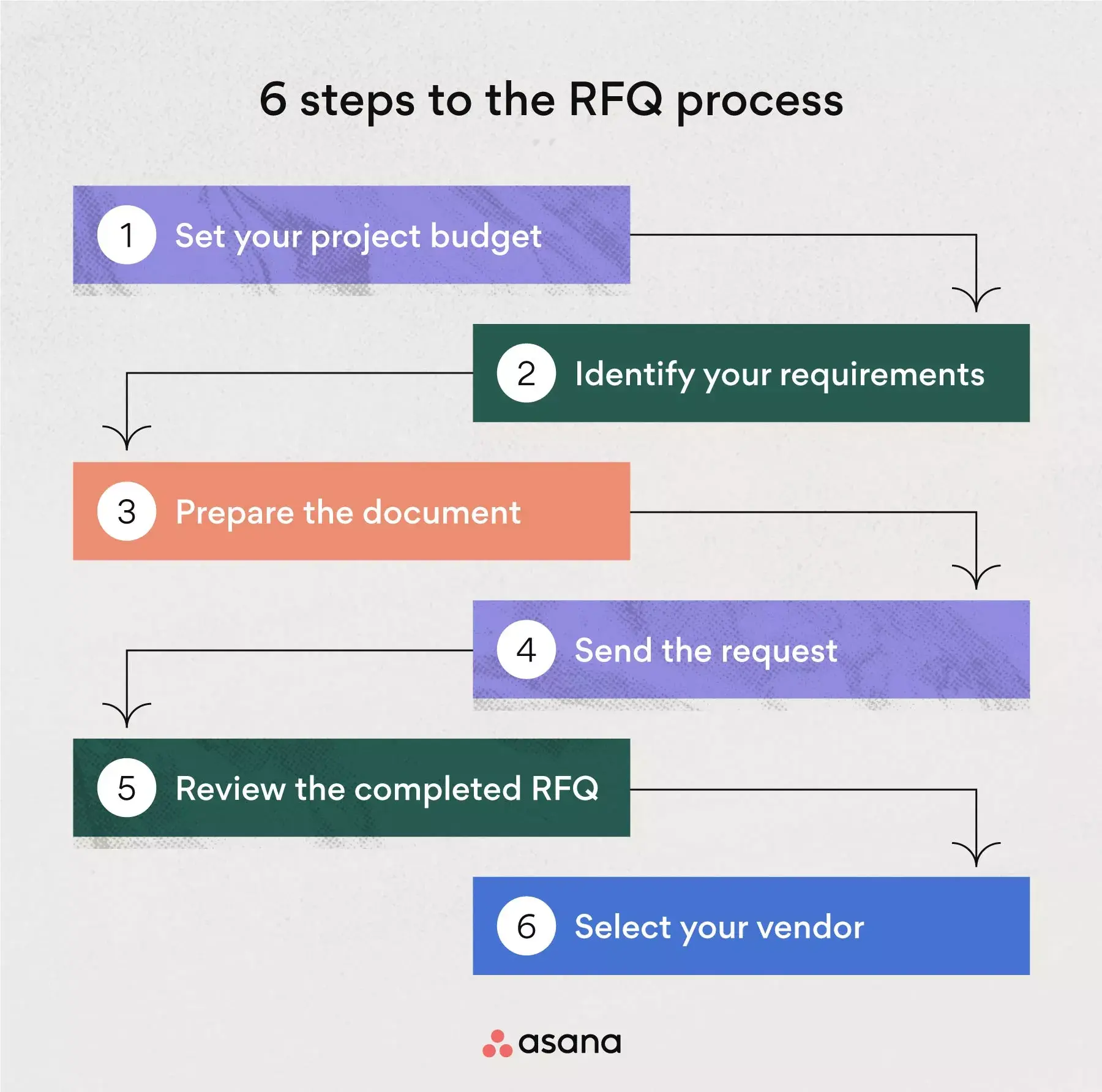
Start by defining the purchase in your scope of work, then follow these six steps to prepare the RFQ and review responses.
In this RFQ example, Maya at Example Events needs 100 matching folding chairs and 10 matching rectangular tables for an event on November 12, 2026. Equipment must arrive by 4 p.m. on November 11 and be collected after 10 a.m. on November 13. Quotes are due by 5 pm on October 29.

1. Set your project budget
First, set your project budget. Include the purchase price and any delivery, setup, collection, labor, or tax charges that apply. Assign someone to check that the proposed purchase fits the available budget.
For Maya’s event, the equipment subtotal is only part of the cost. She asks suppliers to quote delivery, setup, and collection separately or confirm if they are included. That gives the budget reviewer a complete amount to check before approving the purchase. Include these charges in your cost management plan.
2. Identify your requirements
Identify your requirements before completing the RFQ template. Requirements management helps your team agree on the specifications suppliers must meet. Separate essential requirements from preferences, and ask vendors to explain any exceptions.
Below are some examples of requirements that might be important to include in your RFQ document:
Items, quantities, and specifications
Delivery requirements
How quotes will be reviewed
Terms and conditions
Payment terms
Maya lists the quantities and matching equipment as requirements, along with delivery and collection times. A lower price isn’t helpful if the equipment arrives after the venue needs it.
For example, the team at HelloFresh checks ingredient samples before handing the request to its Strategic Purchasing team for sourcing. Depending on what you are buying, a sample or quality check can help you confirm suitability before comparing prices.
Read HelloFresh’s case study →
Free RFQ template
3. Prepare the document
Complete the buyer’s fields and give the RFQ a reference number, issue date, and version. Send the same document to every supplier so their prices reflect the same scope.
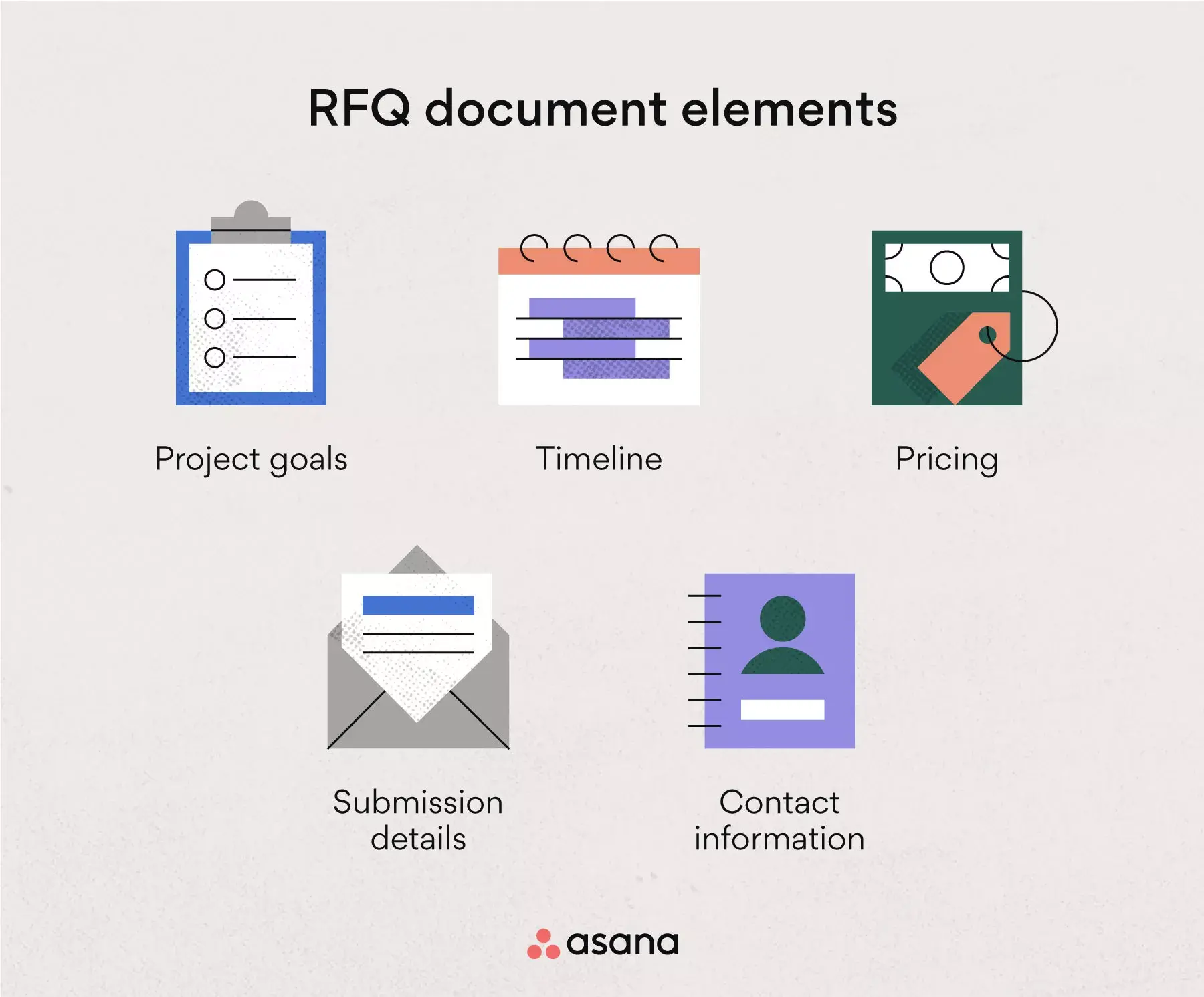
Before sending your RFQ, check that it includes:
Project goals: Describe the goods or services you need and the objectives they support. Include the specifications and quantities suppliers should price.
Timeline: State the required delivery or service dates, location, setup, and collection requirements. Include the time zone when timing matters. These dates should match your project timeline.
Pricing expectations: Request unit prices, line totals, currency, taxes, and additional fees. Instruct suppliers to mark included services and explain exclusions instead of leaving fields blank.
Submission details: Set separate deadlines for questions and quotes. Specify how to submit responses and which attachments to include.
Contact information: Provide the name and email address of the person who can answer questions about the request.
A well-documented RFQ reduces misunderstandings and leads to more accurate pricing quotes.
4. Send the request
Send the same RFQ version to each invited supplier and confirm they can access the document or response form. Set a response deadline that allows time to check availability, calculate prices, and ask questions.
Keep each supplier’s pricing confidential. If an answer changes the scope or project deliverables, share the updated requirements with every invited supplier so they can quote on the same basis.
Yıldız Ventures collects supplier applications through an Asana form, which creates tasks for departments to assess. You can use a similar setup for RFQ responses: collect the same details from each supplier, allow quote attachments, and assign someone to review each submission.
Read Yıldız Ventures’ case study →
5. Review and compare quotes
First, check whether each supplier meets your mandatory requirements and includes all requested prices. Ask about missing charges before comparing totals. An empty field means the cost is unknown, not zero.
Maya receives three quotes for the same equipment. The amounts below are illustrative and include the tax quoted by each supplier.
Supplier | Items subtotal | Other charges | Tax quoted | Total quoted cost | Delivery and review |
A | $650 | $450 | $220 | $1,320 | Nov 11, by 4 pm. Meets requirements. |
B | $800 | Included | $160 | $960 | Nov 11, by 4 pm. Meets requirements. |
C | $600 | Not confirmed | Not confirmed | Incomplete | Nov 12, 8 am. Misses delivery deadline. |
Supplier A charges $500 for chairs and $150 for tables. Delivery ($200), setup ($150), and collection ($100) add $450, bringing the total to $1,320 with the quoted tax. Supplier B’s $800 equipment price includes those services, for a $960 total with tax. Supplier C’s $600 subtotal is incomplete, and its proposed delivery misses the required date.
Use an Asana cost-comparison project to organize each supplier’s response with its review. Create a task for each quote, attach the document, assign a reviewer, and record costs and delivery dates in custom fields. Keep supplier submissions separate from your team’s internal comparison.
If your plan includes formula custom fields, you can calculate totals from the quoted amounts. Otherwise, check the calculations and enter the totals manually.
6. Select and approve a vendor
Read the shortlisted quotes again to confirm that the prices, delivery dates, and terms match your requirements. Record why you selected the supplier, who must approve the purchase, and the amount being approved.
Maya recommends Supplier B because it meets the requirements and offers the lowest complete quote among qualified suppliers. Sam approves the $960 purchase on November 3, before the quote expires on November 6. Maya then assigns tasks to confirm delivery, check the 100 chairs and 10 tables on arrival, and arrange collection.
For example, the team at C40 uses Asana to manage purchase requests, procurement approvals, and invoices. Custom fields keep the committed price and invoice amount with the purchase, helping the team check that the eventual bill matches what was approved.
RFQ example: Renting equipment for an event

This sample RFQ combines Maya’s request and Supplier B’s response. The buyer specifies equipment, quantities, and dates; the supplier fills in prices and confirms whether it can meet the requirements. Use this sample RFQ template as a guide to the level of detail each party should provide.
Buyer’s request | Details |
RFQ reference | EVT-2026-011, version 1 |
Buyer and contact | Maya, Example Events · maya@example.com |
Equipment | 100 matching folding chairs and 10 matching rectangular tables |
Quote deadline | October 29, 2026, 5 pm London time |
Event date | November 12, 2026 |
Delivery | November 11, 2026, by 4 pm |
Collection | November 13, 2026, after 10 am |
Location | Example Events Hall, 10 Example Lane, London |
Services | Includes delivery, setup, and collection |
Supplier B returns the following itemized prices:
Item | Quantity | Unit price | Line total |
Folding chairs | 100 | $6 | $600 |
Rectangular tables | 10 | $20 | $200 |
The completed response also confirms the charges and terms:
Supplier B’s response | Details |
Items subtotal | $800 |
Delivery, setup, and collection | Included |
Tax quoted | $160 |
Total quoted cost | $960 GBP |
Delivery and collection requirements | Confirmed |
Payment terms | 30 days from invoice |
Quote valid until | November 6, 2026 |
Exclusions or exceptions | None |
Supplier contact | supplier-b@example.com |
The $960 total includes equipment, delivery, setup, collection, and the supplier’s quoted tax. With delivery and collection dates confirmed, Maya has the information needed to compare this offer with others.
The ultimate guide to choosing a work management toolCommon RFQ format mistakes to avoid
An RFQ format should make quotes easier to prepare and compare. Watch for these common mistakes:
Vague or incomplete specifications: Describe the product or service and any required standards. Suppliers should have enough detail to price the same work without guessing.
Unrealistic timelines: Asking for quotes too quickly or setting project deadlines that don't account for production and delivery realities will limit your vendor pool. Give suppliers adequate time to prepare thoughtful, accurate responses.
Missing quantities or units: State how many items you need and whether suppliers should price each item, hour, day, or another unit.
Different response formats: Give every supplier the same pricing fields so you can compare line items, additional charges, and totals.
Comparing partial prices: Check that each quote meets requirements before comparing total costs. A low subtotal may exclude delivery, setup, taxes, or other required charges.
Poor revision control: Sending outdated specifications or making changes without notifying all vendors can be confusing and lead to mismatched quotes. Always keep your documentation current and communicate updates clearly.
Streamline vendor management with Asana
Once you’ve selected your vendor, put the agreed terms into action. Asana helps you track progress, manage vendor communications, and organize purchase approvals, delivery dates, and invoices. Get started today to bring your procurement process and project execution together in one place.
Free RFQ templateFrequently asked questions about RFQ templates
Use a request for quotation form when you know the specifications, quantities, and delivery requirements and want comparable prices from suppliers. It works best when several qualified vendors can provide what you need. If you still need help defining the solution, an RFP may be more useful. An RFQ supports procurement management for goods or defined services.
Give suppliers enough time to check availability, calculate prices, and ask questions; generally, 3-4 weeks. The deadline depends on the purchase's complexity and whether suppliers need site visits, samples, or input from subcontractors. Set separate deadlines for questions and quotes, and allow more time when the response requires substantial preparation.
Invite suppliers that can meet your requirements and give you enough choice to compare offers. Three to five vendors may be a practical shortlist, but the right number depends on the supplier market, your purchasing rules, and your team’s capacity to review responses. Include more suppliers only when the additional comparison will help the decision.
RFQs are common in manufacturing, construction, government procurement, healthcare, and retail. They can also help teams buy defined services, such as equipment rental or maintenance. The form should reflect the purchase and any industry-specific requirements. A general RFQ template may need additional clauses or review before it is used for a regulated purchase.
A standard RFQ format includes buyer contact details, a reference number, specifications, quantities, delivery requirements, and response instructions. It also gives suppliers space to enter itemized prices, additional charges, taxes, payment terms, and exceptions. Separate the buyer’s requirements from the supplier’s response so both parties know which fields to complete.
Compare both. Unit prices help you verify that items and quantities match, while the total quoted cost includes delivery, setup, taxes, and other applicable charges. Confirm that each supplier meets your mandatory requirements before comparing prices. Request missing costs instead of treating blank fields as zero, and check whether quoted totals cover the same scope.

