


Asana for IT Leaders
AI that fits right in. Results that stand out.
Asana fits into the systems and processes your business already runs on—orchestrating how people, AI agents, and workflows execute together to deliver results that compound over time.


Most AI gets stuck between pilot and production
Moving from AI pilot to business process takes more than a good prompt. Work crosses systems, data, and teams, so agents need the right access and controls, while people need visibility and clear decision points. Without proper governance and coordination, even promising AI stays isolated, making measurable results harder to achieve.

One plan for people, agents, and work
Asana puts agents to work across your systems and orchestrates that work around your goals, projects, people, and dependencies in one living plan. Agents can carry multi-step workflows forward while people stay involved in the decisions that matter.
How 100+ enterprises are putting AI to work
See how 100+ enterprises are moving AI beyond the pilot and into workflows that deliver real business value.

Asana AI helps leading businesses get work done





Agentic workflows, with IT in control
With Asana, you can orchestrate agents around business priorities, execute workflows across systems, and keep people connected and in control.

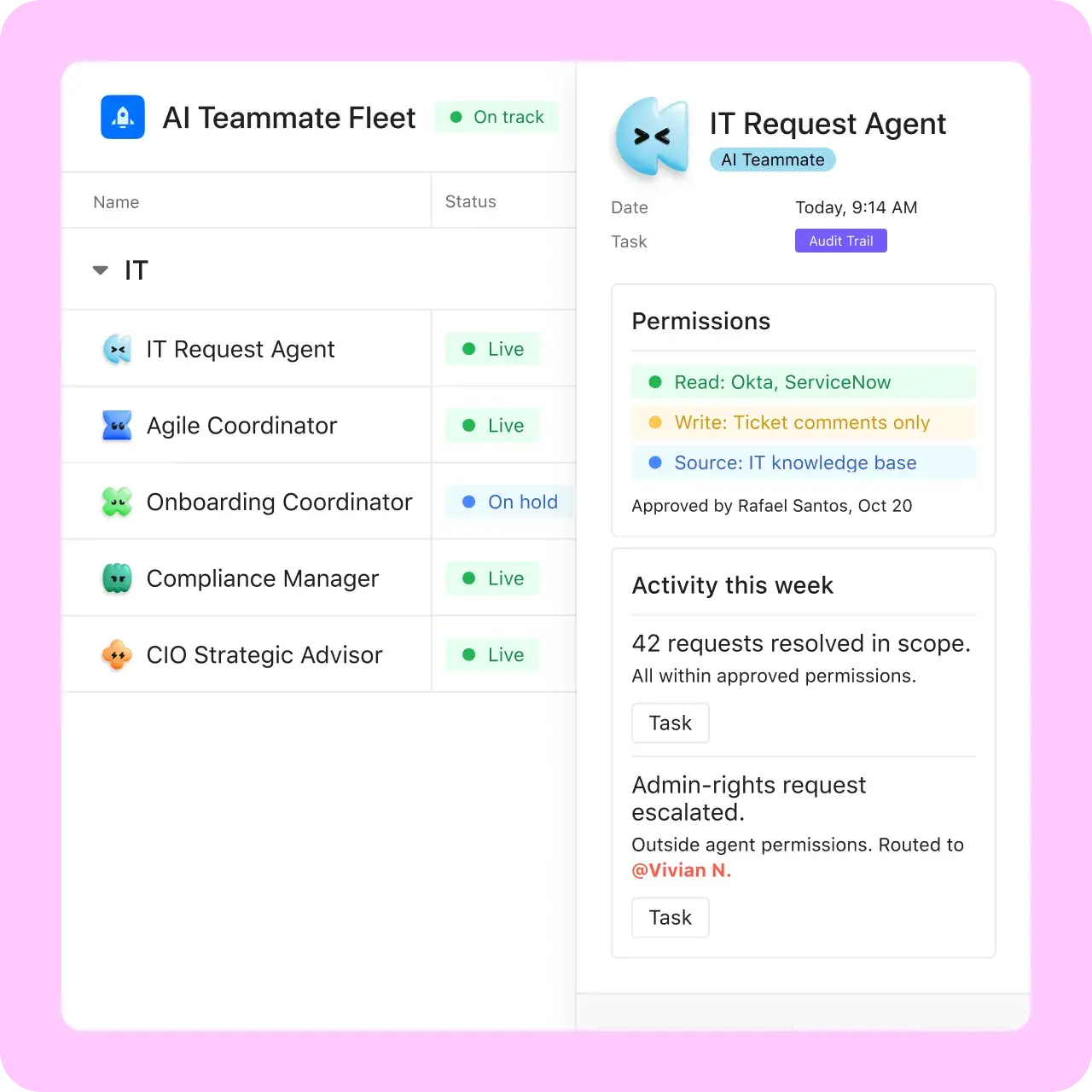
Give every agent a place in the plan
Asana helps IT turn defined business processes into agentic workflows fast—no engineering dependency, no custom code. Every workflow connects to goals, projects, people, and dependencies on the Work Graph®, so agents have the business context to do the right work. IT sets the conditions for safe adoption; teams direct, assess, and improve what agents deliver.
Protect your data with security that scales with you
Trust that your work is safe and secure with Asana’s robust infrastructure and a powerful set of data protection and admin controls.
SAML
Trusted guest domains
SCIM
Audit log
Service accounts
Advanced compliance APIs
Admin app management
APIs for third-party SIEM integrations
How Aetna scaled AI in a regulated environment, with 13x ROI
Aetna’s Medicaid SPMO embedded AI directly into intake, prioritization, and risk management, with PMO leadership reviewing every AI-generated recommendation. The result: $596,230 in value in four months, 90% less manual work on status reporting, and a team that scaled without growing headcount.

Keep exploring
From research to ROI—resources built for IT leaders.



Talk to an expert
Talk to one of our experts about where AI could work harder for your business—from identifying priority workflows to understanding how Asana orchestrates execution across your existing systems.
Frequently asked questions about task management tools
Asana and StackAI give IT a governed system to deploy agents and coordinate work across service delivery, enterprise apps, procurement, compliance, and operations. StackAI connects work across the systems your business already runs on, and Asana Service Management supports structured intake and resolution where needed. Asana keeps requests, approvals, owners, and follow-through on one shared plan, so teams move faster with people in control. Learn more about how enterprises are putting AI agents to work with Asana's enterprise AI report.
Agents work inside real IT workflows, not outside them. They can check intake for completeness, route work, draft questionnaire responses from approved sources, surface missing evidence, and draft status updates. Your team reviews approvals, exceptions, and decisions that require human judgment.
Asana acts as the coordination layer across the tools your IT leaders and teams already use, instead of asking IT to rip and replace them. Teams can connect systems like Salesforce, Okta, Workday, Jira, and communication tools, then turn cross-system activity into visible work, approvals, and follow-through on one plan.
IT teams use Asana to automate routine tasks, standardize processes, manage access controls, and coordinate planning in a single platform. For example, Zoom saves 133 work weeks annually by automating workflows and reducing time spent switching between tools. Outreach has strengthened access controls and automated employee onboarding, while TheSoul Publishing has standardized quarterly planning and now manages IT processes in Asana. These examples demonstrate how organizations can streamline IT operations and create a stronger foundation for AI adoption. To help leaders plan their next steps, Asana’s State of the IT Leader report provides research on security, tool sprawl, and AI readiness.
Begin by creating a shared project that clearly defines the goal, owners, deadlines, and approval points. IT teams can track progress and workflows in Asana, while AI agents flag missing information or stalled tasks for review. For additional guidance, refer to Asana’s guide to IT project management.