A look under the hood: How research shaped Asana’s new 30+ prebuilt AI Teammates


Authored by Sarah Chiappetta and the Content Writer AI Teammate.
What if AI could make your whole team more productive, not just the individuals on it? Here’s how customer research and 18 years of work management expertise shaped AI Teammates that are ready to work from day one.
AI has made individuals faster. People can draft copy, summarize meetings, write code, and turn ideas into working documents in seconds. The harder problem is turning that individual speed into team productivity. Business-critical work still depends on coordination: deciding what needs to happen, assigning ownership, carrying context from one step to the next, and knowing when a judgment call belongs with a person. When AI sits outside that workflow, the bottlenecks remain.
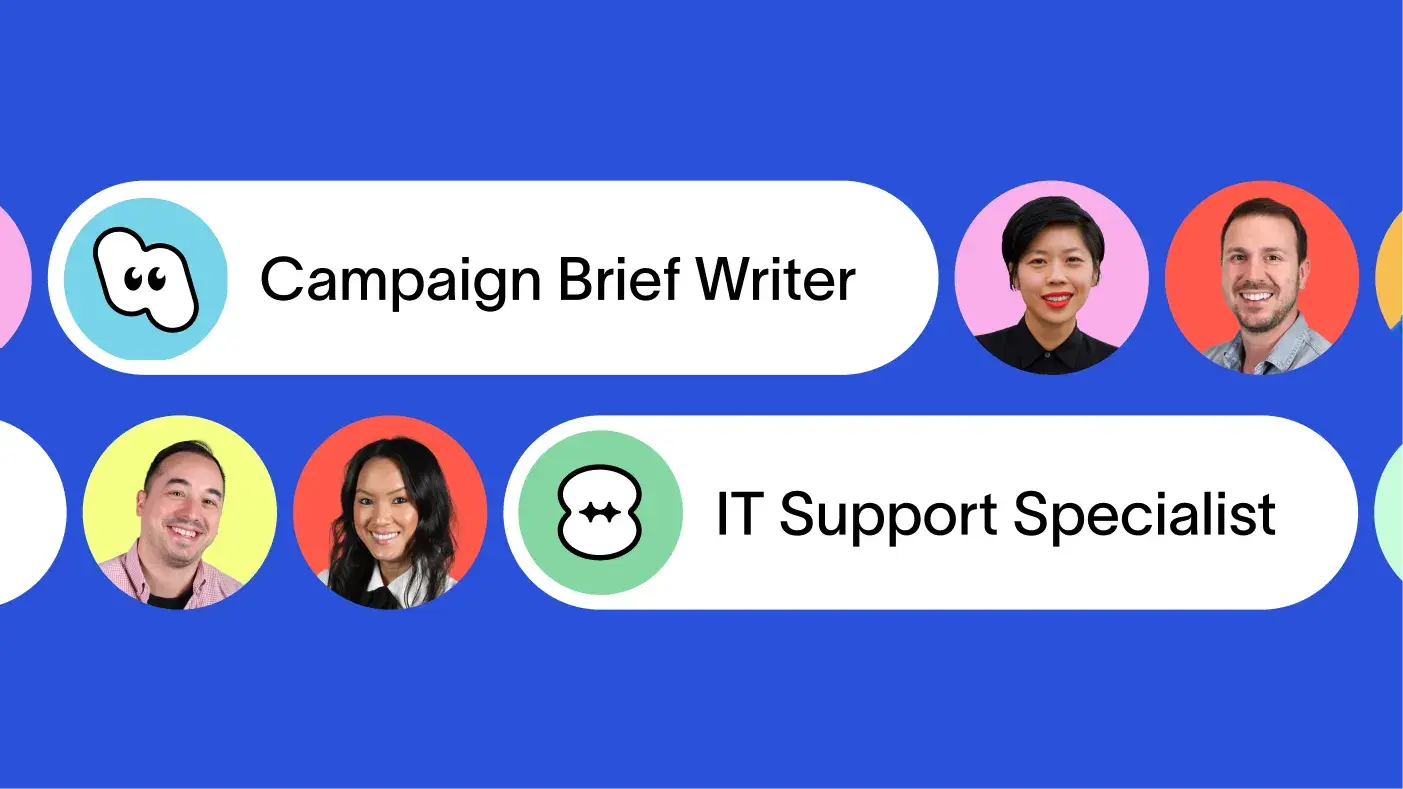
That's the gap Asana AI Teammates are built to close. With 18 years of work management expertise and millions of users, we've seen how the best teams operate across every role and industry. We applied that expertise, combined with direct research and collaboration with customers, to build 30+ prebuilt AI Teammates for specific roles and industries. The result is a collection of AI Teammates grounded in how work actually gets done, ready to go from day one, and built to get smarter the more your team uses them.
These AI Teammates are available today as part of Agentic Work Management in Asana, your easy button for AI productivity across every team.
30+ Role and industry-specific AI Teammates across marketing, ops, IT, healthcare, retail, manufacturing, and professional services
160+ Skills in the library, prebuilt into each AI Teammate based on research into how that role actually works, with the ability to customize as needed
10+ Connected apps, including Gmail, Slack, HubSpot, Databricks, and more
Here's a look at the research behind them.

AI Teammates move work forward for your entire team
Most AI tools work for one person at a time. You open them, ask a question, get an answer, and close them. AI Teammates are designed differently because they're shared resources that work alongside your whole team, not just whoever happens to be using them.
We learned this early with our private beta, where we worked hands-on with enterprise customers over several weeks, watching how they actually put AI Teammates to work. The moments that clicked weren't when an AI Teammate returned a smart answer. They were when it moved work forward in ways the whole team could see, like creating subtasks, leaving comments, and advancing to the next step.
When we expanded to a public beta, the teams that got to value fastest and saved the most hours treated AI Teammates like real teammates. They shared them across workflows, looped in colleagues, and built on each other’s work. The difference wasn’t the AI, but it was whether the AI Teammate was part of a shared workflow that the whole team owned.
That shaped a foundational design decision: AI Teammates are multiplayer by default. Anyone on the team can assign work, see what's in progress, and collaborate with the same AI Teammate, inside the projects and tasks where work is already happening.
How it looks in practice: A product manager assigns the Launch Coordinator AI Teammate to build a go/no-go checklist for an upcoming release. A product marketer then leaves a comment on the Google Doc requesting a draft announcement, and the Launch Coordinator acts on the request, resolves the comment, and updates the doc.
The more they work with your team, the smarter they get
In an Asana study surveying 298 people from a U.S. market panel in April 2026, 88% of them, decision makers, we asked which AI benefits people actually value. 51% of respondents selected shared memory and context as the most meaningful, an AI that gets smarter over time for the whole team, not just one person.
We heard the same thing in our private beta. When customers first saw AI Teammates in action, one of the first things they latched onto was the potential to scale institutional knowledge, by training an AI Teammate on their specific domain so the whole team could access it, not just the person who built it. A leading Financial Services customer described it as the AI Teammate getting more useful the longer it works with you, learning from past problems so the team doesn't have to keep solving the same things from scratch.
Because AI Teammates run on Asana's Work Graph®, the tasks, dependencies, owners, and timelines your team has built up, they carry that context from one assignment to the next.
How it looks in practice: After several weeks of working with the product team, the Program Ops Manager AI Teammate identifies a recurring pattern: design specs are consistently routed to the same place. It suggests adding a rule to the project, once approved, it automatically handles future routing, without anyone having to ask.
Every AI Teammate has an identity, permissions, and an audit trail
Multiplayer AI and shared memory sound good in theory, but the moment you tell a team that a shared AI Teammate can see their projects, act on their work, and retain knowledge across workstreams, that’s when the questions start. Who controls what it can access? What happens when it does something unexpected? Who can see what it's done?
Across both our private and public betas, trust was the recurring theme. Missed steps, inaccurate answers, and unclear expectations quickly undermined confidence, and as customers began thinking about scaling AI Teammates more broadly, the asks got specific. They needed to know what the AI Teammate could see, what it could act on, and what would be logged when it did.
Those asks directly shaped what we built into every AI Teammate: a named identity, scoped permissions, and an audit trail.
How it looks in practice: An IT admin sets up the IT Request Agent with access scoped only to the IT project, for example, it can't see HR or Finance. Every comment it leaves, ticket it closes, and task it assigns is logged in the audit trail, so there's always a clear record of what it did and when.
We looked for recurring patterns inside specific roles and patterns across industries
Those three principles, multiplayer by design, shared memory and context, and governance built in, are the foundation every AI Teammate is built on. But a foundation alone doesn't make an AI Teammate useful for a specific person doing a specific job. For that, we had to get particular, digging into role-based and industry-specific research to understand what each team actually needed.
Role-based research helped us understand what's actually distinctive about each function.
Marketing: The clearest opportunity wasn't the creative work itself. It was everything surrounding it: campaign kickoffs, cross-team coordination, content pipelines, launch readiness, and the overhead of tracking creative work across tools. Creative production predominantly happens outside Asana, and keeping tabs on it falls on individuals, creating visibility gaps, duplicate work, and an administrative burden that compounds with every campaign.
Operations and IT: Research surfaced different friction points. In Operations, important information often existed but failed to reach the right people at the right time. In IT, repetitive, high-volume work consumed team capacity, like ticket triage, compliance preparation, and onboarding coordination.
Together, these findings informed the skills library, a collection of specialized capabilities that help AI Teammates perform specific jobs well. For prebuilt marketing AI Teammates, that means skills like launch and event readiness, editorial calendar management, and creative performance tracking are ready from day one and adaptable to reflect how a team actually works. Across Marketing, Ops, and IT, one theme kept surfacing: the work doesn't live in one place. That's why AI Teammates work across the tools where work already happens through integrations with Gmail, Slack, HubSpot, Databricks, and more.
Role patterns only tell part of the story. The other question was whether those patterns held across industries, and what changed when the work itself looked fundamentally different. So we brought customers in healthcare, manufacturing, retail, and professional services into the research, built with them, and watched what happened when they used AI Teammates on real work in their own environments.
Industry research showed us where even greater specialization was needed. In manufacturing, teams needed an AI Teammate that could surface what the organization had already learned, flagging when a team was about to repeat a failed experiment and reducing the documentation burden that causes steps to get skipped. In retail, employees juggling multiple roles and critical launch dates needed everything to work before anything went live: product copy reformatted for every channel, launch timelines built out, production trackers checked for stale work.
The research shaped 30+ prebuilt AI Teammates, each built around the specific patterns we found in that role or industry, and customizable for the way your team works. And for when your work calls for something different, building your own is just as straightforward: define the role, add skills, give it guidance, and grant it access to the right projects and tools.
The research resulted in Asana’s new roster of AI Teammates
AI productivity doesn't have to stop at the individual. When AI Teammates are multiplayer, grounded in shared memory and context, and governed in ways organizations can trust, that productivity moves through the entire team, across every role, every workflow, and every handoff. That's what 30+ prebuilt AI Teammates make possible today, and what building your own makes possible for the work that's uniquely yours.
AI Teammates are available today on Starter, Advanced, Enterprise, and Enterprise+ plans as part of Agentic Work Management in Asana, alongside Asana Dash, AI Studio, and Asana MCP and AI connectors. Get started with AI Teammates today.
![[ACM Blog] Hero](https://assets.asana.biz/transform/15791025-1526-4e70-a52d-0412d237c30b/Resource-thumbnail_800x450_Client?io=transform:fill,width:2560&format=webp)