The future of agency work
Explore why AI-native client management is now a competitive necessity, then see Asana Client Management in action--leading agencies are unifying client communication, automating the busywork, and getting real-time visibility across every account
2:00 – Introducing Asana Client Management
4:42 – Bi-directional Client Portal Features
6:48 – Purpose Built AI Teammates
8:25 – Client Directory and Capacity Planning
10:04 – The Unified Work Graph Advantage
12:26 – Future Product Roadmap and Vision
So there's a study that came out recently. It said that managers who use AI at work spend about twenty hours a week just on coordination. And this is compared to managers who don't really use AI much at all in their day to day that were only spending about nine hours a week. Yasheen, have you heard about this study?
I have heard about it. And it kinda makes sense when you think about it. Right? We can give people a faster way to write an email, but it doesn't mean that writing dozens of emails at the end of the week, every single week, all of that toil, all of that work should really still exist. This is part of what we aim to solve with client management and something that, a lot of folks are really, hoping that we were able to solve with client management. So we're excited to show you some stuff.
So you're saying we took these, like, super complicated models, super awesome things, smashed them into the tools that we use today, and actually made the job a little bit harder.
Interesting. Why don't why don't we talk about, like, what we've done here? So I'm Pete Green. I'm on the go to market side here at Asana.
I'm joined here by Yixin Yang, who was on the team that built a lot of what we're gonna show you here This session is all about Asana client management, what it is, how it works, and where it's going on in the future. So relationships are everything to your business. Right? They're one on the quality of your work.
They're earned through trust built over periods of time.
And a lot of this is why agencies were among the first businesses to adopt AI in their practice. Their copywriters drafted faster, designers seemingly iterated overnight and sometimes in hours and minutes, and pretty much everybody's individual work sped up.
But the workflows that house this work, the the drafts, the briefs, the the client back and forth, the the long tails of emails that came with all of this output of work, well, all of that required piecing together fragmented and and disjointed pieces of information from different tools.
And as you can imagine too, AI is also working from that very fragmented picture, so it made this work a lot harder. And this starts to compound over your tools, your people, kind of across your entire book of business.
And so that's why we built client management. It's it's set out to fix exactly this. It's the one place where those client communications, that AI output, and all of your product delivery can live in one single connected platform.
And instead of me going even further and telling you about it, why don't we just show you instead?
Running an agency is a tightrope act. You work to keep clients happy while navigating scattered communication, a tangle of tools, and rising overhead. That ends now. Introducing Asana Client Management, the one place for every client, every project, every conversation.
With a branded client portal to review briefs, deliverables, and approvals, clients are always up to date.
And built in AI can create summaries, action items, and assignments after every call.
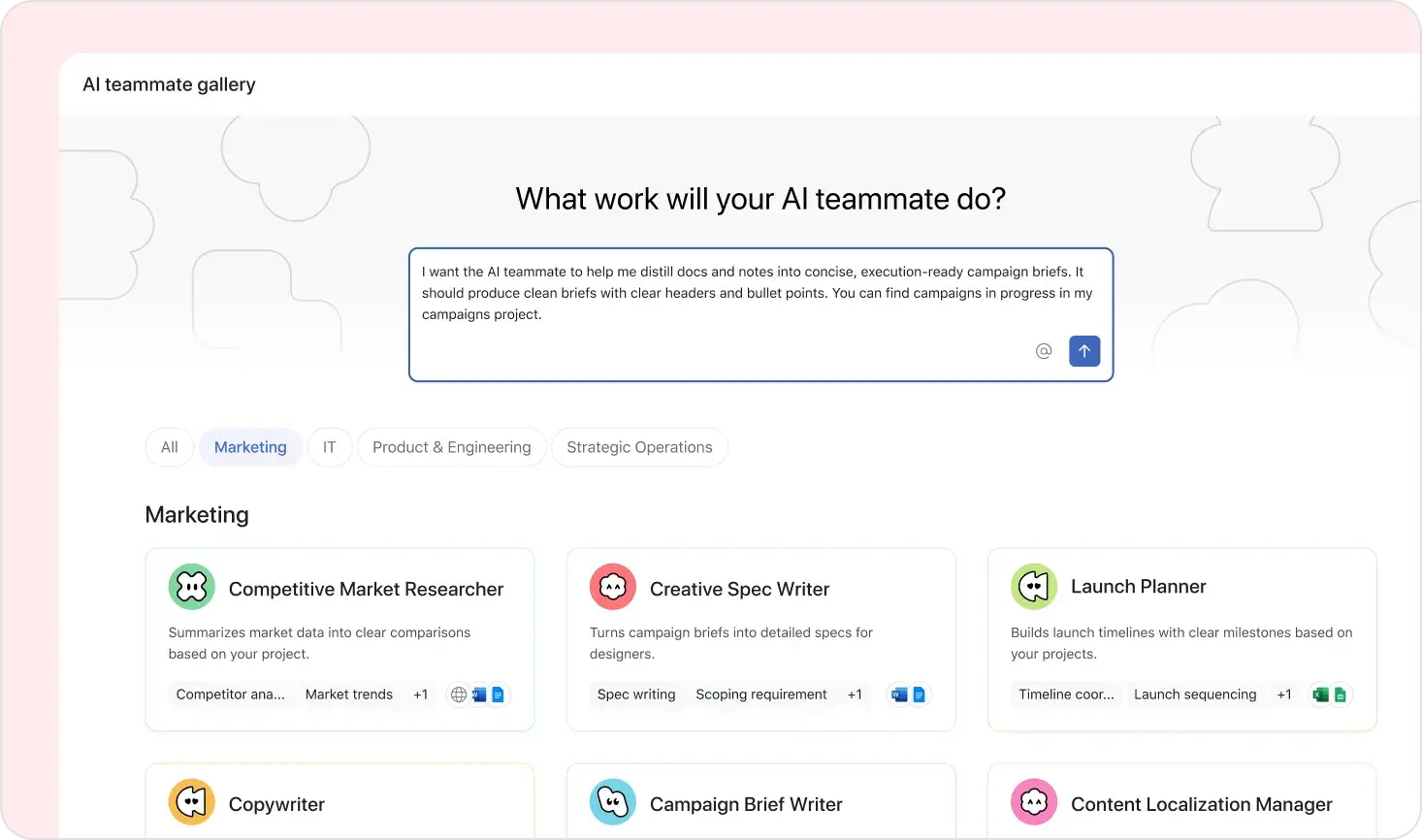
The creative producer AI teammate can turn client briefs into structured tasks assigned to the right people. First drafts get generated for your team's review, saving valuable time.
Client feedback gets captured directly in the workflow, so assets keep improving.
With Asana client management, staffing, billing, and budget information live in one place. Risks get flagged before they escalate, and you can make resourcing and portfolio decisions based on actual data.
Plus, you can get a live read on client health across every account. This all adds up to better client retention, increased profitability, and a more satisfied team.
Start streamlining your agency's work in one place where you can manage it all. Go to asana.com/clientmanagement to learn more.
Awesome. So fun. Okay. Nice. So we built Asana client management around two connected needs. The first one is the client experience.
Your clients want one consolidated hub where they can see everything going on with their projects. What's the latest status? What feedback do I wanna provide? What do I need to request?
All in one view that's curated specifically to them. And the second part is the...
What the agency sees. So in the back of house, we need a really coordinated place where all of the context lives about every single client, all of the work being done that is streamlined, organized, and automated where it needs to be and able to deliver really great outcomes. These two things together turn good client relationships into long lasting durable ones where really great work can be delivered. So I'm gonna take a few minutes here and show a little bit more of a deep dive into how that works in client management.
We're gonna start here in the client portal. This is the client portal, and I'm gonna peek back the curt...
Pull back the curtain a little bit to the back of house view. This is the view that your team configures, and you can curate exactly what each individual client sees. What's the latest status update? What files need to be shared for approval?
What tasks are assigned? And it's bidirectional. So that status update that you published, the client can answer directly back in that same status update and ask a question, give feedback, ask for clarification. All of it is centralized in the portal rather than fragmented isolated client emails that only one or two people see.
This is amazing particularly for agencies when you're managing at scale. So an account manager with 10 to 15 active clients with different expectations about levels of engagement, what kind of information they get, That's a lot to manage. The client portal puts it all in one place and so every single, portal is curated exactly to what that particular client needs. So that's the client portal.
But we all know that client relationships aren't only built in email threads or even in Asana client portal or Slack. They're human to human and a lot of this happens in meetings.
Meetings are where decisions get made, new direction is given, feedback is provided. And all of this needs to make its way back to the building team. That can be a lot of work, which is why I'm really excited about Asana meetings. AI meetings allow you to record and transcribe meetings, generate a summary and transcript, and capture that all of in Asana.
Even more exciting is that it captures action items of what was said in that meeting and it generates them into tasks. So now you have structured work that is ready for your team. Here, we have a kickoff call that was turned into a few tasks including the first one to write a draft of a creative brief. And instead of assigning it to a team member, here we've assigned it to an AI teammate, the creative producer.
The creative producer doesn't start from scratch. The creative producer has all of the context about this client and can pull it into that first brief that they're writing. So they know about the meeting that just happened, the past meetings that happened, the feedback that was given in this portal, past projects that were work... Worked on, and other assets like brand guidelines and more. They create a really, really great first draft for the team to review so the team can get past that first scary blank page moment that we all know about and get to work.
The team can also chat back with this AI teammate, ask it about context, ask for additional web research, and refine the campaign brief, then publish it back to the portal and straight to the client.
The other three AI teammates in Asana client management work the same way. So we have four burp... Sorry, purpose built teammates and they are designed exactly to do the jobs and skills that agencies told us they want to automate the most. So there's the operations coordinator, an executive advisor, an account advisor. They all work the same way. One click task delegation, producing a draft for human review, having a collaborative moment, and that is AI teammates in Asana client management.
Now, we've talked a lot about the collaboration between clients and the agency, how we turn unstructured work into structured work with client context backing all of that. I'm gonna change track a little bit and talk a little bit about how client management gives you visibility across all of the work that you're doing in your agency.
This is the client directory. The client directory provides you one view across your entire book of business with all the key information that normally is living separately in a CRM. Here, you can have it also in Asana, and you can have renewal dates, what's on track, what was the last published status update, who owns this account, what's the current progress. Each each of those pieces of information lives right in this client in for... Client directory where your whole team can see it so they can deliver their best work. And for each of those accounts, all of the information about that client, all the work that's going on is all in that account record, and so it's all well organized for your team.
And then finally, we have team capacity. So team capacity allows you to see exactly how your team is staffed across all of that work. You can see exactly who is working on what and when, who is available, who is overburdened, and make changes to that plan. That's client management.
So I wanna bring this back and and ground it to a little bit of what I said at the very top here. The the study that said AI is actually making our job harder to coordinate work. And the the reason for this is AI, and especially bolted onto our tools today, they don't actually know what's happening across the rest of your team. What AI does is make a lot of your individuals, your teammates, human teammates around you more more productive, increase the output, but it doesn't actually know what's going on across the rest of the team.
There is no shared multiplayer workspace for for any of this. And so, okay, Pete, you just showed a bunch of teammates. You and your Sheen are like there's all these teammates with AI in client management. So so what's different about that?
Well, these teammates are governed by the same what we call work graph that exists across your entire workspace. The same single consistent data model that governs your tasks and your projects and your portfolios and your goals. The difference here is now you can add in your clients, the people you work with, the vendors, the clients, those that need access to specific portions of your work to be a little bit more specific and and, with the right levels of preferences in the way that a lot of these work.
And so other, you know, other tools store files and they can draft status updates for you and, you know, they might have a chat bot on the side that make you feel really, really good when they give you really awesome productive feedback. But what they can't do is is create this place where your client communication, your project delivery, which is the bread and butter of what work management has always been, and your AI output in this single consistent data model. The work graph is is something we at Asana have been building for for nearly two decades. And and now today, it's been built specifically for what you do in your businesses and the way that you operate with Asana client management.
So I'll tell you a little bit of story...
A little little story here. I love I love customer stories. Amsiv is a large multi service agency with over 900 clients. And at a company of that size and scale, the the cost of fragmentation with what's going on is real.
Different people on different teams have different views of what's happening across multiple different accounts. And you can imagine that when you...
When it looks kind of like that, every hand off of work, it starts to become a risk. Right? Every new client onboarding, that has to be built from scratch. I agree.
I totally agree.
And so Adam, who I'll tell you about in a sec, he and the team put together what they called a client hub. One single persistent record per client that they built within Asana. And now this actually became the the foundation for a design partnership with Yashin and the rest of the product teams that basically took what that problem looked like at scale and helped us... Helped influence a lot of what you saw on the screen today. Adam Lazada, the digital workplace platform enablement lead there at at AMSIV, he's gonna be hosting a fireside chat later on today that I think you'll all really get a lot out of where he'll walk through how they took what was kinda once a workaround for for for them and honestly a lot of other customers. What was once a workaround in Asana work management actually became a natively built operating workflow through Asana client management with what we've uncovered with with the client portal and the client directory there.
And now, Yasheen, do you mind showing us where this product's gonna go in the future? Because I think it's... I think it's pretty exciting.
Okay.
Yeah. So today, in the September launch, we really built that around the things that I just talked about. So client collaboration, AI in the workflow, structuring work, visibility across your whole business. This is really about working operationally better as a team and having purpose built workflows for agency work.
What's next is we aim to extend that foundation to really focus on how projects get staffed. So today, when you start staffing a project, when an engagement starts, a project plan needs to be made, and then you have to figure out who's gonna do this, who has the right skills, who's available. Often, includes hopping out into other tools, usually a bunch of spreadsheets, often some tribal knowledge, just trying to figure out, okay, how are we gonna get this done? Do I have what I need to get this done?
We think that there is a better way. So we are building a purpose built workflow that really enables you to build staffing plans that are informed by things that you care about the most, such as roles, skills, past client experience on past accounts, even rates and more, and building an availability. Sorry. That's very important.
And building out a staffing plan that the team can then take a look at, tweak, and make into what is actually going to be executed. So you no longer have to start from scratch. It is a planned view that, you can respond to and helps accelerate the work.
And then looking a bit farther, we're going to be taking a look at the business metrics, the performance metrics that agencies care about most. That is typically delivery, like, is this on time, budget margins and profitability, and also client health. Is this client happy? So Asana is deeply in the work.
We know a lot about, what's going on with the actual projects being delivered. We've kind of talked about that a little bit. And so we can flag early when there's risk such as scope creep or over assignment or margin erosion and give you that signal. And it's not just about alerting after the fact, which a lot of tools can do.
It is about giving you the signal early so you can take action. You can replan a little bit of that project. You can reassign work. You can prepare for a client conversation before it's a problem, before it's a much harder conversation to have.
So that is profitability. Today, we have sort of better collaboration, better communication, better visibility. Next, staffing with informed by, the data that matters most. And then finally, performance metrics and a proactive view across delivery, profitability, client health.
All of you got into this business to do great work. You didn't get into this to cobble together status updates on Friday at 4PM when everybody seems to be leaving. You didn't wanna spend your Sunday nights trying to piece together what decisions were actually made in the meetings that happened the week before that you weren't even in so that you can get ready for that stand up at 9AM on Monday morning. You got in this to to run your business and and and grow your business and do great work for your customers.
And so going back to, you know, the... This... I'll reference this one more time, and then you never have to hear it from me again. That study at the beginning that saying AI is making our job harder. Well, you think that AI would actually make those things a little bit easier, but but here's the issue.
Tools, the things that you're using today, those don't compound. Those don't compound growth for your business, for your clients, for your work. The context that you have around all of that is what does compound your business. And so if you can think about, you know, each of those value streams of work, saving down those those preferences, the things that you do consistently in terms of revision, finding all of that work proactively to update that status, that's exactly what Asana client management is and what it can do within your business.
And so all of that used to live as institutional knowledge. You know that coworker that knows exactly what to do with a specific task when it comes through. With Asana client management, with the teammates, it's not institutional knowledge anymore if it can actually be saved down as a preference that is client specific for the work that you do. And so I got three final calls to action.
These probably would have been the recommendations from the meeting that Yashin probably would have recorded for me here. Number one, QR code in the corner. It's on this side. QR code in that corner.
Go ahead and give give that a scan. Start a trial. If you're an existing Asana customer, it'll just turn right on in your instance today. If you're not, play around with it.
See what it looks like to get your agency work, your client work within Asana. Number two, go check out Adam Lozada's fireside chat later on.
Whether you are curious about what this type of work looks like at that scale or you wanna hear firsthand knowledge, not from somebody who isn't working within an agency, but somebody that actually does great work within a team that does great work, go check that out later on today. And then number three, come find Yasheen and I and the rest of the team at the demo booth. I'll tell you where I got these really cool Asana Klein management yellow slash green slash bright cactus is actually the Nike Nike term shoes, and how maybe we can get you a pair if we get started on Asana Klein management today. Thank you.