Migrating your service management to Asana
In this fireside chat, Patrick Williamson, CIO at Array Behavioral Care, explains why Array moved service management onto Asana instead of a traditional ITSM platform, how the switch cut platform costs and technician effort, how AI now handles ticket classification and troubleshooting, and what's next as the team expands beyond IT into HR and legal.
0:48 – Challenges With Disintegrated IT Silos
3:11 – Asana Adoption and Goal Management
4:58 – Transitioning to Asana Service Management
6:53 – Asana Service Management Design Partnership
9:23 – Reducing Tier One Support Tasks
10:35 – Leveraging AI and Knowledge Bases
13:40 - Expanding Service Management Beyond IT
My name is Patrick Williamson. I'm the CIO for Array Behavioral Care. We're a a tele behavioral health services company. We service patients in all kind of acuity settings, so we do therapy, medication management, outpatient therapy services. We support emergency departments.
Yeah. Amazing. So thanks for joining me. Yeah. For those of you who don't know me, I'm Arnev. I'm the head of product.
Patrick's team has been working very closely with us on Asana service management. They were a design partner. They met us here actually almost a year ago, at Work Innovation Summit last year, '20, five, and they've been amazing in terms of helping us incubate the product, get all the feedback, and things like that. Yep.
My question for you, Patrick, is you made a call that most CEOs wouldn't. Rethinking service management as an operating model is quite a big bet. You know, there's a standard way in which enterprise service desks have worked in the past. So if you walk the audience through the rationale and why it made sense for you.
Right. Well, I've been, I've been doing IT services my whole career. I think I'm 23 in now.
I've seen a variety of, you know, service teams, service design. I've, you know, built service teams. I've done I don't know how many ITSM deployments. ServiceNow, BMC, Jira.
There's a full list, and they all, frankly, don't work that well. I mean, there's there's there's pros and cons, but, like, they're they're this this disintegrated silo that IT operates out of, and when we when we became an Asana customer a couple years ago, all of our company's work and DNA was now inside of Asana. That's where work happened.
And so we... It was even more glaring of this this problem where we were like this silo, and people were like, do I have to go to Avanti to submit a ticket?
Like, can you guys just integrate the two? And and And we eventually got to this mindset of like, why don't we just replace what we're doing? Can we rebuild what we have in Avanti today into Asana? And so that we started this journey before WIS last year.
And then, you know, we we we started, you know, the design partnership, which I know we'll get into, but it just... It it it was this moment where we were able to break down the barriers and the silos of where the rest of the company was working, and IT was off on their own system. And so there was this natural progression that that made me feel comfortable to to make that move.
Yeah.
So there was, like, very clear outcomes in terms of bringing your employees a great experience when working with the ticket management system and combining the systems of, like, collaboration with ticket management Right.
So that it was all on the same page. Right. Yep. Yeah. And I know we've got some questions coming up that, like, unpack that for the audience on how you did that journey, made the transition, so that'd be great.
Maybe to, like, level set for folks here, what was your Asana usage like? Yeah. Like, in the steady state, how do you use us today?
How does your organization actually run-in Asana?
Sure. Yeah. So I started the company in late twenty twenty three, and the whole company was really siloed, spreadsheets everywhere, workflows that required manual follow ups, like the traditional kind of mess that we find our businesses in, and we went out to the market to find, you know, a work management system, so when we chose Asana, and we identified some key workflows that were really difficult across the business. Being a clinical services company, we do a lot of clinician onboarding, so we took our onboarding process, we worked with Asana professional services, and we got that into the platform, and then we just started evolving from there. I think one of the cool evolutions that we've gotten to is our entire company top down is using Asana all the way from the goal feature down to managing tasks. So our CEO, you know, he manages 40 goals across the company that we have. They're each assigned to executive leaders like myself.
I manage the teams. They have the projects. We do...
We have a a cadence or a rhythm of work where, you know, we do bimonthly goal updates. We communicate those. We've got meetings for accountability and and sharing results, and so, like, Asana is, like, truly in our DNA from, like, the top down. And so then, you know, adding on to these IT services processes just made all of the sense.
Amazing. I mean, I love hearing these stories where a company actually leverages the full pyramid of clarity and has goal setting and your CEO is deeply involved. Yep. There are a few customers I work with who've achieved this level of success in the deployment. It's so fantastic to see. Yeah. Thank you for walking us through that.
Maybe just diving a bit deeper into, like, this transition of going from collaborative work management, goal management, to actually doing ITSM. Right.
As a CIO, I mean, most CIOs would probably go with an existing name brand ITSM vendor Yeah.
Because there's a, you know, set of checkboxes that they will obviously all take as part of an RFQ process.
There are analyst reports that would recommend them.
Why were you willing to bet against that?
And, like, what inspired you to kinda go on that journey?
Yeah. I think, as I explained, I've done a number of different ITSM platform deployments over time.
I'm a recovering ServiceNow deployment lead twice.
It, you know, gave me the gray hairs I have today.
We went through this Avanti transition. As soon as I started the company, team had just launched Avanti, and it was like, oh, really? You chose Avanti? But, you know, it's a legacy platform.
It's not...
They're they're not keeping up with the modern times, and so as as we really got deep with Asana, it was like, wow, with Asana AI and and workflows, like, I could recreate this. So we were having a board meeting in Chicago in November of 'twenty four, and got out of the meeting, and I said, I'm gonna build an ITSM platform today. And so I built basically a help desk project matched exactly what we're doing in Avanti. Built it in four hours.
That wasn't using AI or anything. That was just using the core product, and so we came up with a plan. We cut over to that probably six weeks later after we did some other tweaks and workflows, And then I was at WISS, and my lovely account team, I don't know where they're at. They're here in the audience somewhere.
Oh, right there. Nice. Romina. She got me connected to the product team here just to to talk through, like, hey, Array built this ITSM platform.
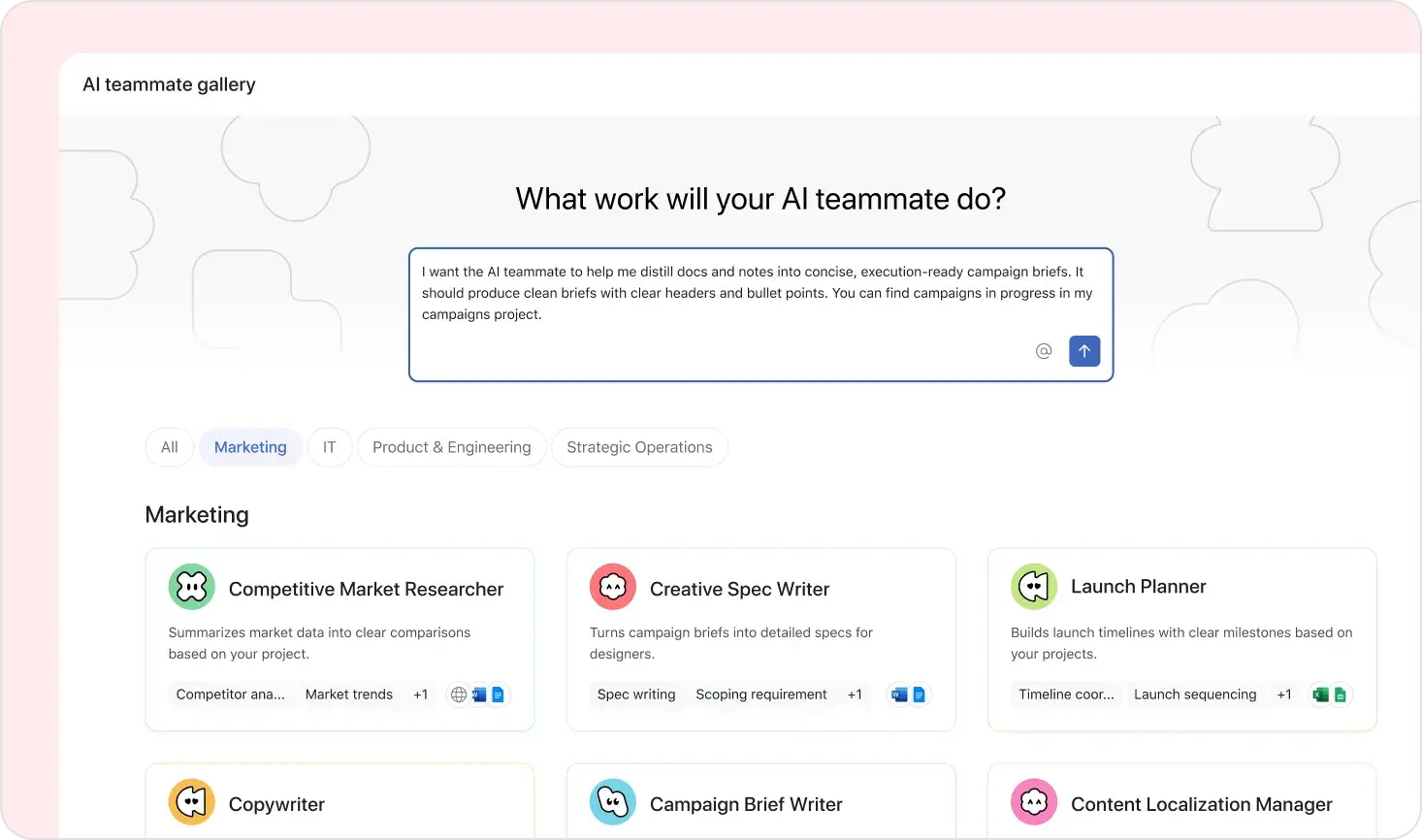
We're building a service product. Would you be interested in becoming a design partner? Which coming with the kind of the baggage that I have of of all of these ITSM platforms over time, it was like, oh, I would love to be building something from the ground up, especially that's AI powered. I saw the vision that you guys had, and I was like, I I gotta be part of this.
And so it's actually been the...
One of the most fun meetings I have of the week. My family is tired of hearing about Asana for service management at the dinner table, because on Thursdays is when we meet, and I'm like, oh my gosh, you gotta see what we did today, and my wife and kids are like, dad, stop. Like, stop talking about service. So it's just, it's been very exciting.
So, like, when I look at the product, like, on the screen earlier today, I see all the fingerprints of, like, the the workflows that we adjusted and the features that we added along the last nine months. And so coming from a technologist background, if you if you guys are in the similar similar positions and and you're dealing with these systems that are, you know, difficult to configure, hard to maintain, this was built with all of us in mind, coming with all of the years of experience I have in it. So I hope you guys like it. If you if you look at it and you you use it, you know, I'm really proud of what we did together.
Amazing. I mean, it's an amazing story and, something that I'm super excited about because one of my principles in terms of building product is actually to co build products with customers like yourself, customers who are visionary. Because there's only so many things you could decipher as a research and development team by doing, you know, first party research or looking at competitors and things like that. The real ergonomics in terms of making sure that the end to end journeys that a practitioner actually cares about is delivered is in partnering with the practitioner and partnering with technologists like yourself to go build that product.
So, like, thank you for that investment of time and resources to make it happen. It's been a lot of fun. Yeah. Maybe a a sort of a deeper question is you were already on your journey custom building an ITSM solution on Asana Yeah.
The existing product.
How was that switch for you? Like, did you have to sell your team and convince them that they should wait for Asana service management to mature, or was it a no brainer given some of the AI capabilities that Jen and team were pitching? So you talked talked Yeah. About, like, how you manage expectations for your team and motivated them.
Yeah. You know, IT help desk and system administrators, they don't want to be answering tier one questions. They don't want to necessarily have to answer the same question every single day.
Everyone wants to kind of be moving up and growing up a little bit, you know, and so what this is really allowing us to do, at least with this initial phase one go live, is take all of kind of the level one requests and incidents, troubleshooting, and how to, and answer it agentically through the service portal. And so our team will be able to level up, if you if you think about it, to not having to do a lot of the tier one repetitive things.
And then the the kind of the next phase of this will be incorporating a lot of the automation. So request management workflows, a lot of the things that we're showing on the screen today Whether it's leveraging Stack, your own automation tools that you can plug in.
That's our next phase of this, and so when our team looked at it and our help desk looked at it, they were like, oh, I don't have to answer the questions of how do I plug in my monitor anymore? You know, like, people aren't gonna send me a Teams chat or open a ticket for Yeah. I can...
They can just go to What's the best WiFi password is available?
Absolutely.
And so so what's awesome is inside the service product, there's a knowledge base, and you, as the customer, get to define what's in that knowledge base, what's unique and specific to your business.
You configure it. If there's knowledge that's missing, it recommends. You should make additions to this. You have the ability to draft and review all of that. We spent a lot of time just beefing up our knowledge Knowing that, like, we wanted this to be as self sufficient as possible. And so, the AI deflection rate where people will be able to use the service portal and not ever escalate to an agent, I I know it's gonna be at least 20%, and then once we start doing more request workflows and automation, it's gonna go up from there. So... Which is great because the team is is being able to do more valuable work, the stuff that they like doing.
So I think that was actually gonna be my follow-up to you, which is we saw a stab back from your team that they believe about 20% of their capacity will get freed up Right.
Asana service management is fully deployed Yep. For them to do, like, more strategic work. Right. Perhaps, like, you would tell the audience a bit more about what that strategic work is because, again, we we believe that products like the Sana service management and the AI functionality that we are building is there to help teams achieve more, help elevate human beings to doing strategic work that fulfills them Right. Versus, simply take away tasks that they were completing. So I think talking a little bit about that philosophy, that ethos could be helpful.
Yeah. Two examples I guess I could share. So first, what we did, since we have all of the tickets in Asana today, we exported that, we analyzed them, and we developed the knowledge base to go address what's the current tickets. And so that was kind of our plan, and that's how we came up with that number.
Being a clinician services company, we have a lot of clinicians that need help, and so this will allow us to spend more time with clinicians, showing them how to use the software, showing them how to resolve issues, you know. Their time is very precious, and so they don't have a lot of it, so we white glove the clinician troubleshooting. So that's going to give our team more time to do that.
The other area, our team wants to grow, and they want to lean more into automation. They want to learn new products. You know, I have growth plans for the entire service team, you know, certification plans, you know, learning new technology, becoming system administrators. They don't have time for that, you know, when they're doing tickets all day. And so, this is going to help free up some of that time so they can start to level up.
Our current system administrators are moving into more automation engineering Yeah. And AI engineering. And so, like, the whole team is Getting elevated. This transition to elevating in their own respective way, but this is just a piece of that that evolution.
Amazing. I think that's a super inspiring story. Right? Like, this is a way where you're sort of not doing busy work anymore, things that are draining, and really focusing on the things that help you elevate yourself in your career as a practitioner. Yep. So super, super excited to hear that.
Maybe in the final few minutes, I'd love to hear your perspectives on where do you see service management expanding beyond IT? Which functions are facing, like, similar challenges today in terms of the number of, like, questions they're getting and tickets they're getting, and how do we Sure.
Do we help improve the Yeah.
I can talk about the array perspective, but also being in, you know, the variety of companies I've been in, I I have a good perspective on where...
What other teams outside of my company Yep. Could apply this. But our HR team is, like, chomping at the bit to get to get service. Like, they've seen what we've developed, and they've got essentially one FTE that just answers questions, you know?
And so our our chief people officer is like, you know, how do we do this? Like, help me develop the contents. You know, we've got a ton of policies and procedures that we can convert into the knowledge base, and then that'll help her team do something similar. Our legal team has...
Deals with a lot of contract and contract reviews, state law questions, like, we've developed Microsoft Copilot agents for some of this, but it's like moving people to a different section of the technology that they're not necessarily using every day, so, like, adoption isn't great. If we had this in the service portal, a lot of those questions could be answered natively, and, like, this now kind of becomes the how to interface of Array, where multiple teams can load content in. Our account management team, you know, there could be some goodness there, but, you know, think of any team that's servicing people, you know, so if you were NYU was on stage, So think of all the students that, you know, need Totally.
To to get support.
You know? So there's there's a lot of applications at every business, I would imagine.
Yeah. I mean, one thing from just a strategy perspective that I believe in is service management is not only about addressing concerns and, like, a defect or some, like, break fix issue that an employee runs into. It's actually an opportunity for us to elevate the employee experience and actually unlock their full potential. Yeah.
So if it was super easy for someone to know, like an NYU student or an employee at Array, how to best do their work or get get optimal outcomes through the centralized portal and they're constantly being coached via these tools, that I think can be a phenomenal, like, next gen outcome going forward. Right. Yeah. Agreed.
Any final words of wisdom, Patrick, before we wrap up?
No. I... I'm super proud of the product. So if you have questions, please come talk to me. I'd I'd love to share my insights on it.