Amsive's journey with Asana Client Management
Before a purpose-built solution existed, Amsive built one themselves. In this conversation, Adam Lozada, Digital Workplace Platform Enablement Lead, shares how Amsive identified the gaps, what they built to close them, and what's most exciting to him about the new Asana Client Management product.
4:55 – Onboarding and Knowledge Transfer Pain
8:47 – Solving Discovery Fatigue
12:55 – Leveraging AI Teammates and Claude
19:06 – Future Agency Models and AI
24:12 – Shifting Focus to Strategic Work
Hi, everybody. Welcome. Thanks for joining us. I know you've probably all had a full day, lots of conversations, lots of exciting stuff, and Adam and I are excited to bring some energy, have a really fun conversation for this afternoon. I was thinking maybe we start with some crowd work?
Yeah? No. Love that.
Perfect. So, we are really excited to kind of close out the day with some pretty real talk about agency life, and what that means, and what it really takes to deliver results consistently for clients. We want to have a pretty honest, kind of casual conversation with you all, with the goal to really, hopefully you leave feeling a little less alone in maybe some of the challenges you have, and see a path to solving some of those. So my name is Molly Greenberg. I am the head of new product introduction here at Asana. So my team sits at the intersection of product, engineering, and go to market.
Really, our job is to make sure that new products don't just ship, but they actually land with all of you. I've been with Asana for a little over four years now, and have been really closely involved with the development and launch of our client management product, so this conversation has been a long time in the making, and we're excited.
Super excited.
Yeah, I think we all know intuitively that the best client relationships are those that compound over time, and every conversation and engagement is an opportunity to add to what your team knows about a client, which is what, you know, my colleagues are doing today with all of you. And it's important as we learn your preferences, history, what's worked, what hasn't, that is only really valuable when that context is somewhere it can accumulate and grow, and for most agencies, that really isn't always the case, and it can't always be consistently leveraged. So Adam Lazada is joining us today as the digital workplace platform enablement lead at Amsiv, which is an 800 person performance marketing agency, and when the tools and systems that Amsiv had in place didn't really solve this context problem. Adam actually built something himself inside of Asana, and then when Asana started thinking about building a client management specific solution, we called Adam. So welcome.
Well, thank you. That was a great introduction. Happy to be here. I'm looking forward to the shot.
Awesome. So maybe let's start by kind of setting the stage with some context. Can you paint us a picture of life at Amsiv? The scale, range of services you offer, what it means to manage a lot of client relationships at once across a lot of different teams working on those clients.
Yeah, so Ampsif is performance marketing agency.
We have 800 people, but at any given point we try to keep everything in house. So we do everything from your digital marketing, paid media, SEO, creative influencer, all the way through print production, wide format printing, and everything inside.
So with that, with that many clients and that kind of scale of services, at any given moment, our client directory, I think in total is like 900 plus, but at any given moment, we've got a 150, 200 active clients, and they, unfortunately, don't all start on the first of the month and don't all end at the end of the month. So they're coming and going, and, you know, across all of those different departments, everyone is hyper focused on their own piece, so it can be a lot. Client management becomes its own role.
Right, right. And so what I'm hearing is what kind of makes this genuinely hard is a shared understanding of who this client is, what is happening across the account in its entirety.
Tell me a little bit about how that's been working in the past or other challenges.
Yeah, I think naturally when this is happening, I'd like to say that my teams are the best at what they do, but when that happens, they're hyper focused on what they're doing, and it's hard to take that 30,000 foot look and understand holistically what's happening at a client. You know, we have clients that have 10, 12, 15 different engagements happening in different departments. So the teams are focused on what they have. So their their knowledge is, you know, naturally becomes very dependent on what they know, what they're what they're handling.
They do a great job, you know, jotting it all down and keeping it together. But in the world we live today with this kind of explosion of tools, that means that each department has their tool that works specifically for them and does a really great job for them, and they keep all their knowledge there. But the other teams don't have access to it. They don't use it.
They don't know what's going on, but they know what's happening for their piece, so it becomes this kind of fragmented silos that just happen because of the work that's going on.
Yeah. I think that that resonates for sure. And before we maybe get into how you started to address that, we could have a little real talk of, you know, that's a general problem I think we all can relate to, but in the actual day to day, what were some of the moments that made you stop and go, okay, something's not working here?
Yeah, I mean, I think anybody working in an agency knows that the the day doesn't go smooth. Right? And there's always there's always pain points. But when we started to kinda talk about this client management and understand, we would always come back to this idea that when we were onboarding, whether that was net new clients or a current client that was getting a new solution that we were adding to their program, or a former client that was coming back to us.
They were coming in and joining at these different points, and it always felt like we were starting from scratch. It was always, you know, one, two, three, four, five, continue on meetings of onboarding meetings, And everybody's sitting around to get set up and understand what this client does, and everybody asking the same questions over and over. And and this is not a shot at Asana, we love Asana Asana forms, but it was always like, why do I have to fill out 500 Asana forms to tell you the same information that I've documented everywhere? And every solutions team was like, why can't they fill out the forms with all of the information?
Why don't they have this? And so it became very clear that like the knowledge transfer was the pain point and was the...
What the issue was.
I saw so many nods out in the crowd. I saw far too many nods about the Asanaforms comment. Come on.
No kidding.
No, it's very real, and guess Mimi, what were some of the signals that made you say, okay, this is actually like a system or process problem, not a people problem, to your point of, hey, I need them to fill out this form. Why do I need to fill out this form? It's not training or enablement. What kind of made this ping as structurally and systematically?
Yeah, so we actually, And I highly recommend this if you haven't done this, but when we were starting to do this, we just kind of wrote out the workflow. As we wrote out the workflow and you see exactly where it starts and where it ends, we would just interview people and ask them because we were like, okay, this might be a training thing, like filling out a form's that hard. But You think. Yeah.
Actually, you you would think. But as we started to work with everybody, it always just came back to...
We would interview people and ask them for the process, and whether they were ten years or ten days, they would be able to list out the process. But it would be slightly different, it would be at different stages, maybe a different tool was used, or like who was responsible for it was slightly different. So it became like it's not necessarily the people, they understand Right. You know, what the idea is, but our system clearly is not written out or defined well, or the pieces just aren't where they need them so that this flows.
Right. I think onboarding, in a lot of our conversations, came up as the consistent spike of where this kept breaking down. I don't know if that resonates with other people.
We nod, a show of hands. Okay. Have a lot of nods.
Partially because it should it should be a repeatable process.
But any other reasons maybe why that or another particular area were the most acute, you think?
Yeah, I think we're an agency, and hopefully everyone here is working at an agency as well, you're working with clients. That relationship never ends, and it is the most important thing. And when we were, again, mapping this workflow and talking about what was going on, just the idea that when we start an engagement with a client, you know, sometimes our sales teams are working with a client for months before they sign anything. Right?
And they've created this relationship and they've talked through everything and they've gone over what is important to them, what their KPIs are, and what they're looking for in the direction. And then we would get inside with our solutions teams and they would be like, great. Let's talk about what's important to you and what are your metrics really? Oh my god.
And then...
Or internally, we would have the same conversations. And, you know, when you're bringing a client in and somebody's signing for five, six different solutions and they have to meet with five or six different teams and every time answer the same questions, it kinda leaves a bad taste in their mouth.
And for our teams, was a struggle too. So it really... Every time we wrote it out and every time we talked about the pain point, it came back to this idea of onboarding and this knowledge transfer and like a single source of truth and how do we get that to our teams without having to rely on the the individuals to follow, you know, such strict wrangling of information from all the different platforms.
Yeah. I call it discovery fatigue. Yes. When you've had the... A conversation with a customer from five different people who have five different jobs to do, that kind of are all asking the same questions, but just in a slightly different flavor. I mean, if we can be honest here among friends, that has impacts.
I don't know, maybe hypothetically, or this is not something that would ever really happen to you, but did you experience any potential impacts of not having this process set up?
So unfortunately, we have.
Fortunately for all of everyone here, my boss couldn't make it today so we can tell the story. But I remember very distinctly, we were sitting on one of these onboarding calls and we are all sitting around and of course everyone is multitasking and doing a million different things. And they're going around and talking about the client and the brief and what's on it. And somebody on the call was just talking about how they read the metrics, they saw the brief, they understand everything, but what they really thought was like, hey, you know, what I what I'm gonna take to the client is I'm gonna just tell them, you know, your website is trash and we we need to we need to redo it because if you do it, it'll help us achieve our goals.
And everyone kind of nodded, some people were like, okay. Yeah. You know, you get the thumbs up emoji. Somebody clicks on Teams.
And then, listen, somebody came up to me and was like, I'm sorry. Did did you just say you're gonna tell the client that your website is trash?
And they're like, oh, no. No. Sorry. I I didn't say that to them, and I'll, know, I'll deliver it in a much more professional way, it'll be great.
And they were like, no. No. No. We did their website six months ago.
And they were like, what? And, like, you didn't know that? And everyone kind of freaked out and panicked. And, you know, it...
Was a lot more context that came out of it. And it was like, they didn't have the budget. They didn't agree with what we wanted to do. That's why the engagement didn't happen.
But it was like, wait a minute. Why did nobody know this? And they were like, well, we've got it all documented and written in such and such place. And we're like, nobody else has access to this and knew it.
And, you know, the spin on this is that thankfully we had that conversation, we were well organized, and we were able to then frame it as you know, we know previously you worked with us and you didn't agree with what we wanted to do, you didn't have the budget, it didn't work up, we think, you know, you didn't see results, this will help now.
But how many times did that conversation, that person was multitasking or didn't hear it, or somebody didn't speak up, or we went to the client and said something like that, and I can't imagine, you know, saying to the client, your website's trash, and the client's turning around and be like, you guys made it.
Thank you for sharing that. I appreciate it, and also you all have headphones on, so I don't know if you heard the audible gasps that came out of people, but I think probably everyone's imagining, you know, their own version of that that's either happened or or could happen. And so what I appreciate most about you is, and I'm a builder at heart, so I I get this, like, You didn't wait for somebody to come to you and say, hey, we should do this differently. You identified a problem, and then actually said, hey, I think I can solve this leveraging Asana. Maybe we've deployed it in some ways and not others. So tell us kinda what you started building on your own to solve some of these gaps.
Yeah. So we... As we wrote out those workflows, we talked about it. We tried to figure out what was working, what We always came back to the idea that at some point everyone is putting information in or touching Asana. So Asana should be the central hub just because at some point everyone's touching it. And as I said before when it comes to tools and whatnot, we were trying to stop the expansion of tools and get another tool to do this.
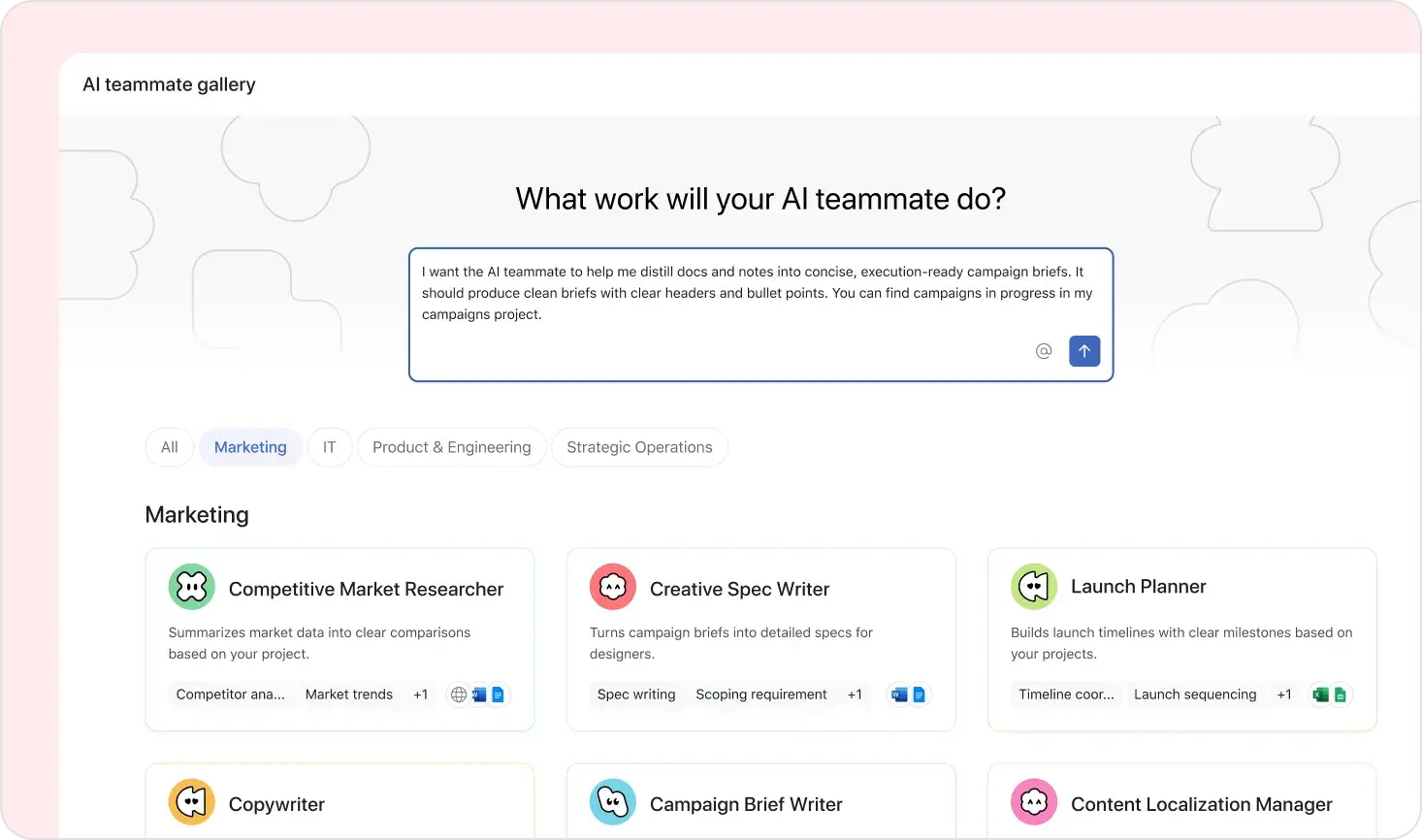
So I created what we lovingly call the client hub in Asana, and kinda connected our CRM platform. We utilized the AI teammates and some of our frontier AI models as well to create this client hub, which is a directory of all of our clients. So every task we call a client card, every task becomes a client. When our sellers close something in Salesforce and and mark it as closed one as a customer, it triggers automatically.
We'll land in the hub as a task. It gets assigned to our AI teammate named Vision. Yes, he's named after the Marvel superhero. Awesome.
If every...
If you're not as nerdy as me and don't know what that is, just forget I didn't say anything. Red?
Did you become the Red one?
He's got a whole avatar pointing at his head. It's great. But he gets assigned to it, and he'll go through and comb through all of Asana and find anything that's related to that client. Our frontier model, Claude, in this case, will comb through all the different platforms we have that aren't connected yet to Asana.
And we'll send it back to him and kinda ping us the vision and say, hey, this is the extra information you're missing. We've roiled out the format of exactly what we wanna see. And together they will build out the description section of that task as an account brief. So it'll tell you who the client is, all of the key metrics, their just standard data, what vertical they work in.
It'll link to our SharePoint with where the MSA is, where the SOW is, every Slack channel that we're talking about for this client, every single email file that's been put in, it will create an account pulse so you know what's happening in the last thirty, sixty, whatever days it is. It'll tell you who's working on the account with links to them and what tasks they're working on, what's what's a blocker right now. And what's nice about it is it's a task so the teams can then multi home the task to the project they're working on in in one place. They can take a quick view and because it's Asana's AI teammates, the team if something is wrong or needs to be edited can just at mention vision and tell him to fix it.
He keeps his own change logs so we know exactly when he changed what and what's going on, and just update it. And you don't have to worry about wrangling the work or copying and pasting it.
You do it in the places you work, and the teammates will take care of the rest and put it in one I love that.
You can probably start to see the similarities if you were in Pete and Yashin's session earlier, kinda going through the product that Adam put in the legwork on his own to to build a lot of the skeletons of this that we've worked together to turn into the product that we now have live today.
I always kind of say that I think Asana grew up a little bit in the wrong category. We're not really project or portfolio management. Like, sure, that is a capability that we have, but I really see Asana as it's like an operating system for the business, and it's ultimately like a workforce productivity platform, and it works best when you can bring your data into that platform, and then allow it to drive the way that you work, and kind of that's when it shines, and it sounds like that is a lot of the approach of what you did of bringing in the Salesforce data, bringing in the previous customer conversations, bringing in meeting transcripts from calls, and then turning it turning it over to Vision.
Yeah, exactly. I think when when everything is fragmented, it just makes everyone's life harder, so being able to put it in one place where everyone can reference and work together on it, it just makes it easier to get the job done.
Yeah. So you've been a great partner to our internal product teams as we've Absolutely. Yeah, developing this over the last year or so.
Curious maybe what feedback you've provided about what are the capabilities that matter most?
Yeah. I think when we started it, it felt very much like a collection of the projects and getting everything in one place, and that was very useful.
And some of the teams that are here, may have said like, this feels like just kind of a slight improvement.
But what really is important is this data and getting everything in one place. And I think the team gets that. And what you guys are doing, I really believe in it. And I see the the future of what it looks like. And if you saw the presentation earlier, just being able to not just collect the projects and put them all together, like, that's a portfolio. But being able to get the holistic view of everything, being able to have very excited about meetings, and just have that natively in where your transcripts are just landing and you don't have to rely on people moving them in.
Being able to kind of work off the table that that you guys put in there. So... And the portal, think, is huge.
I was focusing on that back of house and what's happening on the agency side. Being able to create a place where your clients can, you know, request things and kinda see work that's happening live, but at the same time not see the back of the house. You know, it's kinda that duck on water. You want them to see the com side, but not the craziness happening. So not being able to read all the comments that are happening on our task and whatnot is super helpful. So I I think, you know, my version's kinda held together with bubblegum and and popsicle sticks, with what Asana's building. Really looking forward to it.
Yeah. So somebody would have put it... A task in on the back of house to say, pitch client website redesign. The client wouldn't have seen that, and somebody would have said Yes. Let's maybe...
Let's table this one.
Anything through the process that maybe you had an initial idea about, and kind of as we built and developed and got feedback, your idea changed about what it needed to be?
Yeah, I think that, again, initially I was so focused on my team and we're trying to address in my specific role. I'm always focused on what can happen with my team, and just in those conversations and seeing these other pieces was like, this can be more.
I I think even just talking about that portal and the ability for the clients to engage with your team opens up a new door for transparency that they feel.
And again, our teams can work on them so much faster because, you know, even to your point about that task in the back end, Vision would've caught it, and somebody would've said, no, this already exists, or we don't need that, or maybe not not a great idea. So we can just connect everything, and I think that's kind of been the the turn where I was really focused back of house on the teams, and, like, now having back of house, front of house connected, kind of the same idea, putting everything together and not having it fragmented or separate.
Yeah, so it's not even just your internal experience, but it's your client's experience. And so for us, it's not just you guys as our client's experience, but it's our client's clients.
Oh, The happier they are, the happier we are with you guys, so it keeps working out.
In your role, I think you're kind of uniquely positioned to be on the cutting edge of a lot of people, process, technology, and kind of the the scaffolding that holds all those things together. Maybe taking off your Amsiv hat for a second, just putting on your kind of agency innovator hat. How do you see the model potentially needing to change over the next one to two years?
Yeah, it's fine. One to two years is what you say because I think in the world we live in now, especially with AI, things happen so much faster. What wasn't possible last week is And possible today, I think if I take my amps of hat off and I'm looking at just from an agency side, I think it's it's no longer about...
And you yes, take this as you want, but I don't think it's about the the the speed to be able to produce things or being able to say, hey, we're...
You're using AI and we can produce these things so much faster, or we can produce x amount more. Because unfortunately, as the tools get better and become more available, everyone else has them, and everyone else is doing it. So it's not a differentiator anymore. So I think when you can use the tools effectively to kind of put the information that they gather and they can do together, and your team can pivot and focus on, like, how can we use these tools to make our lives easier, do the busy work around it, and allow the teams to do the work you hired them to do, that...
Those are the agencies that are gonna...
Really gonna win. Like, you know, you're you're gonna win on your team and their creativity, their strategic abilities, not we can produce x amount faster than everyone else because, unfortunately, every other agency is gonna have the exact same models, gonna have the same tools or templates and whatnot. So I think that that's really where it's moving. That it's funny, it feels cyclical that like when one company can, you know, over the years, somebody has a new technology or something, this is our differentiator.
But now when it comes to AI, think it's just out there and everyone has it. So the differentiator is using the tools to allow your team to work and kind of take advantage of the human cognitive side of things.
I was just going say, it's almost like your differentiator becomes your client experience, and how you're able to provide the quality of work with that human centered relationship that's never gonna go away.
And I think it's so funny because when we talk about client management, when I start this, the idea of the relationship is so important, and even in the example I said, when it was fragmented, people are worrying about like getting the information and starting work when they have it. Even in that instance, once we knew the information, now the pivot was we can reframe this and we know what didn't work before and we can tell them and show them. Now it's a relationship, it's like, oh, these guys have their thing together. They know what's going on, as opposed to us having cake on our face and looking real bad. You know, I think that's the pivot, and that's where the work will go.
Right, and it's how do you go to your clients as a strategic partner in their success with a validated point of view based on how you've worked together before versus sometimes, hey, I want to sell you a bunch of new services, right, because I think it'll be good.
Absolutely, and no offense to anybody doing it out there, but I think we can all spot when somebody puts a deck up with Claude or puts something out with it, so again, not a differentiator at this point.
Yeah, even when you prompt it to not use Emdashes, you can still tell. They're always there. Anything you think that's coming that maybe agency leaders are not prepared for?
Put your vision hat on and vision.
I think that it's that.
I think we're stuck in this cycle right now of AI, AI, AI and news AI, and we're getting all these tools and they do allow us to kind of level up, but it needs to be leveling up your people. You know, we don't...
I think we're very lucky at AMS if we don't position it as we're freeing up your time so we're gonna give you more things to do, we're we're looking at...
You know, we're freeing up your time from the busy work, and we want you to do what we hired you for. If we hired you to be an SEO or we hired you to be an influencer in social, like, do those things and do them really well. And it's not about how many more tools can we get and how fast, and I think that's just what it is. Like, I think right now, everybody's like...
I hate the question because I get it a lot. But I'll walk into people and be like, where are we at with AI? And I was like, I don't really know what that question means. Like, we have it.
We use it. I I don't know. But, like, that can't be the focus. It can't be, do we get enough things?
What are we doing? It has to be, what are we doing with them?
So I think sometimes we have to pump the brakes. I know things are moving fast, that's where I think people aren't.
Not enough attention is there, and the shift is happening, I think, but not right now.
Yeah, that resonates so much, actually. But two or three years ago, I partnered partnered with with our our CIO CIO on some of our internal AI initiatives of how do we enable our teams internally to use AI, and he and I had so many conversations about, and he was on board with this obviously, of like, it's not just about, hey, now we have all these tools and all these things. It's like to what end and for what purpose and what is the actual impact. Nobody needs, you know, an email written in fifteen seconds or even less now if it if it doesn't actually improve Yeah. You know, the result that we're trying to to get to.
If I'm trying to ask you this for lunch and I put it in Claude and it spits out four paragraphs while written, was there a point to it right? Right.
So like Right, and then I put that into Claude and send you back six paragraphs.
Right.
Perfect.
Now that you have this process and the system around it to support that you have more of this shared, persistent, consistent context with your different teams. How does the work change, or what is possible today now that you're not in these different systems searching for information that maybe wasn't a year ago?
Yeah. I think it is the framing that we have that I just said about not freeing up time to give you more tasks. I think a lot of our teams are struggling with this, I think it's every agency you hear, AI this and that, and you're just worried it's gonna take my job, whatever. But our teams are now starting to see it like, I'm not asking you to take on more busy work.
I want you to focus and produce better. Like, we're a business, right? So at the end the day, we have to do good work for our clients. We have to make sure that they're happy and that, you know, our margins look great and they're staying in green.
But, like, you know, it's it's that piece. And I think that's where it's changed. Our teams can can focus a lot less. Like, even if it's one less meeting a week to open up a calendar where we're like, we don't need that onboarding meeting.
We already have all the information, or I don't need to fill out 10 forms. Maybe it's only three now because we've gotten somewhere. Right? Like, we're not we're not to zero.
But when you have to do less of that, it just allows the team to to get together and work more strategically, and do the things they they love.
Yeah. Anything outside of that that you, you know, hope for or wish the impact to be for, you know, for Amsiv, for your clients, for the industry as a whole if agencies kind of in this moment get this right?
Yeah. I think for...
And I I sound like a broken record, but I I really do believe when agencies get this piece right, when it comes to the client management, the information, not having to chase it, not wasting all that time...
You know, I gave the example again of the very poor thing, but on that call were executives, department heads, SMEs of all the divisions. Like, all of that time, an hour burned on that meeting Yeah. Where we're discovering that we had information we didn't have and chasing around in our tails and whatnot, how many times does that happen? How much wasted time of people's efforts and energy are spent on that piece?
And if you can get it right, like, I'm sure there's cases outside of this, but, you know, people don't say, I don't...
I hate my job because the thing I love to do, I I have too much of it. They say, I I can't stand all these forms I have to fill out. I can't stand all the paperwork I have to do. Why do I have to...
The the admin process, the red tape, this is so hard. If you can get that piece right around your clients and have the AI and stuff automated, the teams, I think, my hope, and I think we start to feel it a little bit, the teams can kind of exhale and, like, do what they like to do and be creative. Because I'm sure how many times you, like, are challenging a team or, like, can we do a better idea? Can we do something?
It's just like, I don't have time. And if you can get rid of that, I don't have time or, you know, at least try to remove that excuse, and I've given plenty of examples to teams where we're like, how long did it take you to do that? And they're like, it's not that bad. It's like four or five hours.
And we're like, cool. The teammate did it in three minutes. Yep. And they're like, oh.
And I was like, so now can you do what we asked you to do and, like, change it up? It's like...
People freak out. They just don't compute. What do I do now? Go do what you wanted to do. You don't have that blocker anymore. I think that's really where it's gonna take off.
Amazing. I feel like folks like you are really critical in agencies to be the ones thinking about this, and being able to create some of these systems and structures, because if somebody's working on a client, and something's going wrong or they need something urgently, that's not the moment that you're gonna think, oh, maybe I could change our process and then we wouldn't run into this. That moment, it's all hands on deck and let's get this client exactly what they need.
Yeah. I think it's a it's a unique space that I'm in. I think if, you know, the teams have the capability, having somebody who can step out and, you know, take that 30,000 holistic view is important because that's exactly what it is. And that's kinda how we get stuck in the loop when you're doing the work, when you're in the job every day.
Like, you don't really have the space and time to look at it. If you can, I think a lot of people will be like, we could do this a little different? We could we could probably do something better. But, you know, it's hard to when you're trying to put out every fire all over the place, turn around.
Totally. And I think we at Asana are also excited to, you know, partner with all of you and kind of help be that if you don't have an Adam at your organization. So that is our time. Thank you so much for joining us today, and thank you, Adam, for your candor and this conversation, and also just your partnership with Asana long term.
This is your second year on stage at Wiz, so we're very happy to have you back, and maybe we'll do a three peep. I'm looking forward to Next year.
Setting up my residency here, so it's something coming next year.
I love it. So we hope that this was enlightening and valuable for all of you in terms of what's possible, and kind of where the product that you've seen a lot of today actually came from. It comes from folks like you who want a better way to do things, and want a partner to do that with. So if you haven't had a chance, definitely check out the client management demo booth in the Expo Hall. We have folks there who are experts in this, who've been building it, that, you know, wanna talk about your process and how we can make it better.
And if we're the last thing standing in front of your happy hour...
We'll see you there.
We'll see you there. Thanks everyone.