Time blocking: Complete guide for focused work & rest


85 % av Fortune 100-företagen väljer Asana¹






In the past week, you've probably reprioritized your tasks, rescheduled your calendar, and maybe even worked late to get something done. You're not alone. Every day, we juggle competing demands on our time and, as a result, experience more chaos than clarity.
Luckily, there's a solution: time blocking.
With time blocking, you can regain control of your calendar to focus on what truly matters. Time blocking can help you align your attention with your intentions, so you always prioritize the right work at the right time. With time management templates, you can also dedicate time to your personal time, downtime, lunch, and other essentials that often get left out in our "always-on" working world.
What is time blocking?
Time blocking is a time management strategy where you schedule every part of your day into dedicated slots for specific tasks. Instead of working from a to-do list and deciding what to do next in the moment, you assign each task a specific window on your calendar, such as checking email from 9–10 a.m. or working on a project from 10 a.m.–12 p.m.
Like most time management strategies, time blocking helps you reclaim your day and understand where your time is actually going. By scheduling blocks of work, you ensure you're completing important tasks while setting aside time for rest and self-care.
According to Gallup's State of the Global Workplace 2025 report, employee well-being and workplace stress remain critical concerns, with engagement and burnout continuing to impact knowledge workers globally. The inability to disconnect from work remains a significant factor contributing to workplace stress and reduced productivity.
Skapa en mall för daglig planeringHow time blocking works
To create a time block, group like tasks and schedule a dedicated window to work on them. There are two fundamentals of time blocking:
Visual scheduling: Block time on your calendar so your work can't be interrupted or scheduled over.
Task grouping: Combine similar tasks into one concentrated block of time.
For example, you might create a one-hour block at 9 a.m. for emails, a block from 10 a.m.–11:30 a.m. for your main project, and another block at 11:30 a.m. for lunch.
By time-blocking, you set aside time blocks for critical work and reduce context switching. Instead of catching up on emails between tasks, you assign specific times to each type of work so you can focus on what matters most.
Time blocking vs. timeboxing
Timeboxing is another time management strategy, but it works differently from time blocking.
Aspect | Time blocking | Timeboxing |
How it works | Assign a block of time to a set of similar tasks | Assign each individual task its own "box" with a start and end time |
Calendar view | Large blocks for batched tasks (e.g., "Review design feedback" from 3–4:30pm) | Granular tasks scheduled individually (e.g., "Review Facebook banner" from 3–3:15pm) |
Best for | Reducing context-switching and protecting focus time | Working within strict time constraints or overcoming perfectionism |
Time blocking vs. task batching
Task batching is an element of time blocking. When you batch tasks, you collect and connect any similar tasks so you can work on them at once. Task batching can help you reduce the amount of time you spend on stray tasks and ad hoc work.
For example, say you manage your company's social media content calendar. Every Monday, you need to review and prioritize that week's posts, share a recap of the past week's posts, and check in with the design team to make sure they're on schedule for next week's work.
By batching these three tasks together instead, you'll be more productive and focused on completing your work for the day. The final step is to schedule that work in your calendar, which then becomes a time block.
Time blocking vs. time tracking
Time tracking is the process of recording the time you spend on projects, typically for billing purposes. It's common for creative agencies, law firms, and teams to have freelance or contract workers. If you're looking to get started with time tracking, there are a lot of great tools and integrations to help with time tracking.
Time blocking can help with time tracking since it gives you clear insight into how long you spent on each initiative. Just make sure you're sticking to your time blocks, or updating them if something changes.
Why time blocking works
Time blocking is more than organizing your calendar; it's a strategy for being intentional with your time. When you dedicate specific blocks to focused work, you reduce context switching and give your full attention to what's in front of you.
Key benefits of time blocking include:
Reduced context switching: Stop bouncing between tasks and losing momentum.
Protected deep work time: Reserve uninterrupted blocks for your most important projects.
Better visibility: See exactly how you spend your time and identify patterns.
Burnout prevention: Schedule rest alongside your responsibilities.
Who should try time blocking?
Time blocking won't be effective if your calendar is mostly filled with meetings. But if you frequently have chunks of open time, you can use this strategy to better manage your attention and focus.
As Parkinson's Law states, "work expands so as to fill the time available for its completion." Time blocking helps you take back control of your calendar by intentionally scheduling work.
Time blocking is particularly useful if:
You frequently try to multitask
You need help focusing on one task and reducing distractions
You want to be intentional about your time and energy at work
You need a clearer sense of where your time is going each day
You struggle with overworking
As you get started with time blocking, think of each block as an uninterrupted chunk of work where you can tackle critical projects and get into deep work.
What is deep work?
The term "deep work" was coined by Cal Newport, one of the biggest modern proponents of time blocking. Though time blocking has been used throughout history, with Benjamin Franklin among its earliest adopters, Newport was the first to connect it to deep work in the digital age.
According to Newport, time blocking can help you schedule large blocks of distraction-free time to dive into deep, uninterrupted work.
Time blocking methods to try
While the core concept of time blocking is simple, you can adapt it to fit your work style. Here are a few popular methods:
Day theming: Assign a specific theme or type of work to each day of the week. For example, Mondays could be for planning and meetings, while Tuesdays are reserved for focused creative work.
Task batching: Group similar small tasks, like answering emails or making phone calls, into a single time block. This reduces the mental load of constantly switching between different types of work.
Energy management: Schedule your most demanding tasks during the times of day when you have the most energy. Save lower-energy tasks for times when you typically feel a slump.
Experiment with these methods to find what works best for you, or combine elements from each to create a personalized approach.
Skapa en mall för daglig planering7 tips to start time blocking your schedule today
Time blocking is simple in practice, but it can be a tricky strategy to implement and stick to consistently. With these seven tips, you can take charge of your calendar and avoid common pitfalls.
1. Identify what you need to work on for the day
Like most time management strategies, the first step is to identify what you actually need to get done on a given day or week. If you don't already, practice keeping and updating a to-do list with all of your important work.
Keep in mind, you don't just need to know what to work on; you also need to know what to prioritize. Look for a tool that lets you add details and context to your work, such as priority levels, attachments, and relevant collaborators.
Potential pitfall:
Even with time blocking, there may be days when you can't get to all of your work. If you don't know what to prioritize, you won't have a clear sense of which tasks you must finish today and what you can defer until tomorrow.
2. Figure out when you're most productive
Time blocks are helpful on their own, but you can increase their effectiveness by tailoring the work to your productivity preferences. Think about when you feel most productive.
Do you feel energized in the morning? Schedule the work that requires the most energy before lunch. Do you feel sleepy in the early afternoon? Schedule smaller tasks, like answering emails. Do you get a second wind in the late afternoons? Save your important tasks for that period.
Läs: Hur man blir mer produktiv: 13 tips att börja med i dagPotential pitfall:
After you've been time blocking for a few days, evaluate how you're feeling at the end of the day. If you're feeling drained, you may have misjudged when you're most productive. Try rescheduling your work blocks to see if that helps.
3. Group meetings, if possible
You may have meetings scattered throughout the day, which could be hampering your productivity. At Asana, we call this a Swiss cheese schedule. Scattered meetings make your daily schedule hard to work around and constantly interrupt your focus.
Instead of scattering meetings throughout the day, aim for a block of meetings that are relatively close together, with a few breaks in between. Or consider investing in a tool that automatically monitors this for you, like Clockwise.
Läs: Att övervinna din videomöteströtthet: 7 tips från våra kunderPotential pitfall:
There will be instances when meetings are scheduled outside of your ideal meeting time block. That's OK. Time blocking is a strategy to help you be intentional about your time, but it won't make your entire day fit into a perfect schedule.
4. Schedule your time blocks
Once you know when you're most productive, it's time to schedule the rest of your time blocks. Think through your priorities for the day and schedule dedicated focus time for each batch of tasks in your calendar.
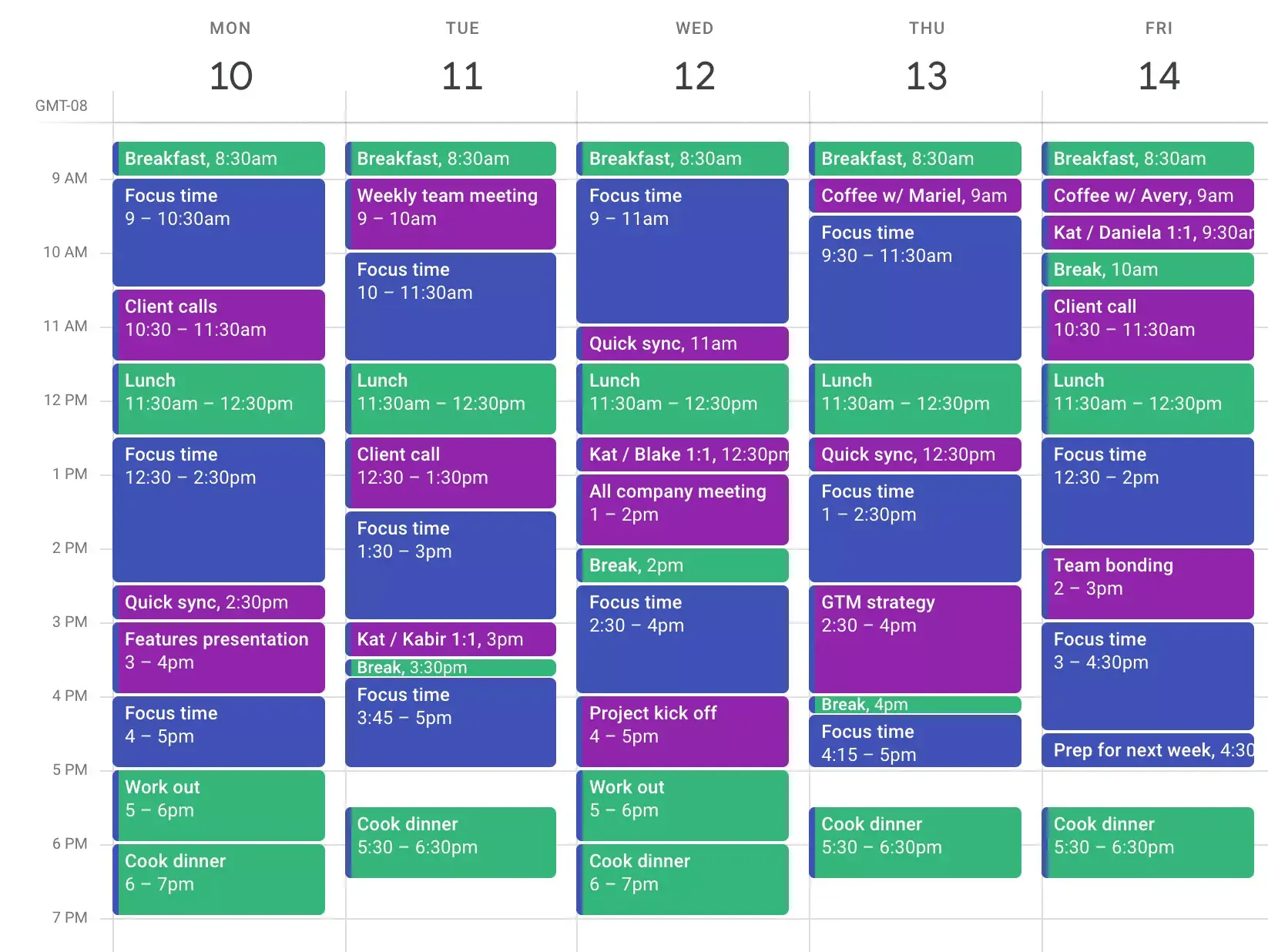
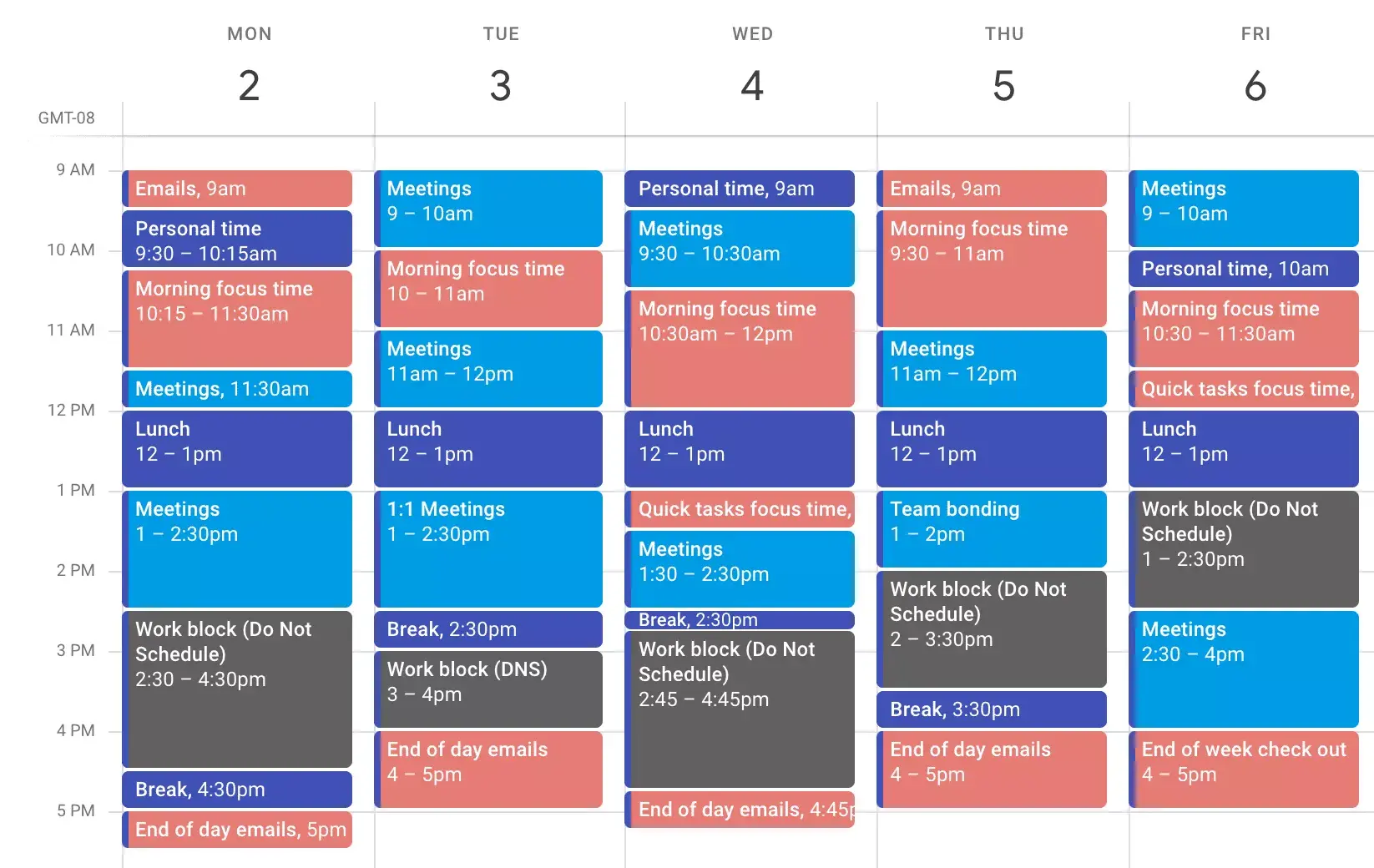
We recommend labeling each time block on your calendar. For example, you might have "Focus time" in the morning, "Personal time" during lunch, and "Do not schedule, work block" in the afternoon for deep work. This helps team members know which blocks they can schedule over if necessary.
Potential pitfall:
If your entire calendar is fully scheduled, it can be difficult for team members to schedule last-minute meetings or get a hold of you for important chats. By clarifying what type of time block you've scheduled, team members can feel more empowered to reach you when needed.
5. Block off personal time
Time blocking isn't just about scheduling your work tasks; you should also schedule downtime every day. In addition to scheduling lunch, give yourself quick breaks for personal time, everyday activities, or daily tasks like picking your kids up from school.
Potential pitfall:
Not every personal time block needs a purpose. Consider leaving a personal time block open so you can decide on the spot if you want to take a walk, check social media, or call your mom. There are no wrong answers (we won't tell your mom).
6. Allow for unexpected interruptions or work
Time blocking fails when you don't have room for surprises, like unexpected tasks or last-minute meetings during an important focus block. You want to be able to engage with these without totally derailing your day.
If these situations frequently come up at work, dedicate an afternoon time block to flexible time. That way, you already have a block for unexpected tasks, or you can move interrupted work to your flexible afternoon block.
Potential pitfall:
Make sure any new task that crops up is higher priority than what you're currently working on. Unexpected work often feels urgent, but that doesn't mean it's more important. Always remember your work priorities, then rearrange your schedule accordingly.
7. Plan for lost time
Even the most effective time blocker will lose time during the day. You might need to check a Slack message, answer a phone call, or get distracted by a roommate, child, or pet. This is natural, and OK.
Consider dedicating certain time blocks for focus work and others for deep work. When you're checking your email and going through daily tasks, you can be interrupted. But if you schedule a block for deep work, consider snoozing all notifications and turning on "Do Not Disturb" mode.
Potential pitfall:
It might take a while to figure out the best strategy to minimize distractions. Keep adjusting your time blocks as necessary. Over time, you might find that you lose less time with this technique.
8. Adjust as needed
Like all time management strategies, you should tweak and adjust your time blocks until they feel right for you. You won't have a perfect day the first time you try time blocking. This strategy is only effective if it meets your goals and needs, so optimize for what works.
Potential pitfall:
If time blocking isn't your style, that's OK too. Try another technique, like timeboxing, where you assign every task a start and end date. To learn more, read our guide to timeboxing.
Time blocking example
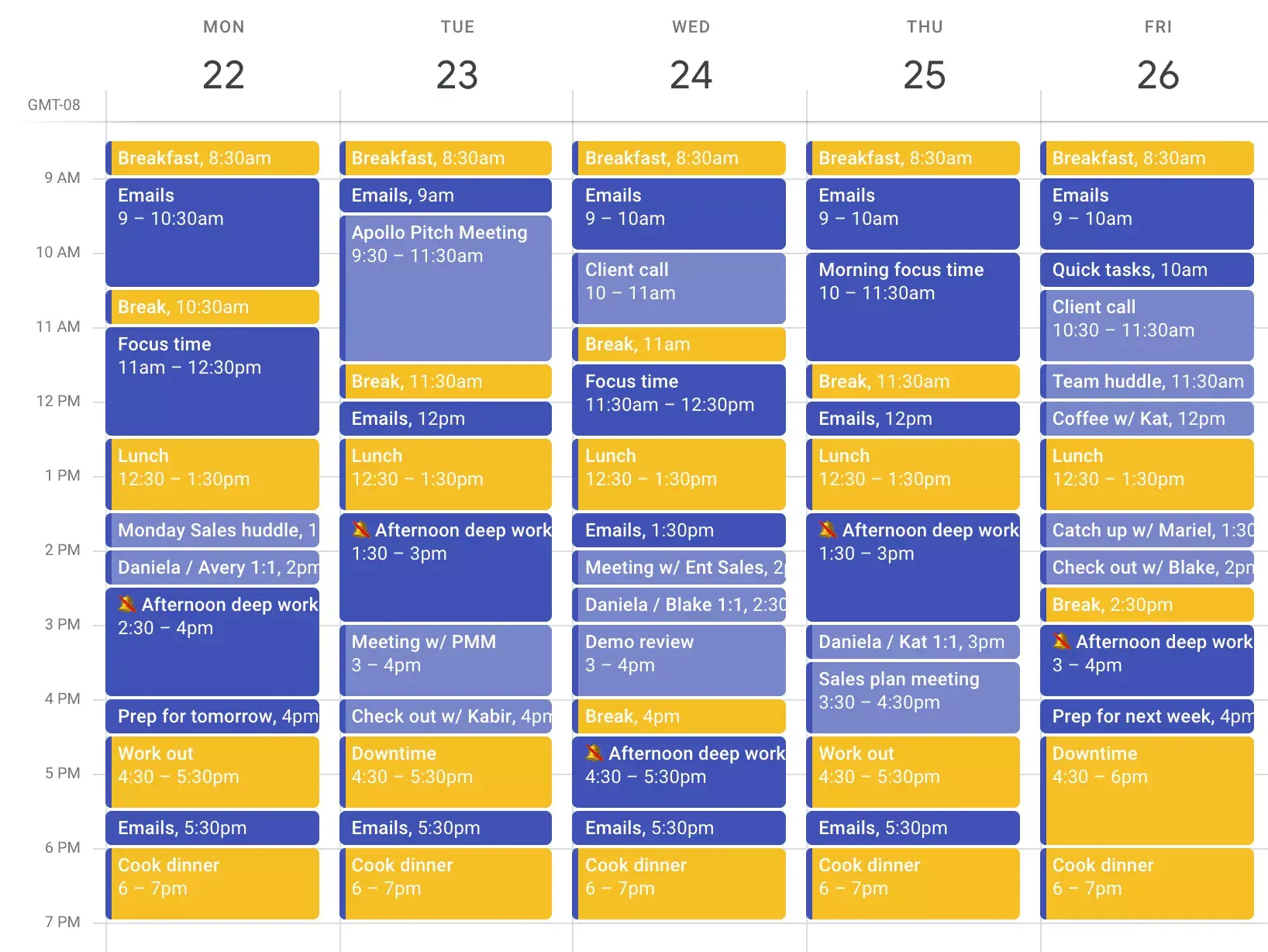
Every person's calendar is different, so every time the blocked calendar will be slightly different, too. But if you implement the seven strategies above, here's what your calendar might look like:
How time blocking helps you reclaim your day
Time blocking helps you be more intentional with your time. By dedicating specific blocks to important work, you can focus on getting things done rather than wasting energy on multitasking and procrastination.
When you have a clear plan for your day, you can work more effectively and protect time for rest. To put these tips into practice and organize your time blocks alongside your team's projects and goals, get started with Asana
Skapa en mall för daglig planeringFrequently asked questions about time blocking
Yes, many people with ADHD find time blocking helpful because it provides visual structure that reduces overwhelm. The key is to stay flexible and build buffer time between blocks.
Yes, time blocking is effective because it encourages intentionality, you proactively decide where to focus instead of reacting to your day. This promotes deep work, minimizes distractions, and creates a clear sense of accomplishment.
The 3-3-3 rule structures your workday into three hours on your most important project, three shorter tasks, and three maintenance activities like responding to emails.
Yes, you can schedule blocks for reactive work and use "floating" blocks for tasks you move as needed. The goal isn't a rigid schedule, but a framework to bring more intention to your day.