Strategy implementation: 6 steps, pitfalls, frameworks


85% perusahaan Fortune 100 memilih Asana¹






Summary
Strategy implementation is the fourth step in the strategic management process, and it's where you turn your strategic plan into action. This could mean executing a new marketing plan or rolling out work management software to boost team efficiency.
Having a strategic plan is great, but without the bandwidth, resources, and support to implement it, your plan won't drive real change.
In this article, we cover the key steps of strategy implementation, common pitfalls and how to avoid them, and frameworks to help you succeed.
Why strategy implementation matters
Strategy implementation matters because it transforms your strategic plan from a document into measurable results. Without effective implementation, even brilliant strategies fail to create value. Here's why it's essential for your organization:
Aligns teams around shared goals. When everyone understands the strategy and their role in it, your organization moves in the same direction. This alignment reduces wasted effort and keeps projects on track.
Turns plans into measurable progress. A strategy that stays in a document doesn't create value. Implementation connects your vision to daily work, so you can track progress and adjust as needed.
Builds organizational agility. The implementation process helps you identify what's working and what isn't. This feedback loop allows your teams to adapt quickly to changing circumstances.
Drives accountability across the organization. Clear implementation processes establish who is responsible for what, making it easier to hold teams accountable and celebrate wins along the way.
Without a focused approach to implementation, even the best strategies can fall flat. By prioritizing how you execute, you set your organization up to achieve its goals.
The 6 key strategy implementation steps
Before you can implement your strategy, you need to create a strategic plan.
Your strategic or implementation plan outlines the steps your team or organization needs to take in order to achieve a goal or objective. Your implementation plan is the roadmap to a successful strategy execution and should include the following steps:
Define your goals
Conduct proper research
Map out any risks
Schedule all milestones
Assign tasks
Allocate helpful resources
Once your strategic plan is set, it's time to get it on the road! There are six steps to follow for a successful implementation.
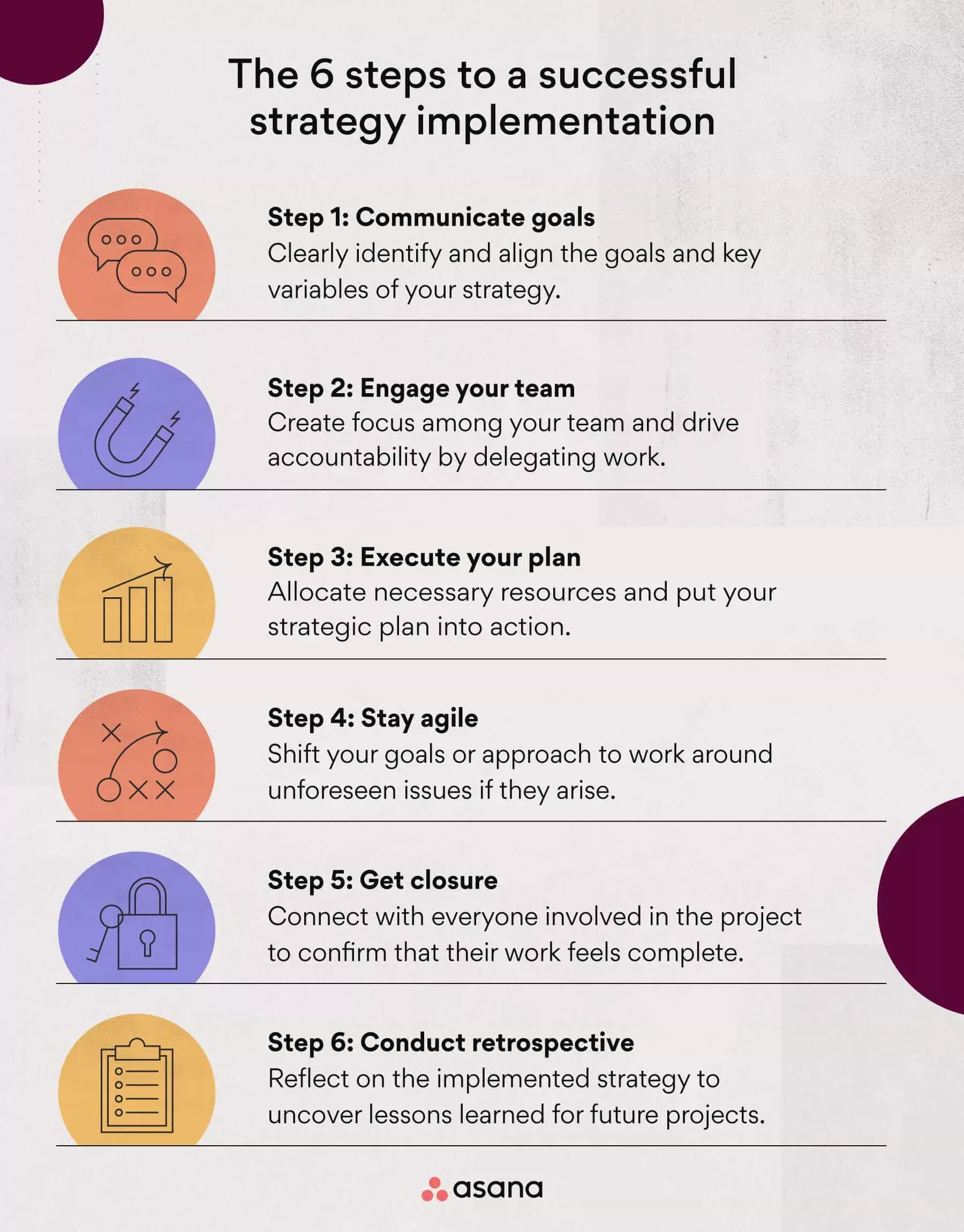
Step 1: Set and communicate clear, strategic goals
The first step is where your strategic plan and your strategy implementation overlap.
To implement a new strategy, you first must identify clear and attainable goals. Your goals should include your vision and mission statements, long-term goals, and KPIs.
The clearer the picture, the easier the rest of your strategy implementation will be for your team and organization.
Step 2: Engage your team
To implement your strategy both effectively and efficiently, you need to create focus and drive accountability. There are a few ways in which you can keep your team engaged throughout the implementation process:
Determine roles and responsibilities early on. Use a RACI matrix to clarify your teammates'roles and ensure that there are no responsibility gaps.
Delegate work effectively. While it can be tempting to keep an eye on everything, micromanagement will only hold you back. Once you've defined everyone's roles and responsibilities, trust that your team will execute their tasks according to the implementation plan.
Communicate with your team and ensure that everyone knows how their individual work contributes to the project. This will keep everyone motivated and on track.
If your strategy depends heavily on data and insights, starting with a research plan template can be helpful. Having that structure in place makes it easier to connect research findings directly to your implementation steps.
Step 3: Execute the strategic plan
Allocate necessary resources, like funding for strategic or operational budgets, so your team can put the strategic plan into action. If you don't have the right resources, you won't be able to achieve your strategic plan, so this should be a top priority.
Here's how you can ensure that your team has the resources they need:
Start with the end in mind to effectively align your project's objectives, key deliverables, milestones, and timeline.
Identify available resources like your team's capacity, your available budget, required tools or skills, and any other unconventional resources.
Define a clear project scope so you know exactly what your project needs when.
Share your project plan with everyone involved in the implementation process using a work management tool.
The better your strategic plan is built out, the easier it will be to implement. For a visual guide to map milestones, timelines, and ownership, use strategic planning software to connect your goals with real-time execution.
Baca: 7 model perencanaan strategis dan 8 kerangka kerja untuk membantu Anda memulaiStep 4: Stay agile
You'll inevitably run into issues as you begin implementing your strategy. When this happens, shift your goals or your approach to work around them.
To stay agile throughout implementation:
Update status regularly. Create weekly, monthly, or quarterly project status reports depending on your strategy's scope.
Share updates broadly. Keep both internal teams and external stakeholders in the loop on progress and changes.
Use a central source of truth. Asana's work management software lets your team coordinate in real time while also enabling asynchronous work, so everyone has visibility into who's doing what.
Step 5: Get closure
Once you implement the strategy, connect with everyone involved to confirm that their work feels complete. Strategy implementation isn't a one-and-done effort; it's an ongoing process that evolves even after the initial rollout.
Getting closure from your team is a crucial milestone that signals you're ready to move into reflection and continuous improvement.
Step 6: Reflect
Conduct a post-mortem or retrospective to reflect on the implemented strategy, as well as evaluate the success of the implementation process and the strategy itself. This step is a chance to uncover lessons learned for upcoming projects and strategies, which will allow you to avoid potential pitfalls and embrace new opportunities in the future.
Baca: 6 langkah rapat post-mortem proyek yang suksesWhat you need to implement a strategy
No matter how well thought out your strategy is, you'll need these five key components to implement it successfully.
Templat rencana implementasi gratis1. People
You'll need a team that not only understands the strategy you want to implement but also has the skills and bandwidth to support you. Appoint, hire, and train the right people for the job and ensure that the competencies needed to succeed are present in your project team.

Tim Kesuksesan Pelanggan Asana sangat penting dalam proses implementasi kami. Mereka meluangkan waktu untuk memahami bisnis kami serta menunjukkan cara membuat alur kerja dan proses praktis kepada kami untuk mendapatkan manfaat maksimal dari Asana. Tanpa mereka, mustahil kami dapat melakukannya.”
2. Resources
Effective resource allocation is one of the most important parts of strategy implementation. Resources can be both financial (e.g., cost of labor) and non-financial (e.g., time to implement strategy).
3. Organization
Everyone in your organization needs to know their responsibilities so they can be accountable for their role in implementing the strategy. This also means the chain of command must be defined and communicated so everyone knows who to contact during the implementation process.
4. Systems
The tools, capabilities, and systems you've put in place are another key component. You have to understand the functions of each of these systems and how they will support your strategic management process during and after implementation.
5. Culture
The final key component is the organizational culture within your company. Rolling out new strategies can be confusing and stressful for teams. Ensuring that everyone knows what they need to know and feels valued and included is crucial for a successful and effective implementation.
Baca: Apa itu manajemen perubahan? 6 langkah membangun proses manajemen perubahan yang suksesMcKinsey's 7S framework
McKinsey & Company created a framework of seven factors needed to implement a strategy successfully. These factors split into hard elements (easy to identify and influence) and soft elements (less tangible, shaped by culture).
Hard elements | Soft elements |
Strategy: Your plan to maintain competitive advantage | Style: The leadership style in your organization |
Structure: Your company's organizational structure | Staff: Your team and their general capabilities |
Systems: Day-to-day procedures and activities | Skills: Your team's competencies |
Shared values: Your organization's values |
To apply this framework to your strategy implementation:
Start with shared values and ensure they align with your hard elements.
Assess how well your hard elements support one another, and identify areas for improvement.
Repeat the same analysis for your soft elements.
This analysis reveals what's working and what needs improvement, helping you gauge how well your organization can implement change.
The three Cs of implementing strategy
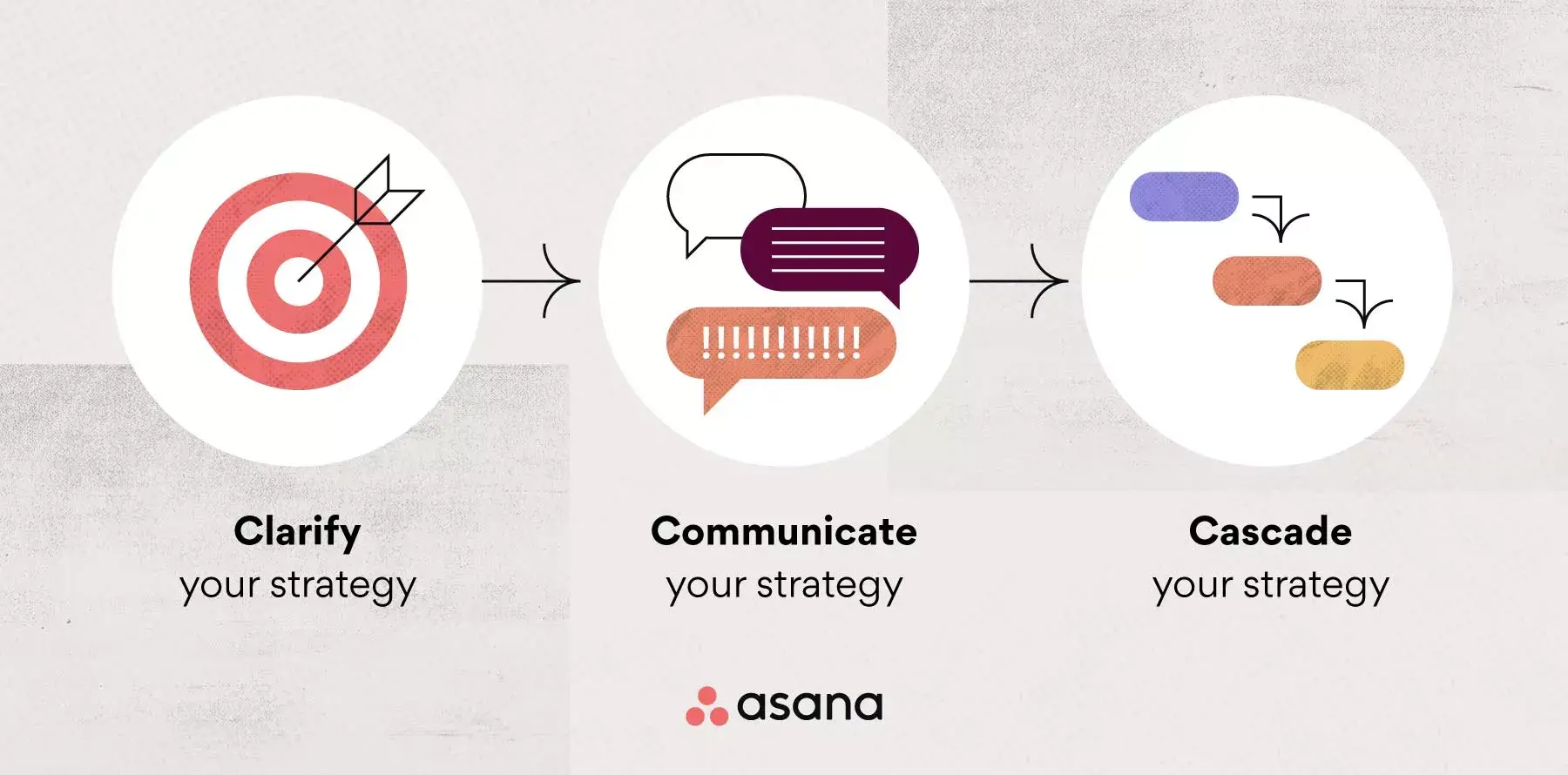
Effective strategy implementation requires closing the persistent gap between planning and execution. According to recent research from the National Association of Corporate Directors (NACD), sixty percent of board respondents rank oversight of strategy execution as the top improvement area for 2026, highlighting how critical implementation remains for organizational success. The three Cs framework, clarity, communication, and cascade, provides a practical approach to bridge this gap.
Let's take a closer look at what they represent.
Clarify your strategy. Ideally, the strategy was well received in the boardroom, and your stakeholders and executives are on board. However, if it's not clearly defined, you may lose your mid-level and frontline team members along the way. Your team can only implement a strategy they understand, so be clear about your goals and strategic objectives.
Communicate your strategy. A poster, announcement, or newsletter won't be enough to communicate a new strategy to your organization. Develop a clear communication plan to ensure that teams know what's going on and create opportunities to ask questions so everyone feels like they're part of the process.
Cascade your strategy. A well-implemented strategy cascades through your entire organization. Involve your organization's managers and ensure they understand the strategy so they can share relevant information, tactics, and processes with their teams. While you may have informed your organization during the communication stage, this step is crucial in aligning every last teammate with your new strategy.
Next, let's have a look at some of the challenges you'll encounter during strategy implementation.
Strategy implementation pitfalls and solutions
A significant undertaking, such as implementing a new strategy, comes with its fair share of obstacles. Below are four of the most common pitfalls you'll encounter when implementing a strategy, plus a few tips on how you can create solutions for your team.
1. Overwhelming or meaningless strategic plan
Problem: If the strategic implementation lacks meaning and potential or if there is an overwhelming number of puzzle pieces to consider, it can really put a wrench in your implementation.
Solution: Use SMART goals to ensure that your strategic plan is specific, measurable, achievable, realistic, and time-bound. This framework will ensure that your strategic plan is both meaningful and possible to implement.
2. No implementation in sight
Problem: It's great to have a strategic plan, but without the resources and support from upper management, the implementation may never happen.
Solution: Your strategic plan should include clear goals, consequences, and requirements to inspire the actual implementation of your strategy. The clearer the document, the easier it will be to get the resources needed to turn it into action.
3. Lack of communication and ownership
Problem: A team that's not 100% sure what the strategy is and doesn't feel confident in their respective tasks can bring your implementation process to a halt before it's even begun.
Solution: Clearly define each team member's responsibilities and delegate any relevant work. This gives team members a sense of ownership over the outcome of the strategy implementation. Ensure that your teammates have the authority and resources to execute their tasks.
4. Lack of accountability and empowerment
Problem: Low visibility and a lack of accountability can make your team feel helpless.
Solution: Schedule regular strategy reviews and team meetings to discuss each team member's progress, emerging issues, and strategy shifts that can contribute to the success of your implementation. Track progress to give your team a sense of accomplishment as they check off each goal they've met.
As long as you're aware of the challenges, you can tackle them head-on and avoid unnecessary setbacks.
Plan, implement, celebrate
Change isn't easy, but in order for your team to grow, it's crucial that your organization does too.
Whether you're in the midst of developing your strategic plan with a small project team or you're already communicating your strategy to the entire organization, reliable project management software is critical in ensuring that everyone has access to the resources they need.
And once the strategy is successfully implemented, don't forget to give yourself and your team a pat on the back. Ready to turn your strategy into action? Get started with Asana to keep your implementation on track and your teams aligned from planning through delivery.
Templat rencana implementasi gratisSources: Harvard Business School | MindTools | OnStrategy
Frequently asked questions about strategy implementation
The 5 C's are company, customers, competitors, collaborators, and context. This framework helps you assess how strategic decisions affect each area and manage risks effectively.
Strategy formulation is defining your goals and approach; strategy implementation is turning that plan into action through resource allocation and execution. Both are essential, but implementation is where plans become reality.
Small-scale initiatives may take a few weeks, while organization-wide changes can take months or years. Set realistic milestones and monitor progress regularly to stay on track.
Common examples include training programs, coaching, feedback loops, workflow restructuring, and environmental changes to support new behaviors. The right approach depends on your goals and organizational context.