Parkinson’s Law: Why Work Expands & How to Stop It Now


85% perusahaan Fortune 100 memilih Asana¹






Summary
Have you ever put off a project until the last minute, even though you knew it would only take a few hours to complete? That's procrastination at its finest, but it's also Parkinson's Law in action. When you have time, you take it, either completing the task more slowly or procrastinating until the deadline looms.
Unfortunately, deadlines don't always increase our productivity, but understanding Parkinson's Law and finding ways to overcome it can. In this guide, we'll explain how Parkinson's Law works and provide tips for getting your work done in less time.
What is Parkinson's Law?
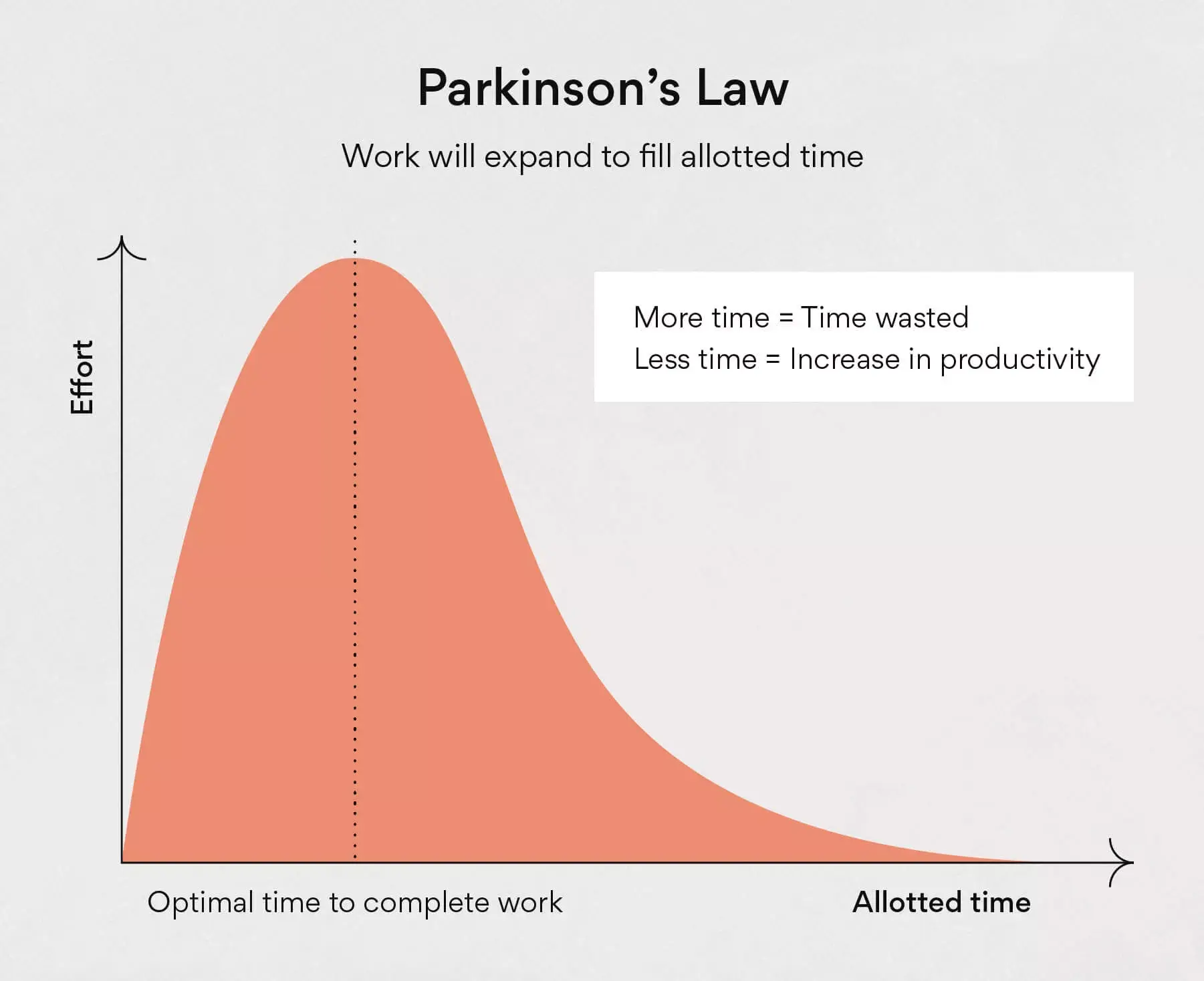
Parkinson's Law states that work expands to fill the time allotted for its completion. Coined by British historian Cyril Northcote Parkinson in 1955, this principle explains why a task that could take two hours often stretches to fill an entire day when you have that time available.

Say you're given a two-week deadline to complete a project proposal. Though you may feel relieved by the ample time, the distant deadline leads you either to work more slowly than necessary or to procrastinate until the last minute. Either way, the task expands to fill the time you're given.
The history of Parkinson's Law
Cyril Northcote Parkinson was a British naval historian who first introduced Parkinson's Law in a satirical essay written for "The Economist" in 1955. He then wrote a book titled Parkinson's Law: The Pursuit of Progress.
His story in the essay involves a woman whose sole task for the day is to send a postcard. She spends an hour finding the card, half an hour finding her glasses, 90 minutes writing the card, and so forth until she fills her day. While Parkinson's example may sound extreme, we've all experienced this at a smaller scale.
Why does work expand to fill the time available?
Studies suggest that when given a task, we estimate how much time is available to complete it rather than how much time we actually need. This mindset results in wasted time and inefficient workflows.
Several psychological tendencies drive this behavior:
Obligation to use time: We feel we should use all the time we're given, even when a task could be finished sooner.
Lack of urgency: Without time pressure, we fill extra hours with unnecessary revisions or perfectionism.
Delayed starts: Knowing we have plenty of time, we postpone beginning the work altogether.
Understanding these tendencies is the first step toward breaking the cycle and reclaiming your time.
Parkinson's Law examples
Parkinson's Law affects everyone, from individual contributors to enterprise organizations. No one is immune until they recognize the pattern and find ways to overcome it. Below are three common examples across different work contexts, along with solutions for each.
Marketing pitch
Say you're a marketing manager working on a new client pitch. You have a one-month deadline to gather all of the materials necessary for your presentation. This deadline gives you plenty of time to prepare, but because you have a few other urgent tasks on your plate, you put the pitch off.
The deadline then creeps up, putting you at risk of missing deadlines as you scramble to complete the pitch at the last minute. In a different scenario, you spend the entire month working on the pitch, adding unnecessary details as the deadline approaches. Your work has now expanded to fill the time allotted.
Potential solution: Marketing team members can work together to realistically determine how long a project should take, instead of setting an arbitrary deadline. Focusing on required time rather than available time increases productivity and prevents inefficiency.
Design lookbook
If you're a designer, this example is for you. Imagine you have a lookbook to complete within two weeks. As a creative, you take pride in your work and may never feel like your projects are fully finished because you can always find something to correct or improve.
Deadlines help you stay on track, but you always let your work expand until the last minute because you become enthralled by every project.
Potential solution: Involve the client early in the design process to avoid unnecessary time spent on revisions. Adding benchmarks for client or manager check-ins gives you feedback on how much progress you've made and when to stop.
The 40-hour workweek
Most companies operate under the 40-hour-a-week model, which assumes that most jobs require the same amount of time to complete tasks each week.
Is it realistic to think that work in the marketing field and the medical field both require eight hours a day? The short answer is no. Parkinson's Law is active all around us; some people are busy 40 hours a week, while others use time management to complete tasks in less time.
Potential solution: Consider using the Pareto principle, which states that roughly 80% of outcomes come from 20% of causes. Focusing on impactful work rather than time spent on work can increase productivity.
Baca: 18 kiat manajemen waktu, strategi, dan solusi cepat untuk menyelesaikan pekerjaan terbaikOvercoming Parkinson's Law
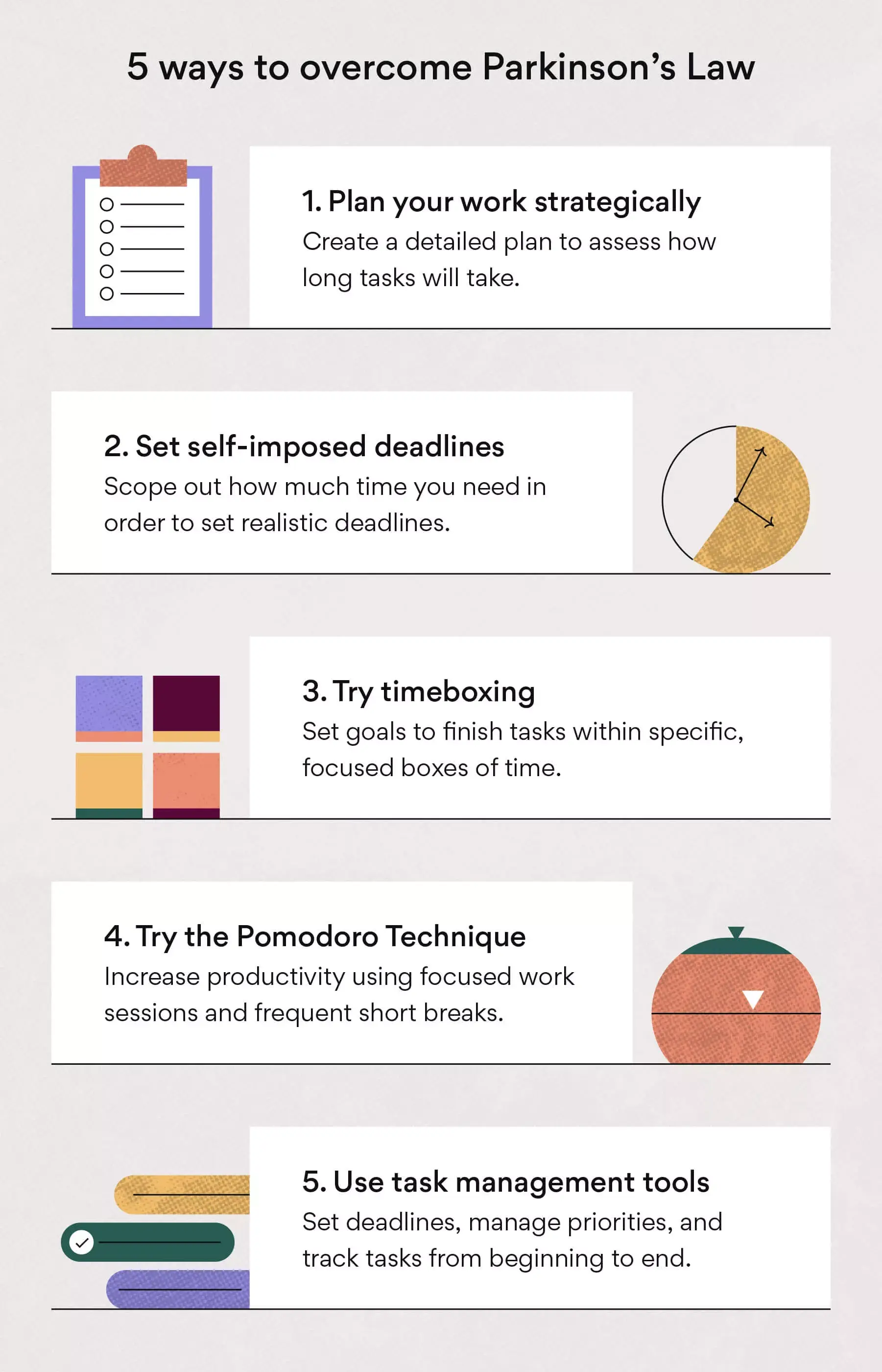
You can use specific strategies to overcome Parkinson's Law and better utilize your time. When you stop letting your work expand to fill your time, you finish tasks faster and free up time for other priorities.
Strategy | How it helps |
Plan your work strategically | Reduces procrastination by mapping tasks in advance |
Set self-imposed deadlines | Shifts focus from available time to required time |
Try timeboxing | Creates intentional time limits for each task |
Try the Pomodoro Technique | Maximizes focus with structured work sessions |
Shorten your meetings | Prevents discussions from expanding unnecessarily |
Use task management tools | Organizes deadlines and tracks progress |
1. Plan your work strategically
When you plan your work ahead of time, you're less likely to procrastinate. A clear plan helps you manage your time and accurately assess how long tasks will take.
In your plan, you should outline:
Your SMART goals
Your list of tasks and actions
The timeline for completion
Specific dates you'll check in on progress
You can also create a broader strategic plan for your company's short- and long-term goals. This may motivate you to be more productive at work.
2. Set self-imposed deadlines
One of the most effective ways to overcome Parkinson's Law is to set self-imposed deadlines. Instead of asking "how much time do I have?" ask "how much time do I actually need?" and set your deadlines accordingly.
To figure out the time you actually need for a task, first:
Understand the project requirements: You'll need a broad sense of what's required of you to determine how long you'll need for a project. This step involves creating a list of all the subtasks and activities within the larger project.
Prioritize activities and tasks accordingly: Once you have a list of your project requirements, you can prioritize your to-do list and determine which tasks are most important and/or complex.
Decide who you need to involve: If parts of your project require help from coworkers, you'll need to assess who to involve. Reaching out to your team at the beginning of your project can save you time later on.
Make your time estimates: You should now have a solid understanding of who, what, and how involved you are in your upcoming project. You can now make realistic time estimates based on your workload and personal productivity level.
Think of your tasks as short-term goals to complete; the faster you complete them, the more available time you'll have for other things.
3. Try timeboxing
Timeboxing is a productive work strategy that can help you fight procrastination, reclaim lost productivity, and focus on what matters.
Timeboxing involves setting a goal to finish a task within a certain time frame. When you plan how long a task should take before starting it, you become more intentional about your work. You can use timeboxing to schedule individual tasks, help your team get organized, or manage meetings more effectively. For a complementary approach, time blocking lets you dedicate specific hours to particular tasks or projects.
Baca: Cara Memprioritaskan Pekerjaan Anda yang Paling Penting4. Try the Pomodoro Technique
Similar to timeboxing, the Pomodoro Technique involves focused work sessions with frequent short breaks. This technique uses 25-minute work sessions and five-minute breaks to maximize focus while reducing mental fatigue.
The five-step approach to managing your time with the Pomodoro Technique includes:
Create a list of tasks ordered by importance, similar to the Getting Things Done methodology
Set a timer to 25 minutes
Work on a task for the duration of the timer
Take a five-minute break
After four pomodoros, take a 15-30 minute break
5. Shorten your meetings
Meetings are a prime example of Parkinson's Law in action. If you schedule a one-hour meeting, the discussion will often run the full hour, even when the agenda could be covered in 30 minutes.
Try these tactics to combat Parkinson's Law in meetings:
Set shorter default durations: Schedule 25-minute meetings instead of 30, or 45 minutes instead of an hour.
Create a clear agenda: Share it beforehand so attendees come prepared, and discussions stay on track.
Assign a timekeeper: Designate someone to monitor the clock and keep the meeting moving.
End early when possible: If you've covered everything, end the meeting. Your team will appreciate getting time back.
6. Use task management tools
Using a task management tool is a great way to organize your workday, schedule personal deadlines, and ensure you have enough time to manage your priorities. You can also make to-do lists and stay on track with projects, whether through team collaboration or for personal projects.
Overcoming Parkinson's Law through continuous improvement is essential if you want to take control of your time and increase the amount of work you complete. The goal is to be more efficient, not to overwork yourself.
Accomplish more in less time with Parkinson's Law
Once you understand Parkinson's Law, you can use it to your advantage. With strategies like self-imposed deadlines, timeboxing, and task prioritization, you can accomplish more in less time and achieve a better work-life balance.
Task management software complements these strategies by keeping your deadlines visible and your priorities clear. Get started with Asana to take control of your time and boost your team's productivity.
Kelola dan prioritaskan tugas dengan AsanaFrequently asked questions about Parkinson's Law
While Parkinson's Law originated as satire, research supports its premise that people focus on available time rather than required time. It's best understood as a behavioral tendency rather than a strict scientific law.
Teams can leverage Parkinson's Law to improve team effectiveness by setting shorter deadlines, using timeboxing for collaborative work, and establishing clear milestones with built-in accountability.
Also known as bikeshedding, Parkinson's Law of Triviality describes how teams give disproportionate attention to trivial matters while glossing over complex, important issues.