Raising $50M: Your success is ours; our success is yours
We have some big news to celebrate with you! Today Asana closed a Series C financing round, raising $50M in new capital. The round was led by Y Combinator president Sam Altman. Sam participated alongside a number of other customers, investors, and leaders for whom we have deep respect.
We’re thrilled, and even more exciting is what this milestone means: It’s a sign of how far Asana has come in empowering teams to be more effective. It’s also fuel for the next two years of the company, helping us make work tracking more pervasive across the world, make Asana easier and more powerful for both small teams and giant companies, and continue striving to build the best team and culture for the work at hand.
We started Asana with the hypothesis that every team in the world is capable of accomplishing bigger goals—and that software could help empower them to drive work forward with more ease, clarity, and accountability. In Sam’s blog post on his decision to invest, he notes that such software is “the kind of lever that could massively increase the productivity of hundreds of millions of people around the world” with the potential to “materially increase the output for the planet.”
The product was born out of our own need to coordinate better: Even when we worked at great companies like Google and Facebook, there were constant challenges keeping everyone on the same page, and a huge amount of time spent on “work about work.” It turns out that these difficulties tracking work are universal across organizations: the bigger your team, and the bigger your mission, the bigger your coordination problem.
We started Asana with the hypothesis that every team in the world is capable of accomplishing bigger goals.
Asana has been our attempt to solve the pain of work about work, letting organizations easily achieve their goals, or take on bigger ones. We call that solution “work tracking,” software that manages who’s responsible for what by when, and generally serves as the source of truth for everything a team is working on. We—now a team of 186 people—have collectively invested so much love and hard work into this attempt, it’s hard to articulate how gratifying it feels to step back and see that it’s actually…working.
We now have 13,000 paying customers, up from 10,000 last September.
Asana is empowering many great teams to achieve clarity, accountability, and results. Uber uses Asana across their operations. CBS Interactive says that “Asana is the glue that connects our three [international] production offices.” The Malala Fund uses Asana to run large scale programs in service of quality education for young women. Khan Academy and Duolingo use Asana to make learning more widely accessible. Simplehuman uses Asana to design products that we use every day.
Customers say that work tracking has become essential. As Sarah Wormser at ClassPass put it, “With Asana, we’re able to keep track of each piece of work in one place. As a result, we execute on requests with greater speed and efficiency without letting anything fall through the cracks, and have more time to focus on being creative.”
All of this inspires us to keep building tools that can help people improve their work lives, and it has also turned Asana into one of the fastest-growing enterprise SaaS businesses. With annual recurring revenue more than doubling every year since we launched four years ago, the company is on track to profitability. This fundraising is the fuel we need to get to the next stage, and to accelerate the fulfillment of our mission.
In choosing investors, we looked for a combination of experienced technology leaders, proven investors, and passionate Asana users, whose lives or businesses have been directly impacted by the software.
Sam Altman (President of Y Combinator) is leading the round. On his decision to invest, Sam writes, “Asana is the kind of lever that could someday massively increase the productivity of hundreds of millions of people around the world.”
8VC, a venture capital firm led by Palantir co-founder Joe Lonsdale.
Founders Fund, who also led our Series B.
Tony Hsieh (CEO of Zappos) via VTF Capital. Zappos is one of Asana’s biggest customers, and Asana is used broadly across the company for collaboration across internal operations.
Mark Zuckerberg (CEO of Facebook) and Priscilla Chan (CEO of The Primary School). Facebook is a customer, Mark is a user, and Priscilla shared that “Asana is the organizational backbone for The Primary School. Asana gives us clarity around our work and goals—allowing The Primary School to better care for our children and families.”
Andrew Mason (CEO of Detour) is so passionate about Asana he sometimes makes us look lukewarm on our own company. (“Once a day I’m like THIS IS THE BEST APP IN THE WORLD. I don’t know of a more perfectly realized piece of software. It’s Platonic in its perfection.”)
Adam D’Angelo (CEO of Quora). Quora uses Asana extensively, and Adam’s been on our board of directors since day one.
Aditya Agarwal & Ruchi Sanghvi
(VP and former VP at Dropbox). Dropbox is a large Asana customer, and Aditya and Ruchi (who are married) use Asana to manage their domesticity.
Eric Ries, author of The Lean Startup.
Roger McNamee, founder of Elevation Partners.
Us (Dustin & Justin). We’re very bullish on Asana. We each pour a lot of effort into building Asana, every weekday. We speak frequently about our excitement for the company’s future, and we’re excited to put our money where our mouths are.
Work Tracking is the third pillar of Collaboration Software
There are three horizontal software tools that are critical for modern teams to have the best chance at achieving the results they seek:
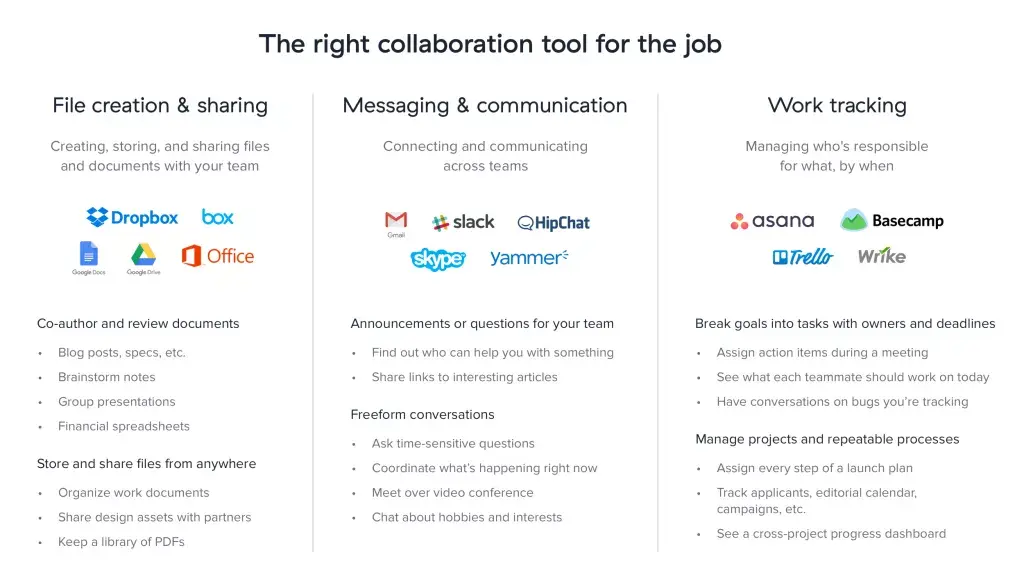
Fun facts: Dropbox and Slack are Asana customers; Asana is a customer of Dropbox and Slack.
All three have undergone major revolutions over the last 10 years. Documents have been around for decades, but only recently became easy to share and collaborate on. The messaging space continues to blossom, most recently with the massive growth of Slack.
But these two categories can only take an organization so far, and thus work tracking has emerged as the third pillar of workplace collaboration. Work tracking is the newest space to emerge. It fills the big hole in the toolset, providing clarity of plan and responsibility, to avoid constant confusion about who’s responsible for what by when. Teams have historically tracked work through a combination of meetings, whiteboards, and makeshift uses of files and messaging—but managing-what-the-heck-you’re-working-on is so critical that it deserves a dedicated solution.
The files and messaging industries represent tens of billions of dollars of market value apiece. Each has hundreds of millions of users. We believe work tracking is a similarly enormous opportunity, because every team can benefit from clarity at work.
When our investors asked us “What has allowed Asana to take the lead in this space?” we attributed it to Asana being the only work tracking solution that’s both easy and powerful. It’s hard to do these at the same time—to have a product feel as easy as consumer software while supporting the depth of functionality to scale to real enterprises running on it. (Imagine trying to merge Microsoft Paint and Photoshop. But, ya know, for team productivity.) We’ve still got a long way to go on both dimensions, but we’re grateful to our product development teams for their dedication to their craft in getting us ever closer.
Managing-what-the-heck-you’re-working-on is so critical that it deserves a dedicated solution.
What now
This capital will fund the next two years of our growth. We’ll be investing in improving Asana for the world’s biggest companies. We’ll make Asana faster, easier, more powerful, and more extensible. We’ll scale and support our customers globally.
Capital helps us hire the people across the globe who are best suited for, and passionate about, enabling teams to work together with less effort. We’re hiring many kinds of people for many roles, and designing the culture with the same loving care we bring to designing the product. We invest heavily in mentorship, personal growth, food and wellness, and fostering a culture of empowerment and trust. We work hard, but live well. We aspire to make Asana the best place in the world to work, and we’re honored to see that (at least for the moment) Asana is the #1 result out of 252,000 when you search on Glassdoor for U.S. companies sorted by rating.
Together, we’ll strive to progressively eliminate each source of work about work, empowering humans to work exclusively on the creative work that only humans can. We’re building Asana to track every detail of every piece of work in an entire company, in a single interconnected graph.
In the long run, we’re working to make Asana the “team brain” that drives entire companies, from high-level OKR tracking to automatic scheduling of the lowest-level details. In partnership with the growing ecosystem of Asana Platform apps, we’re aiming to infuse best practices and automation into every function of a company. As we learn how teams can work together more easily at a human level, we’ll continue sharing that information with other organizations dedicated to great teamwork.
Together, we’ll strive to progressively eliminate each source of work about work, empowering humans to work exclusively on the creative work that only humans can.
We are unabashedly mission-oriented. We believe that if Asana can increase every organization’s capacity to achieve its potential by just 1%, let alone double it, that’s a really leveraged opportunity to benefit the world. We may not succeed, but we’re damn well going to try, and this new round of capital is an exciting milestone in our ongoing efforts to help teams do great things together. If you’re an Asana customer, thank you for being on this journey with us: Your success is ours, and we hope that our success becomes yours. <3
Editor’s Note: This post was updated with a quote from Priscilla Chan after original publication.