Somewhere that’s right for you: choosing your first startup

A few weeks ago, I gave a keynote on how to approach the search for your first startup at the Start @ a Startup conference in New York City. There are several things I think people should optimize for in joining their first startup: culture, balance, and team size. Since now is a time at which many are making decisions about joining startups (especially at the peak of university recruiting season), I thought I’d share the key takeaways from the session, as well as the full-length video for those interested.
Experience fast growth—both of company and self.
My first piece of advice is to work for a company that’s growing quickly in terms of headcount, revenue, or product adoption (and hopefully all three) that will also invest in you as an individual. At a growing company, you’ll gain responsibility quickly and observe multiple stages of a startup without needing to switch companies.That alone is not enough to grow quickly, however, and you may learn the wrong lessons altogether if you are just given responsibility without being regularly coached on what to do with it. At Asana, we “invest in ourselves and each other” with frequent review cycles and onboarding programs and by providing coaches to everyone, something often reserved for executives.
That alone is not enough to grow quickly, however, and you may learn the wrong lessons altogether if you are just given responsibility without being regularly coached on what to do with it. At Asana, we “invest in ourselves and each other” with frequent review cycles and onboarding programs and by providing coaches to everyone, something often reserved for executives.
Work somewhere that is well-run and has a positive work culture.
Specifically, these factors define a great work environment:
An apolitical environment: Without bureaucracy and politics, you’ll have a voice and your success will be based on merit.
A purposeful, mission-driven company: When the whole team is aligned/moving in a common direction, people are thoughtful about their actions and priorities.
Clarity of plan and responsibility: With clearly defined processes, you’ll feel grounded and know when you are empowered to make decisions versus when you need to get direction from someone else.
Strong mentorship: Not only will mentorship accelerate your growth even more, it means your peers will grow quickly, too—you’ll gain knowledge and have confidence in your team as well.
A culture that emphasizes feedback and reflection: While both of these are essential for learning and growth, they also help the company take risks and learn from mistakes. When you know that mistakes will be identified and corrected, you can be sure that the company is always learning and improving—and, as a result, so will you.
A commitment to transparency (where appropriate): While transparency isn’t for every company, when transparency exists, people have the information they need to make decisions, and trust is created.
Why does all of this matter? The first company you join will act as a benchmark for your future experiences; in your second job, you’ll rely heavily on the experiences/processes from your first, and it’s better if they are positive. Remember, there are better ways to learn than just by making mistakes. At a company like the one outlined above, you’re likely to work with great people and not only be building your network, but also learning from those people and, most likely, enjoying working with them.
It’s hard to be a poorly run company and scale quickly, but “hyper growth” companies can overcome many cultural flaws via sheer momentum—this can lead to a bad learning experience and is likely to make you unhappy with your day-to-day as well.
Think about how your choice impacts your whole life.
Choosing your first startup will impact more than just your daily work, career, and skills. It will affect your work/life balance, life outside of work, and health, all of which are central to a sustainable, successful, and happy life.
Unfortunately, many companies have cultures of working 60, 70, or 80 hour weeks, which has been proven to be empirically futile—studies show diminishing and even negative returns past 40-50 hours worked each week. My advice to you is: don’t adopt that fallacy and choose to work productively for a reasonable number of hours each week. Work hard, live well.
In addition to the hours you work (or don’t work) each week, it’s important to have a life outside of work—to have diverse experiences, socialize outside of your co-workers, become part of other communities, travel the world, have a hobby, and so forth. All of these experiences will broaden your perspective and help you grow personally (and, most likely, professionally, too). Finally, eat healthily and exercise. If you set good habits early on, you will reap the returns throughout your life, and you’ll have more energy for both work and play.
Work somewhere that is the right size for you.
Companies have different pros and cons at different stages. Here are some major differences to take into consideration:
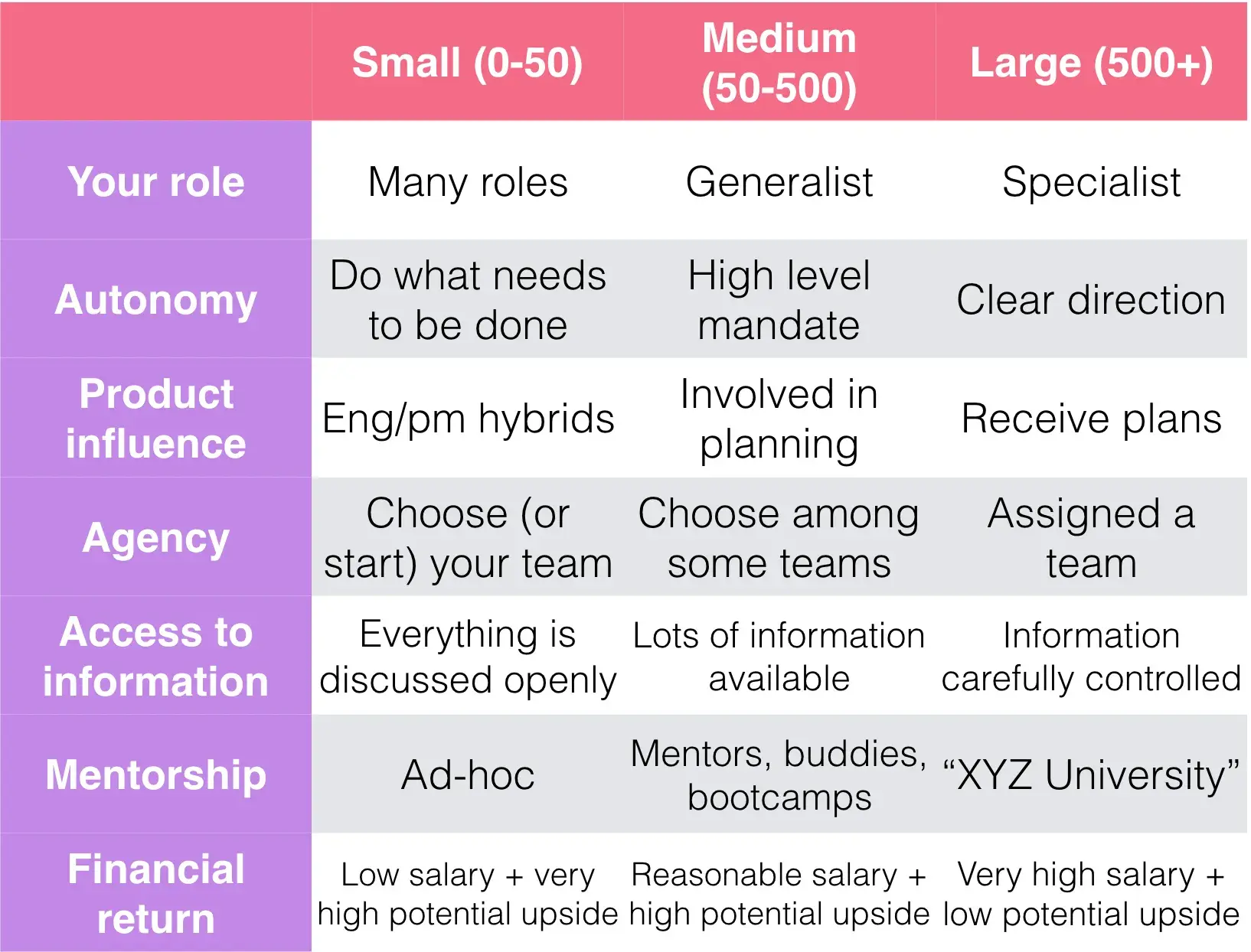
As always, what’s right for you depends on your general risk tolerance and where you are in your life.
This slide paraphrases a lot of nuance, so if you’re intrigued by the content, I highly recommend checking out this part of the video. Also, your mileage may vary—some small companies act like big companies in various ways and vice versa.
Work somewhere that is adding value.
It’s no secret that the tech industry is an innovative, exciting place to work. We have tremendous leverage and can reach literally billions of people with the things we create. Luckily, many companies are doing great things with that leverage and adding value to the world (which is, albeit, a subjective concept). As you’re choosing your first startup, ask yourself if you believe what a company is doing is good for the world, and don’t settle for anything less than a clear yes on that question.
Learning about companies
All of these factors play into choosing a company, but you also need a way to find all of this information out. Here are a few suggestions on how to do that:
Talk to employees there. Come to the interview with prepared questions, and always say yes to offers to talk to more people. Be sure to meet your future team and manager.
Look at the About and Careers pages on their websites. Companies go to a lot of trouble to make these accurately reflect their culture, so it’s a great window into life there.
Watch talks/read posts from the team/leaders. Ask yourself: are these people you want to work with?
Finally, to learn about companies, don’t rely on the press. The vast majority of articles about tech companies are not based on thorough research.
Maximize Your Learning
Independent of which company you decide to join, this is something to always strive for.
Talk to the leaders at the companies you work for and learn about the teams you don’t work on.
Keep talking to your peers at other companies about their work and visit them—they are learning about an entirely different culture and you likely can learn from one another.
And finally, take advantage of online resources (Quora, YouTube, etc). Here are two phenomenal online courses available online.
Choosing your first startup is no easy feat, but having a good understanding of what you’re looking for, as well as what’s out there, is the best way to start. If you’re interested in learning more about starting (or growing) your career at Asana, we’d love to hear from you.