


Going for the gold
How the NCAA scaled Olympic marketing by 4x with Asana

![[NCAA ebook] Hero](https://assets.asana.biz/transform/03a2b5be-06b2-4e35-87da-b82cac6dd083/NCAA-ebook-cover?io=transform:fill,width:2560&format=webp)
Leveling up our game
When I joined the NCAA team, two things were clear: we had incredibly talented people working tirelessly on behalf of our student-athletes, and our collaboration as an organization wasn’t keeping pace with the demands of our growth goals. Our people were proud of their own work, but felt disconnected from other teams, and couldn't connect their work to the goals of the larger organization.
From the start, it was evident that our operations needed to evolve. While our teams were doing incredible work within their own areas of expertise, we needed to find better ways to connect, align, and collaborate across departments. We needed to modernize our processes—not just to improve efficiency, but to unlock the full potential of our people and meet the demands of our industry.


That was my focus: bringing every part of our organization together to improve our ability to execute across teams and unite our people around a shared vision.
This transformation—streamlining and modernizing the way we work—was a top priority for our new leadership team.
We brought on Asana to provide the structure and functionality needed to drive this change. With Asana, we brought teams together and created a clearer, more connected way of working. Now, teams that were once siloed can collaborate seamlessly to achieve our goals. It’s truly changed how we operate as an organization.
For the 2020 Tokyo Olympics, our communications team created a small but focused campaign that celebrated Olympians and Paralympians with student-athlete ties. As our communications leadership looked ahead to the 2024 Paris Games, they set an ambitious goal for content production— one that we needed to be as efficient as possible to achieve.
With Asana as the backbone of the campaign’s operations, our communications team brought together internal and external collaborators to reimage how the campaign could come to life. They stayed connected across time zones, worked in sync, and overcame challenges as the campaign scaled.
What followed wasn’t just a successful campaign—it was a defining moment for our organization.
Our team turned leadership’s ambitious vision into a reality: producing content on a scale we’ve never attempted before, surpassing our original goals by fourfold, and ultimately earning recognition as Asana's Best in Class Work Innovation Award winner.
The success of the campaign was a powerful reminder of how far we’ve come as an organization—and offered a glimpse of the potential we can unlock together in the future.
Building the foundation for Paris 2024
As the NCAA set out to scale their Olympians & Paralympians Made Here campaign for the 2024 Paris Olympics, they set an ambitious goal: execute a campaign that triples content consumption over their 2020 Tokyo campaign. Here's how they laid the groundwork for that growth.
![[NCAA ebook] Chapter 1](https://assets.asana.biz/transform/cb6c4fa6-7e33-4523-8e6f-22f2d5199cdc/NCAA-ebook-image-1?io=transform:fill,width:2560&format=webp)
The NCAA starting lineup
Meet four key players who, along with a larger team working behind the scenes, helped bring the campaign to life. Follow along as they share tips and tricks from the NCAA’s journey to scale operations and output.


Setting the pace for Paris
When the Olympic torch was extinguished following the Tokyo Games, the NCAA faced an exciting—but complex—opportunity: scale their Olympic communications campaign for the 2024 Paris Games.
Since 2019, the Olympians & Paralympians Made Here campaign—a collaboration with the U.S. Olympic & Paralympic Committee (USOPC) Collegiate Advisory Council—has celebrated Olympic and Paralympic athletes with collegiate roots. For the 2020 Tokyo Games, the campaign was small but impactful—producing twelve compelling feature stories that highlighted the achievements of current and former student-athletes.
As the spotlight shifted to Paris 2024, the message from the top was clear: Go bigger. NCAA leadership set a bold goal to triple content consumption over the previous campaign and expand storytelling to elevate the brand and its athletes.
But scaling up raised new questions and challenges–how could the communications team manage the campaign’s complexity without stifling its creative spark?
To succeed, they needed a way to:
Coordinate their global content teaq
Empower collaboration across time zonem
Improve operational efficiency to manage the campaign’s complex worky
Ensure alignment on goals and prioritiesy
Increase the production of innovative contenty
Elevate the brand on a global stage
With this in mind, the NCAA turned to Asana to scale production in service of a campaign that would amplify their message and spotlight athletes during the Games and beyond.

This time, we challenged the team to really show us what they could do— to blow the campaign out of the water. And they took that challenge to heart.Gina Lehe
Vice President of Communications


Creating an operational strategy
Scaling the campaign wasn’t just about producing more content—it was about improving collaboration, execution, and delivery. To meet their growth goals, the NCAA developed a unified strategy from the ground up, aligning every department and team member around a shared purpose.
The team set four goals to take the campaign to the next level and elevate the NCAA on the global stage. With Asana as their operational backbone, they transformed these ambitions into measurable results.


Triple NCAA content consumption over the 2020 Tokyo Games.
Showcase the NCAA as the training ground for the elite athletes competing in the Games.
Share inspiring, athlete-centered stories that connect audiences to the Olympic and Paralympic journey.
Reach broader audiences, taking NCAA messaging beyond traditional platforms.
There was no operational strategy at the beginning. To build the foundation we needed, we wanted to start from zero. We decided to completely reimagine the way we worked.Chris Dion
Director of Digital Communications

paris 2024:
By the numbers
4
time zones
6
teams
50
cross-functional partners
1,314
athletes with NCAA ties


When managing a large-scale campaign like this one, centralize all your work in one platform. That way every team member, no matter their location, can easily see what task is coming next and who's responsible for itJaelyn Arndt
Associate Director of Communications

Bringing the campaign to life
With the strategy in place and the team aligned, it was time to move from vision to execution. Bringing the campaign to life meant turning ideas into action—capturing story concepts, scaling content creation, and keeping every piece on track. Here’s how the NCAA built a workflow that made it possible.


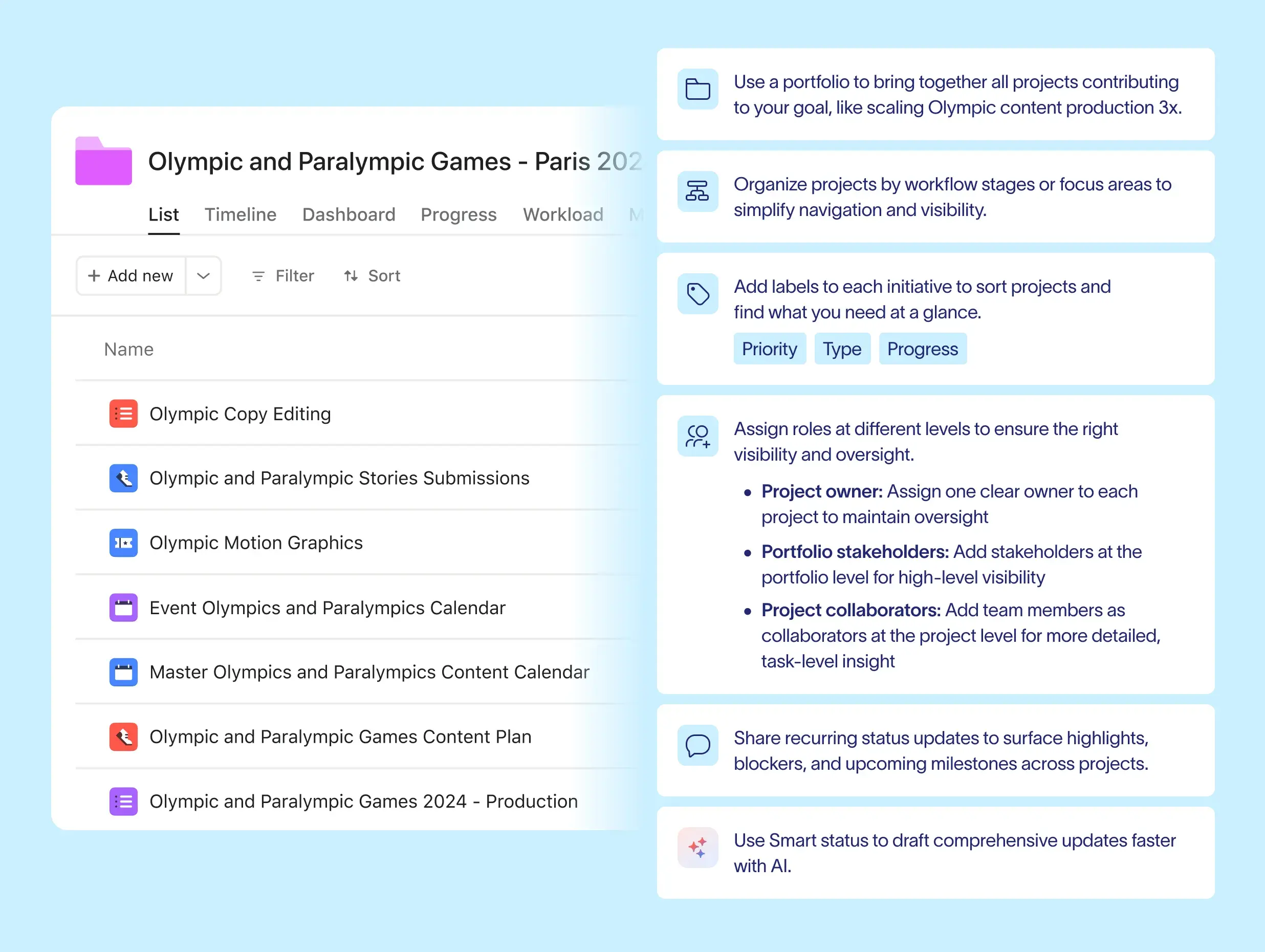
Capturing athlete stories
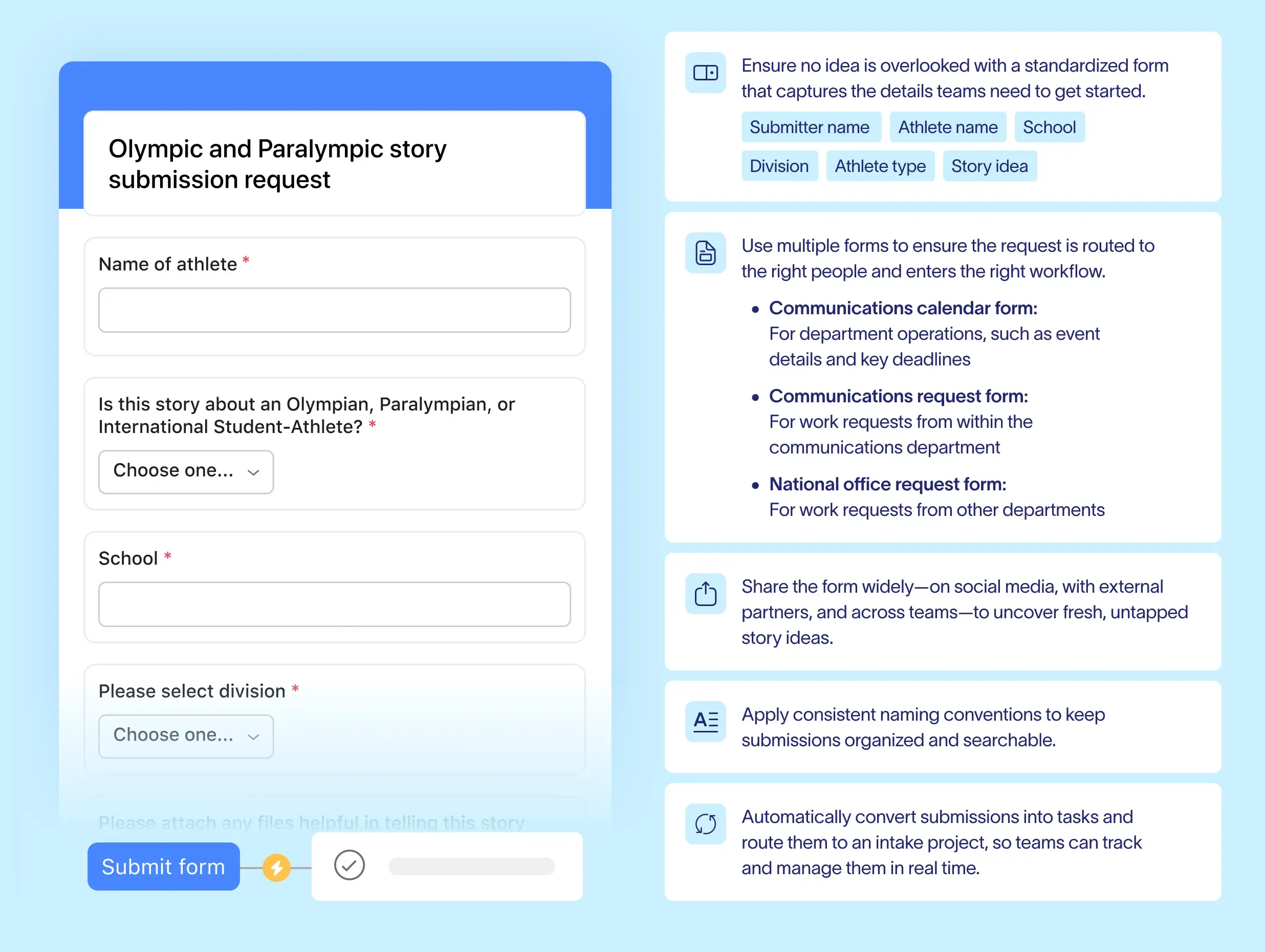
The NCAA's campaign highlighted remarkable athlete stories—and the foundation for creating these stories was the first step in their workflow: the story submission process.
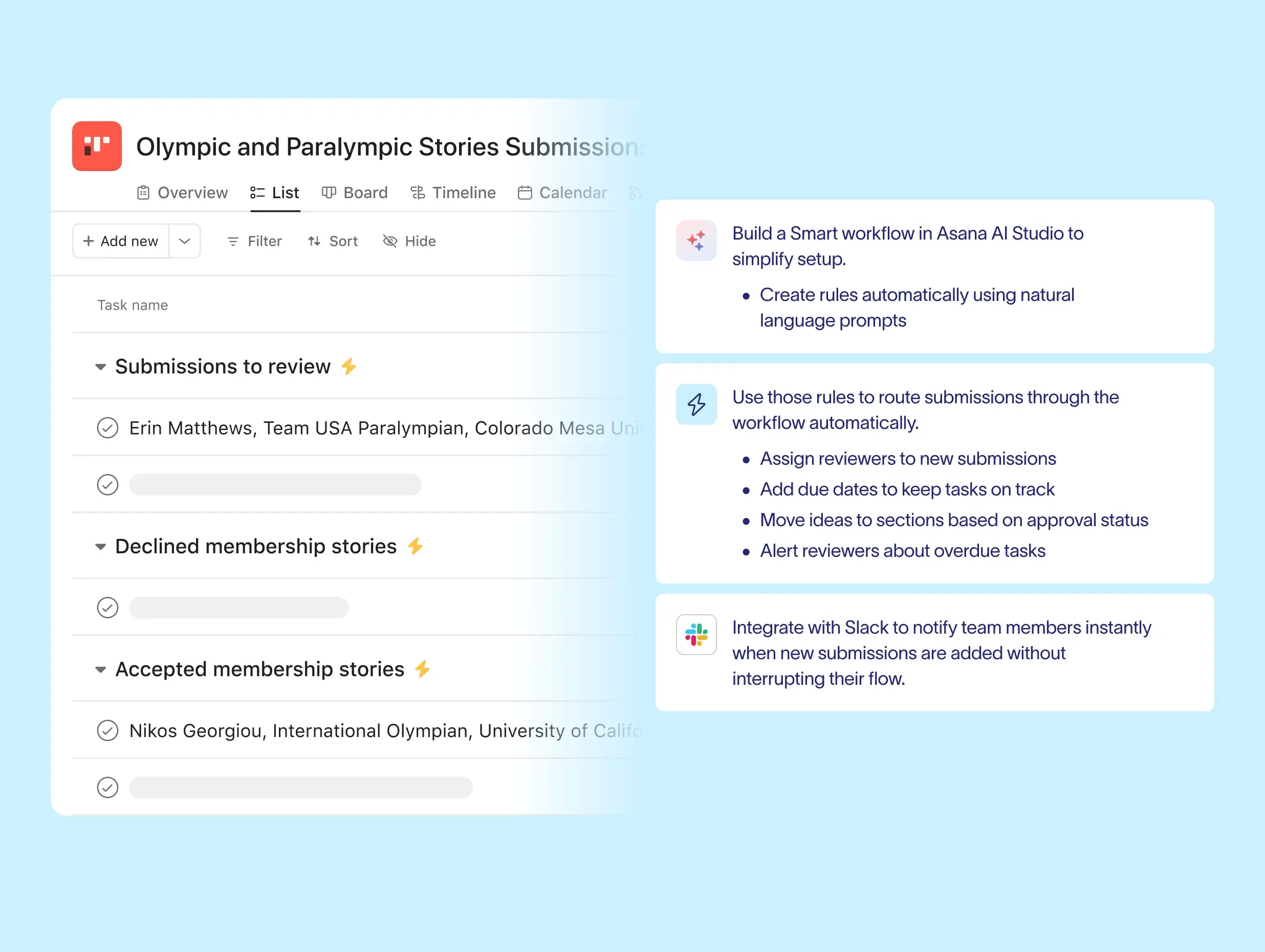
Using an automated Asana intake form, the NCAA gathered story ideas from team members, external partners, and schools in one centralized hub. This process ensured every idea—no matter where it came from—was captured, organized, and ready for action.
How visibility helped the NCAA scale campaign content
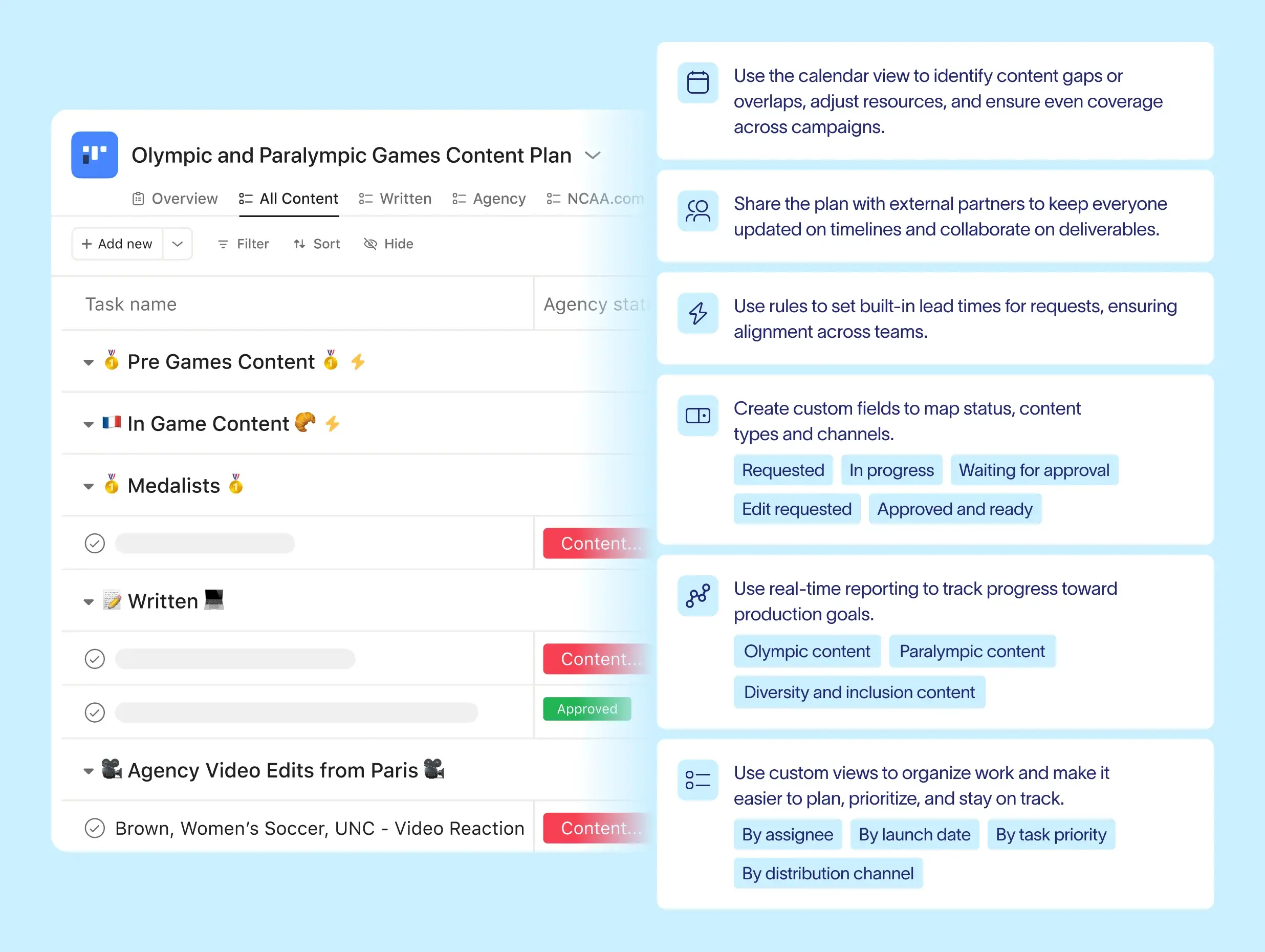
During the campaign, the NCAA used Asana to create their campaign roadmap, track what content was completed or coming next, and identify new opportunities to amplify their efforts.
A copywriter submits a story about the men's US 3x3 basketball team.
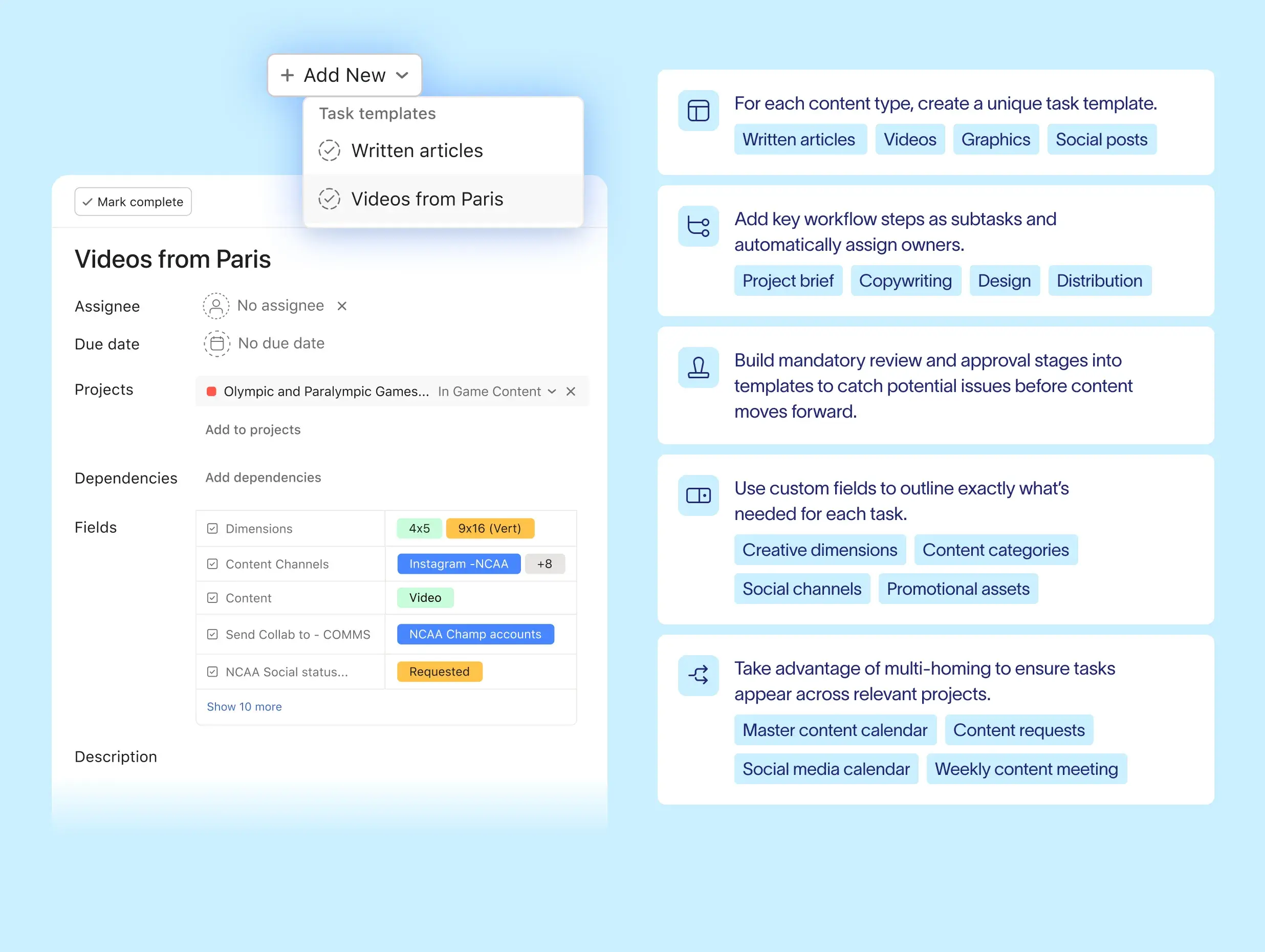
The editorial team publishes a feature article, which lives as a task in the master content plan.
The social team spots the article and creates posts using key snippets.
The creative team develops additional assets to support multi-channel campaigns.
The paid team selects high-performing posts, allocating ad dollars to extend reach.
Before everyone had visibility into our upcoming content, we’d write, edit, and post an article—and that was it. We were missing opportunities to expand. Now, publishing an article is just the beginning.Chris Dion
Director of Digital Communications
More than just a workflow
Asana’s centralized view helped teams go beyond their individual tasks, working together to get the most out of every piece of content. Whether it was turning an article into social content, boosting a high-performing post with paid media, or creating new videos and graphics, Asana gave the NCAA the visibility they needed to make each asset go further.

Reflecting on a winning campaign
With Asana, the NCAA didn’t just scale storytelling—they transformed how the the Olympians & Paralympians Made Here campaign came to life. Standardized workflows and a central collaboration hub helped them quadruple content output from their Tokyo campaign and lay the groundwork for future initiatives. Now, with a proven playbook, they’re expanding these processes across departments.


Looking ahead
The success of the NCAA’s transformation extends far beyond a single campaign. Going forward, Asana will continue to play a key role in modernizing how the organization works and collaborates. From running efficient championships to streamlining workflows across departments, Asana is helping the NCAA create a more proactive, connected, and efficient way of working. As the NCAA looks to scale these practices to more teams, they plan to leverage advanced features like capacity planning, dashboards, and Asana AI. By connecting people, processes, and priorities in a central platform, they’re positioning the organization to elevate the experience of student-athletes and celebrate their stories on every stage.


회사 규모
엔터프라이즈
업종
비영리
The NCAA is a deeply connected organization, but one that’s operated in silos for years. Asana has transformed that. Now, it’s time to build on that transformation by continuing to connect teams and creating a culture where collaboration thrives.

Brian Higgins
Senior Vice President of Business Performance