Where work connects
Connect work to goals and automate workflows with AI as your teammate.
85% of Fortune 100 companies choose Asana¹



See how Asana keeps work moving across use cases
Campaign management
Plan, track, and complete your campaigns all in one place.
Creative production
Accelerate creative work by automating workflows from start to finish.
Project intake
Capture, prioritize, and assign requests automatically so your teams have more time to work.
Product launches
Coordinate teams, tasks, and timelines to keep every launch on schedule.
Organizational planning
Address business needs quickly by analyzing progress, bandwidth, and blockers on one platform.
Resource planning
Visualize how teams are staffed and what resources are available across your business.
Goal management
Connect everyone's work to the organizational goals they support.
Employee onboarding
Standardize onboarding to help new employees make an impact quickly.
What sets Asana apart
More clarity and accountability
Connect strategic goals to the teams that help achieve them. See progress in real time, update stakeholders, and keep the company on track.
Learn about goals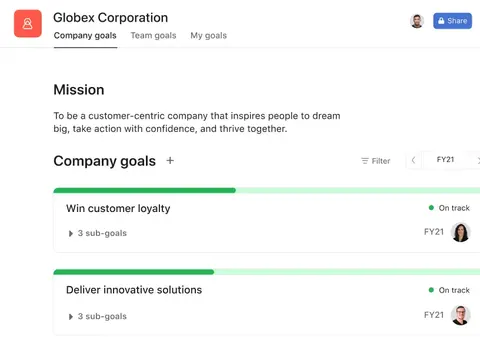
Amplify your impact with AI
Work smarter and faster with AI-powered workflows that take on your teams’ busywork.
Meet Asana AI
Scale with enterprise-grade security
Ensure your company's data is completely secure and that you are in compliance with the latest standards.

Connect over 300+ integrations
Asana connects with the enterprise tools your organization already uses, right out of the box.
















The world’s top companies trust Asana


Company Size
Enterprise
Industry
Food/Hospitality
Asana makes everything shareable, which saves us time executing programs because it’s so much easier to replicate and learn from what others have done.
Simon Levinson
Global Digital Manufacturing Process Innovation Manager, Danone

Company Size
Mid-Market
Industry
Retail / Fast-Moving Consumer Goods (FMCG)
To hit our ambitious growth target, we need to move fast. But we can’t do it without clear processes that remove as many blockers as possible. I'm a strong believer that implementing processes, like the ones we built in Asana, will help us drive success.
Romain Ehrhard
CIO, KENDO
Company Size
Enterprise
Industry
Technology
Asana is our air traffic control. We have the visibility to scale production and support a higher number of ad campaigns to support our revenue goals.
Eugenia Contreras
Associate Manager, Spotify

Company Size
Enterprise
Industry
Media
Having one centralized ecosystem that brings all doers and stakeholders together has really accelerated our understanding of the work we do and the speed in which we do it.
Steven Tai
Director, Marketing Operations, Gannett
Get started easily
Tour the platform, read a few deep dives, or kickstart your work management journey with the right template.
Recognized as a leader by top analyst firms

A Leader in the Gartner Magic Quadrant for Collaborative Work Management² two years in a row
A Leader in the The Forrester Wave™: Collaborative Work Management Tools Report³
A Leader in the IDC MarketScape: Worldwide Collaborative Work Management Vendor Assessment⁴
The only platform that can support your company at any scale
1. Accurate as of December 2023, includes free and paid users.
2. See the 2024 Gartner® Magic Quadrant™ for Collaborative Work Management (CWM). GARTNER is a registered trademark and service mark of Gartner, Inc. and/or its affiliates in the U.S. and internationally, MAGIC QUADRANT and PEER INSIGHTS are registered trademarks and The GARTNER PEER INSIGHTS CUSTOMERS’ CHOICE badge is a trademark and service mark of Gartner, Inc. and/or its affiliates and is used herein with permission. All rights reserved.
3. See The Forrester Wave™: Collaborative Work Management Tools, Q4 2022 report. The Forrester Wave: Collaborative Work Management Tools, Q4 2022. The Forrester Wave is copyrighted by Forrester Research, Inc. Forrester and Forrester Wave are trademarks of Forrester Research, Inc. The Forrester Wave is a graphical representation of Forrester’s call on a market and is plotted using a detailed spreadsheet with exposed scores, weightings, and comments. Forrester does not endorse any vendor, product, or service depicted in the Forrester Wave. Information is based on best available resources. Opinions reflect judgment at the time and are subject to change.
4. IDC MarketScape: Worldwide Collaborative Work Management 2023–2024 Vendor Assessment — Uniting Teams, Data, and AI for Flexible Work, Doc #US49434923, December 2023